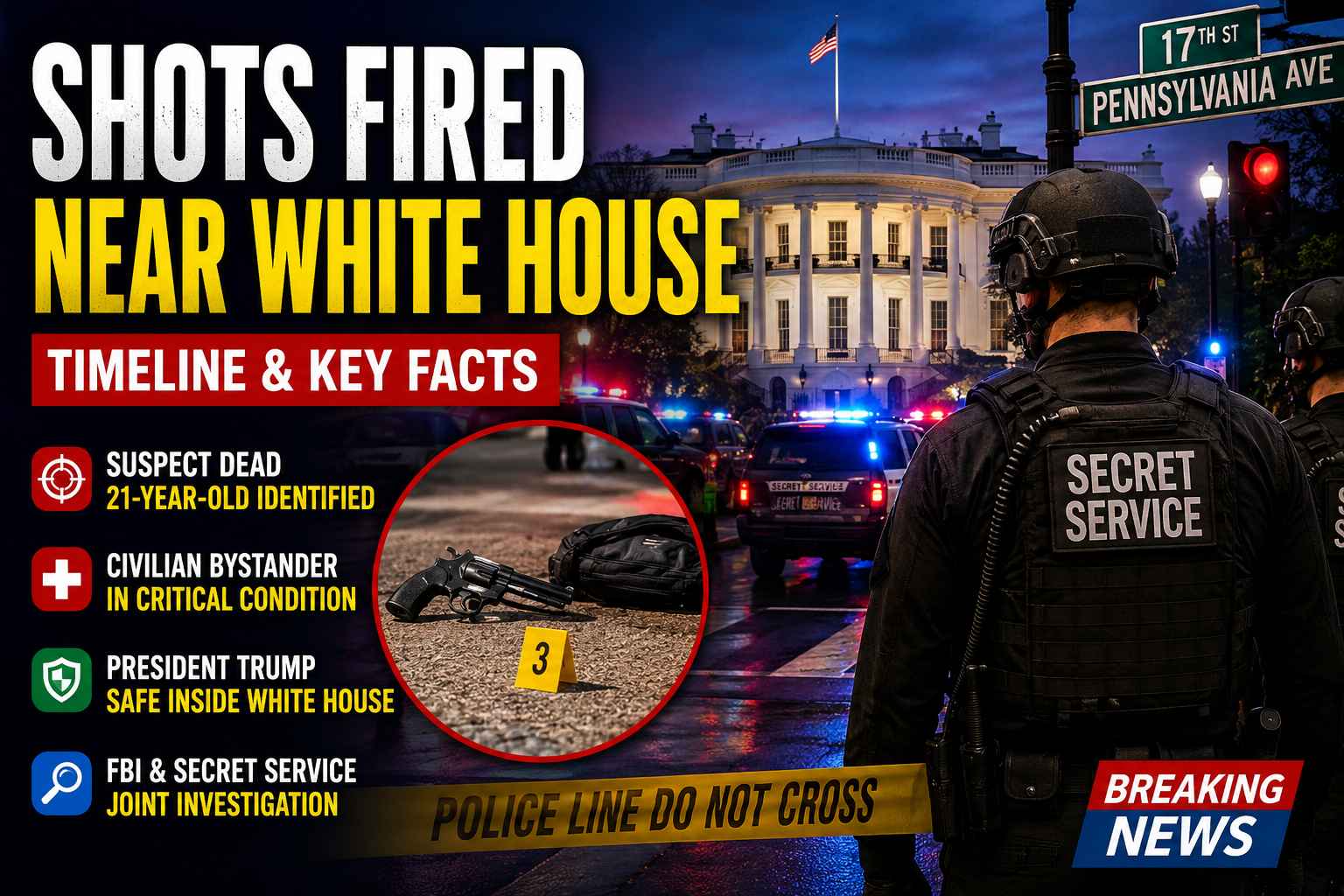
Secret Service personnel respond to a shooting near the White House security perimeter as federal investigators examine the incident scene in Washington, D.C.
Shots Fired Near White House: Verified Timeline and Key Facts
Gunfire outside the White House on Saturday evening triggered a massive security response, forcing an immediate lockdown of the executive mansion and sending shockwaves through the nation’s capital. The incident, which unfolded at a checkpoint along 17th Street and Pennsylvania Avenue, resulted in the death of a 21-year-old suspect and critical injuries to a civilian bystander. While President Donald Trump was inside the residence and unharmed, the chaotic scene has reignited urgent conversations about perimeter defense, mental health, and growing security concerns around federal institutions.
As federal investigators piece together the timeline, here is a verified breakdown of exactly what happened, how security protocols functioned, and the critical questions that remain unanswered as the investigation continues.
Incident Overview and Key Metrics
To provide immediate clarity on the event, here is a summary of the verified details confirmed by law enforcement:
| Key Metric | Details |
|---|---|
| Date | May 23, 2026 |
| Location | White House Perimeter |
| Suspect | Nasire Best (21) |
| Primary Agency | U.S. Secret Service |
| Investigation | FBI + Secret Service |
| White House Status | Temporary Lockdown |
| President Status | Safe |
| Civilian Injury | Critical Condition |
What Happened
Shortly after 6:00 p.m. ET, an individual approached a U.S. Secret Service security checkpoint located near the intersection of 17th Street and Pennsylvania Avenue NW. This specific checkpoint sits just outside the Eisenhower Executive Office Building, an area heavily trafficked by government staff, journalists, and tourists.
According to official law enforcement statements, the man pulled a revolver from a bag and began firing toward the security booth. Members of the Secret Service Uniformed Division, who are tasked with securing the physical perimeter of the complex, immediately returned fire. The suspect was struck multiple times during the confrontation.
Emergency medical personnel transported the gunman to George Washington University Hospital, where he was pronounced dead. During the rapid exchange of gunfire, a civilian bystander was caught in the crossfire and sustained a critical gunshot wound.
The White House grounds were locked down for nearly an hour before authorities declared the perimeter secure. Journalists reporting from the North Lawn were ordered to take immediate cover, highlighting the sudden and severe nature of the threat. The disruption at the capital comes at a sensitive time, as markets closely monitor the US economy 2026 outlook amidst ongoing geopolitical tensions.
Verified Timeline
All times are in Eastern Time (ET) for Saturday, May 23, 2026.
- Approx. 6:00 p.m.: Suspect Nasire Best approaches the outer security perimeter at 17th Street and Pennsylvania Ave NW.
- Shortly after 6:00 p.m.: Best retrieves a revolver from his bag and opens fire toward the security booth. Witnesses in the area report hearing between 15 and 30 gunshots in rapid succession.
- Seconds later: Secret Service Uniformed Division officers return fire, neutralizing the suspect. A civilian bystander falls after being struck by a bullet.
- 6:04 p.m.: Secret Service agents aggressively clear the White House North Lawn. Journalists and correspondents are ordered to sprint into the James S. Brady Press Briefing Room for physical shelter.
- 6:15 p.m.: The White House is placed under an official lockdown. Emergency medical personnel arrive at the outer perimeter to treat the suspect and the injured bystander.
- 6:30 p.m.: FBI Director Kash Patel confirms via social media that the Federal Bureau of Investigation is on the scene assisting the Secret Service with the response and evidence collection.
- 6:45 p.m.: The official White House lockdown is lifted after tactical teams confirm there is no ongoing, coordinated threat to the complex.
- 8:00 p.m.: Secret Service officials confirm the suspect has died at the hospital.
Who Was the Suspect?
Law enforcement identified the deceased gunman as 21-year-old Nasire Best, a resident of Maryland. To understand the gravity of Saturday’s response, investigators immediately looked at the suspect’s history, discovering a troubling pattern of behavior directed at the executive branch.
Court records reveal that Best was previously arrested in July 2025 after attempting to breach a different White House checkpoint. During that prior incident, Best ignored direct commands from federal officers, reportedly claimed divine status, and actively demanded to be arrested. Following a psychiatric evaluation, the court issued a “Pretrial Stay Away Order,” legally barring him from the White House perimeter. Best subsequently failed to appear for a scheduled court hearing, resulting in an active bench warrant issued in August 2025.
This historical context shifts the narrative from an unpredictable, sudden attack to a systemic issue involving mental health, repeat offenders, and the challenges of tracking high-risk individuals before they arrive at highly sensitive federal locations.
What Authorities Have Confirmed
In the hours following the shooting, the U.S. Secret Service and the FBI established a unified command and verified several critical details to the public.
They confirmed the weapon used was a revolver, which the suspect concealed in a bag until he reached the checkpoint. They also confirmed the status of the President. While President Trump was inside the White House during the exchange of gunfire, he was never in direct danger. Executive operations continued without interruption, and a full evacuation of the residence was deemed unnecessary.
Additionally, authorities confirmed that no law enforcement officers sustained injuries during the gunfight. The only casualties were the suspect and the single civilian bystander. Market analysts covering political meme coins noted that while such incidents heighten political tension, the immediate confirmation of the President’s safety quickly stabilized sentiment.
What Investigators Are Still Trying to Learn
While the primary sequence of events is established, several crucial aspects of the investigation remain open. The most pressing question surrounds the bystander’s critical injury. Law enforcement has not yet confirmed whether the civilian was struck by a bullet fired by the suspect or by return fire from Secret Service officers. Comprehensive ballistics investigations and trajectory mapping are currently underway to determine the exact origin of the round.
The exact motive also remains undefined. While the suspect’s history of mental illness is thoroughly documented, authorities have not officially designated the shooting as an act of targeted political violence, domestic terrorism, or a “suicide by cop” scenario. Investigators are currently tracing how a 21-year-old with an active bench warrant obtained a firearm and traveled to downtown Washington undetected.
How White House Security Lockdowns Work
Following the incident, many observers questioned why the White House North Lawn was cleared so aggressively when the actual shooting occurred outside the gates on a public street. The answer lies in the Secret Service’s “Defense in Depth” strategy.
The White House perimeter operates in concentric circles. The intersection of 17th Street and Pennsylvania Avenue represents the outer layer. When a lethal threat is detected at this boundary, standard operating procedures dictate that the inner perimeters—including the North Lawn—must be immediately sterilized.
Clearing the lawn ensures that if a coordinated, multi-person attack is underway, or if a shooter manages to breach the first line of defense, the inner grounds offer no vulnerable targets. Hustling reporters into the reinforced Press Briefing Room is a mandatory lockdown protocol designed to protect civilian life while heavily armed tactical response teams secure the sector. The response was visually jarring to the public, but operationally, it functioned exactly as designed.
Why This Story Is Receiving So Much Attention
The incident instantly dominated global news aggregators and social media platforms. This intense public interest is driven by a highly sensitive and polarized national climate.
The incident comes amid heightened scrutiny of security procedures surrounding high-profile government institutions and public officials. The public memory of the 2024 assassination attempt in Butler, Pennsylvania, remains deeply ingrained in the national consciousness. Any security breach involving the White House instantly commands global attention, reflecting broader anxieties about domestic political risk factors. Such disruptions in the capital can also briefly sway financial markets, similar to how unexpected macro data affects global currency pairs like the EUR/USD exchange rate.
Historical Context
Fence jumpers and checkpoint disturbances at the White House are not entirely uncommon, but active gunfights are exceptionally rare. Historically, perimeter breaches usually involve unarmed individuals experiencing mental health crises or staging political protests.
Incidents involving gunfire near federal security perimeters remain rare and typically trigger extensive reviews of existing security procedures. The fact that the suspect was a known entity to the Secret Service, having been arrested for a perimeter breach just a year prior, highlights a recurring vulnerability. It exposes the difficult balance federal agencies must strike between maintaining public access to the capital and neutralizing known threats operating freely within local jurisdictions.
What Happens Next In The Investigation
The investigation now moves into a meticulous forensic and legal phase. The FBI will lead the ballistics analysis, examining shell casings, bullet fragments, and impact angles to definitively determine who fired the shot that injured the civilian bystander.
The local medical examiner will conduct an autopsy and toxicology screening on the suspect to determine if substances played a role in his actions. Concurrently, analysts will review hours of fixed security camera footage and officer body-worn cameras to reconstruct the encounter second by second.
On Capitol Hill, the incident is likely to trigger requests for briefings. Congress may seek answers on why an individual with an active warrant for a previous White House breach was able to return to the exact same location armed with a handgun.
Frequently Asked Questions
Why was the White House lawn cleared?
The North Lawn was cleared as part of a standard Secret Service lockdown protocol. When shots are fired at the outer perimeter, exposed individuals on the inner grounds are immediately moved to secure locations to prevent casualties from stray gunfire.
Was the President in danger during the shooting?
No. President Trump was inside the White House residence at the time of the shooting. The Secret Service confirmed he was safe, and executive operations were not disrupted.
Who is investigating the security incident?
The investigation is being conducted jointly by the U.S. Secret Service and the Federal Bureau of Investigation (FBI), with the FBI providing forensic and ballistics assistance.
How often do armed incidents happen at the White House?
While unarmed fence jumpers and protests occur occasionally, active gunfights at security checkpoints are extremely rare, prompting immediate and thorough security reviews.
What is the current condition of the injured bystander?
The civilian bystander who was struck during the exchange of gunfire was transported to a local hospital and remains in critical condition. Authorities have not yet released the victim’s identity.
Final Takeaway
The May 23 White House security incident serves as a stark reminder of the volatile security environment currently surrounding the nation’s capital. While the U.S. Secret Service successfully contained the lethal threat at the outermost perimeter, the tragic critical injury of a civilian bystander underscores the severe collateral risks inherent in sudden urban confrontations.
As investigators work to finalize ballistics reports and trace the suspect’s final movements, the event highlights the complex intersection of severe mental illness, public safety, and national security. Moving forward, the focus will likely shift to systemic reforms, questioning how law enforcement tracks high-risk individuals to prevent known threats from returning to the gates of the White House.
Editorial Note:
This article is based on publicly available information, official law enforcement statements, court records, and verified reports available at the time of publication. Details may change as the investigation develops.
About the Author