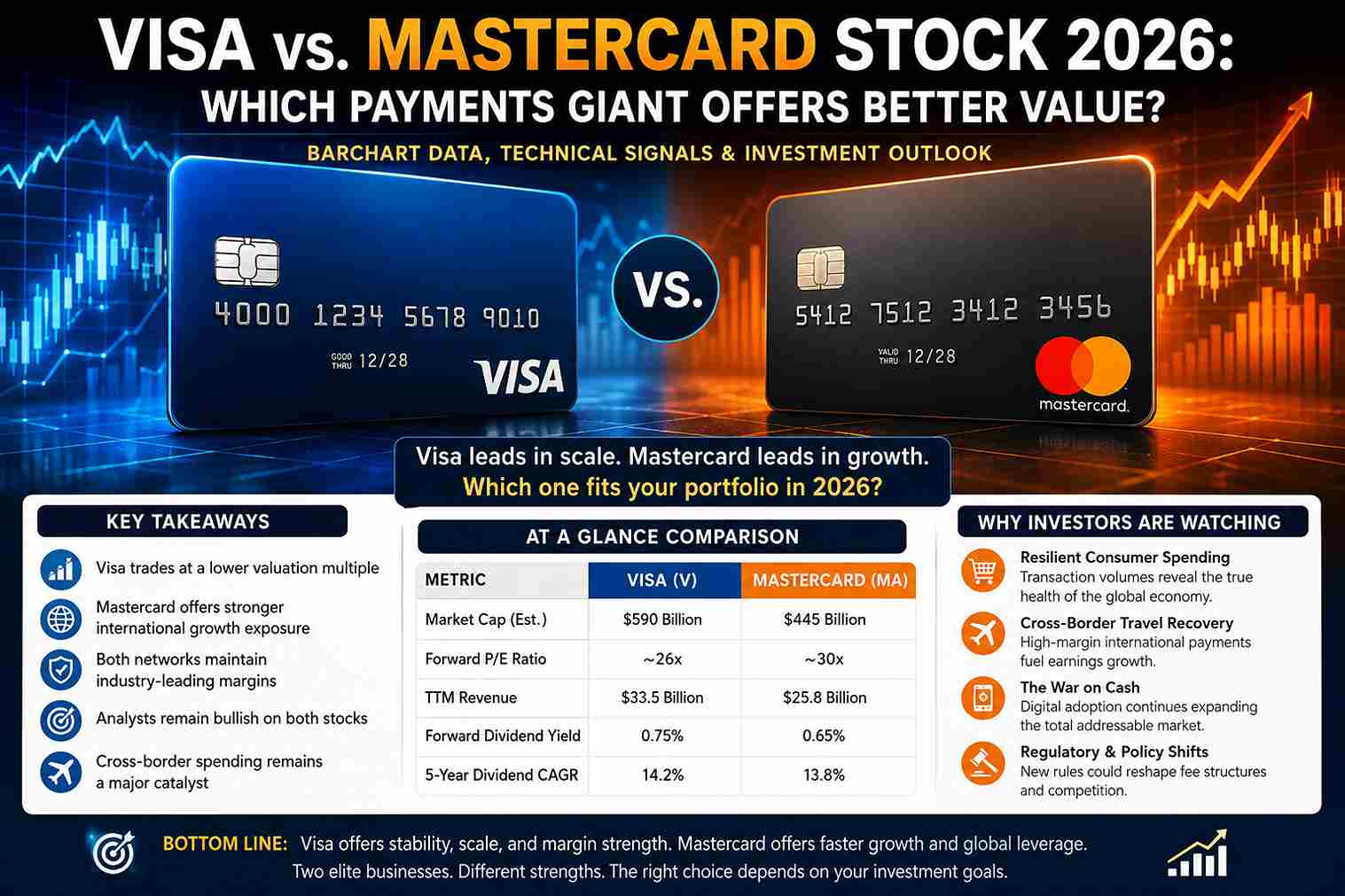
Visa vs. Mastercard in 2026: Which payments giant offers the stronger combination of growth, profitability, and long-term shareholder returns?
Visa vs. Mastercard: Which Payments Network Looks Like the Better Buy in 2026?
Visa and Mastercard have outperformed most traditional financial stocks for years, yet both are now trading near key technical levels that have attracted fresh institutional attention. New Barchart data is forcing investors to ask a simple question: which payments giant offers the better risk-reward opportunity in 2026? Macroeconomic shifts, fluctuating consumer spending patterns, and evolving regulatory environments have forced markets to re-evaluate the resilience of these financial technology cornerstones. More importantly, recent Barchart momentum data highlights a notable divergence in how institutional capital views the near-term trajectories of these two organizations.
Why are analysts comparing Visa and Mastercard so closely right now? The current economic cycle presents a unique crossroad. While inflation has cooled, consumer credit dynamics are shifting. Investors are utilizing screening tools and Barchart technical indicators to determine which network offers better downside protection and higher terminal growth rates. Barchart data currently shows both equities consolidating near critical moving averages, prompting value-seeking portfolio managers to initiate comparative models.
This analysis strips away the market noise to evaluate both companies. We will review the fundamental metrics, technical sentiment, emerging growth catalysts, and the structural risks facing the global payments duopoly.
The Baseline: Examining the Current Barchart Metrics
Before evaluating the qualitative differences between the two networks, establishing a quantitative baseline is necessary. Visa operates as the larger entity, maintaining a significant lead in overall transaction volume and total issued cards. Mastercard, while smaller in absolute scale, has historically demonstrated agility in specific international markets and value-added services.
Recent Barchart data highlights how the market is currently pricing these operational differences. The following table provides a snapshot of the primary valuation and scale metrics.
Table 1: Visa vs. Mastercard Quick Comparison
| Financial Metric | Visa (V) | Mastercard (MA) |
|---|---|---|
| Market Capitalization (Est.) | $590 Billion | $445 Billion |
| Forward P/E Ratio | ~26x | ~30x |
| Trailing 12-Month Revenue | $33.5 Billion | $25.8 Billion |
| Forward Dividend Yield | 0.75% | 0.65% |
| 5-Year Dividend CAGR | 14.2% | 13.8% |
The data reveals a consistent market trend. Mastercard typically commands a slightly higher forward price-to-earnings multiple. Market participants assign this premium based on Mastercard’s aggressive growth in cross-border volume and slightly faster historical revenue growth rates. Visa trades at a relative discount, offering investors a lower entry multiple and a marginally higher dividend yield, backed by undisputed market share dominance in the United States.
Why Investors Are Watching Visa and Mastercard in 2026
The broader retail and institutional investment community has renewed its focus on the payment processing sector due to several systemic shifts. Understanding these baseline drivers helps explain why minor deviations in network performance lead to significant reallocations of capital.
- Resilience of Consumer Spending: Investors are closely tracking credit card transaction data to gauge whether global consumer demand is expanding or contracting under current economic realities.
- Cross-Border Travel Trends: High-margin international travel transaction volumes serve as a vital earnings engine for both platforms, making travel data a key fundamental indicator.
- The War on Cash: The multi-year secular shift away from paper currency toward digital interfaces, tap-to-pay infrastructure, and automated clearing houses continues to expand the total addressable market.
- Regulatory Developments: Emerging policy changes and anti-trust conversations in North America and Europe are altering how investors assess the long-term terminal value of these payment rails.
What Barchart’s Technical Indicators Currently Show
A fundamental thesis requires confirmation from market technicals. Evaluating recent Barchart technical screeners, trend signals, and moving average cross-overs provides deep insight into where institutional trading desks are establishing positions.
Data indicates that both equities have experienced significant technical consolidation over recent quarters, breaking out of standard tight channels to test multi-month support structures. Barchart’s Trend Seeker signal currently reflects a neutral-to-bearish short-term outlook but highlights long-term stabilization. Specifically, Visa’s 50-day moving average (DMA) has recently converged toward its 200-day moving average, signaling an extended period of baseline accumulation. Mastercard displays a healthier short-term momentum score, maintaining its price action slightly above its corresponding 200-DMA, which reflects stronger institutional accumulation on market pullbacks.
In terms of Relative Strength Index (RSI) parameters, both payment processors have repeatedly moved out of overbought territory and into balanced zones near 45–50. This technical resetting implies that the previous valuation premium has been partially digested by the market, presenting a structurally sound entry environment for systematic accumulation strategies rather than speculative trading.
The Foundation: The Four-Party System Advantage
To understand the valuation multiples assigned to these equities, investors must understand their specific operational roles. Neither Visa nor Mastercard issues credit. They do not hold consumer debt. They do not face default risk if a cardholder fails to pay a monthly bill.
They operate the four-party system. This framework connects the consumer, the merchant, the issuing bank, and the acquiring bank. Visa and Mastercard provide the technological infrastructure that secures, authorizes, and settles the transaction. They extract a fractional fee for providing this routing service. This operational structure provides profound capital efficiency. It insulates both companies from the severe balance sheet volatility that impacts traditional lending institutions during credit contractions.
Profitability and Margin Expansion
Scale is the primary driver of profitability in the payments sector. Once the core routing infrastructure is established, the marginal cost to process an additional transaction approaches zero. This dynamic results in operating margins that rank among the highest in the S&P 500.
Both companies excel in converting top-line revenue into free cash flow. However, slight variations exist in their profitability profiles, largely driven by differing levels of capital expenditure and international investment strategies.
Table 2: Profitability and Margin Comparison
| Profitability Metric | Visa (V) | Mastercard (MA) |
|---|---|---|
| Gross Profit Margin | ~80% to 85% | Industry-Leading / High-Margin Structure |
| Operating Margin | ~67% | ~58% |
| Net Income Growth (YoY) | 15.5% | 16.2% |
| Return on Equity (ROE) | ~48% | ~165% (Due to capital structure) |
Visa demonstrates a clearly superior operating margin. The company benefits from its immense scale, particularly in the highly profitable North American market. Mastercard reports a staggering Return on Equity. This figure is a function of Mastercard operating with a optimized capital structure and a smaller equity base, amplifying the percentage return. Both sets of metrics indicate highly efficient, cash-generating business models.
Growth Catalysts: What Could Drive Shares Higher?
Despite their current size, both networks possess distinct avenues for continued expansion. Analysts modeling future cash flows primarily focus on three growth vectors.
1. Cross-Border Transaction Volume
Cross-border transactions represent the most lucrative segment for both networks. When a cardholder makes a purchase in a foreign currency, the network applies foreign exchange fees and higher processing margins. The continued normalization and growth of international travel, coupled with expanding global e-commerce, acts as a direct tailwind. Mastercard has historically indexed slightly higher in cross-border exposure, which frequently explains its premium valuation multiple during periods of strong global travel data.
2. Value-Added Services (VAS)
Both companies are actively diversifying their revenue streams beyond core payment clearing. They are heavily investing in Value-Added Services. This category includes predictive fraud analytics, cybersecurity solutions, consulting services, and data processing APIs. By selling these ancillary software products to their existing banking partners, both networks can drive double-digit revenue growth even if consumer transaction volumes remain flat.
3. B2B Payment Digitization
While consumer retail payments are highly digitized, the business-to-business (B2B) payment sector still relies heavily on legacy infrastructure, including physical checks and manual clearing methods. Capturing a larger share of global B2B money movement represents a multi-trillion-dollar addressable market. Both Visa and Mastercard are developing specialized commercial payment rails and virtual card solutions to modernize corporate accounts payable systems.
The Bear Case: Structural Risks and Headwinds
Objective financial analysis requires a thorough examination of potential downside risks. While the duopoly appears impenetrable, several structural threats could compress terminal growth rates and valuation multiples over the next decade.
1. Regulatory and Legislative Intervention
Interchange fees, commonly referred to as “swipe fees,” remain a highly contentious issue globally. Merchants continually lobby legislative bodies to cap the fees charged by payment networks. In the United States, initiatives like the Credit Card Competition Act aim to mandate alternative routing options for merchants. If regulators successfully force increased competition or strictly cap interchange rates, both Visa and Mastercard would experience direct revenue compression.
2. Sovereign Alternative Payment Rails
National governments are increasingly viewing payment infrastructure as a matter of national security. The development of domestic, real-time payment networks bypasses the Visa and Mastercard ecosystem entirely. India’s Unified Payments Interface (UPI) and Brazil’s PIX system have achieved near-universal domestic adoption. If European or North American central banks successfully implement similar zero-fee, real-time settlement rails, the traditional card networks could lose significant domestic transaction volume.
3. Macroeconomic Consumer Slowdown
While immune to credit default risk, these networks remain highly sensitive to total consumer spending. If inflation pressures household budgets or unemployment rises, discretionary spending contracts. A sustained global recession would immediately reduce total payment volume, directly impacting quarterly earnings performance for both equities.
Table 3: Risk Factor Exposure
| Risk Factor | Visa Impact Potential | Mastercard Impact Potential |
|---|---|---|
| US Interchange Legislation | High (Due to dominant US market share) | Moderate |
| Alternative Rails (UPI/PIX) | Moderate | High (Due to extensive emerging market focus) |
| Cross-Border Travel Decline | Moderate | High |
| Currency Devaluation | Low to Moderate | Low to Moderate |
Wall Street Consensus and Analyst Ratings
Reviewing aggregated analyst data provides context regarding broad institutional sentiment. According to recent Barchart consensus figures, Wall Street maintains a strongly positive outlook on the sector, viewing recent price consolidation as a standard cyclical rotation.
Table 4: Analyst Consensus Targets
| Consensus Metric | Visa (V) | Mastercard (MA) |
|---|---|---|
| Overall Consensus Rating | Strong Buy | Strong Buy |
| Number of Analyst Ratings | 38 | 39 |
| Mean Price Target Upside | ~14% | ~16% |
| High Price Target Upside | ~28% | ~32% |
The institutional consensus reflects a slight preference for Mastercard regarding total capital appreciation potential. Analysts typically assign Mastercard higher price targets based on its historical ability to compound earnings slightly faster through international expansion. Visa receives high ratings based on its unmatched stability, dominant cash flow generation, and lower relative volatility profile.
Final Assessment for Portfolio Strategy
Evaluating Visa and Mastercard utilizing Barchart data and fundamental metrics reveals two highly efficient technology infrastructure companies. The decision between the two relies entirely on specific portfolio mandates.
If the objective is stability, scale, and margin strength, Visa currently appears to hold the advantage. Its large domestic market share, conservative debt position, and operational efficiency offer substantial downside protection. If the objective is faster international growth and potentially higher upside, Mastercard remains a compelling alternative, leveraging its cross-border exposure and flexible corporate framework. The reality is that investors are not choosing between a strong business and a weak business. They are choosing between two of the most dominant payment networks ever built. Careful entry points remain critical for long-term alpha generation.
Frequently Asked Questions (FAQ)
Is Visa a better stock than Mastercard in 2026?
The determination of which stock is superior depends on an investor’s specific strategic criteria. Historical data and current valuation screeners show that Visa offers better operating margins and lower comparative volatility, making it highly attractive for risk-averse portfolios. Conversely, Mastercard features faster relative growth trends, appealing to growth-oriented strategies willing to accept a higher valuation multiple.
Why do analysts prefer Mastercard’s growth outlook?
Many institutional models project slightly higher growth trajectories for Mastercard due to its business layout. Mastercard typically drives greater relative volume from international and emerging growth markets. Because these economic segments are transitioning from cash to digital architectures at a fast rate, Mastercard exhibits a slightly higher long-term terminal revenue trajectory.
What is the biggest risk facing payment networks?
The primary threat to the payment processing duopoly stems from evolving international regulatory frameworks. Specifically, legislative mandates that seek to enforce merchant-chosen transaction routing or strictly cap interchange fees present a direct challenge to fee-collection revenue streams globally.
How important are cross-border payments to earnings growth?
Cross-border payments are crucial to total performance because they command substantially higher fees than domestic transactions. These cross-currency transactions involve unique currency conversion fees, making international travel and cross-border e-commerce expansions primary drivers of unexpected margin expansion.
Investors comparing Visa and Mastercard should continue monitoring earnings growth, cross-border payment volumes, and valuation trends before making portfolio decisions.
Financial Disclaimer: The information provided in this article is for educational and informational purposes only and does not constitute financial, investment, or trading advice. Past performance is not indicative of future results. Always conduct independent due diligence or consult with a licensed financial advisor before making any investment decisions.
About the Author