The US economy in 2026 faces a delicate balance between slowing inflation, elevated interest rates, labor market normalization, and steady economic growth.
US Economy 2026: Can Growth Continue Despite High Interest Rates and Sticky Inflation?
The US Economy remains in a highly transitional phase through May 2026, balancing pockets of structural resilience against the sustained friction of elevated borrowing costs.
As the post-pandemic recovery cycle concludes, the macroeconomic landscape is increasingly defined by shifting consumer priorities, normalizing labor dynamics, and a renewed corporate focus on operational efficiency. Several leading economists note that the current environment requires a nuanced reading of mixed indicators, as steady top-line growth metrics obscure deeper realignments in how capital is deployed and how households manage daily expenses.
Recent data indicates a clear departure from the high-velocity expansion seen in previous years. A household financing a vehicle or securing a mortgage today navigates a fundamentally different interest rate regime than they did even 24 months ago. This shift in the cost of capital continues to ripple through domestic markets, influencing retail inventory management, corporate hiring forecasts, and overarching monetary policy expectations. For both institutional investors allocating portfolio risk and consumers balancing household budgets, identifying the genuine underlying trends in this complex economy remains essential.
The trajectory for the remainder of the year will largely depend on the interplay between cooling wage growth and persistent consumer price pressures. Whether the Federal Reserve can guide the economy toward a stable equilibrium without triggering a broader contraction rests on data emerging from the labor market, retail sales, and the global energy sector.
Why the US Economy Is Still Growing Despite Higher Rates
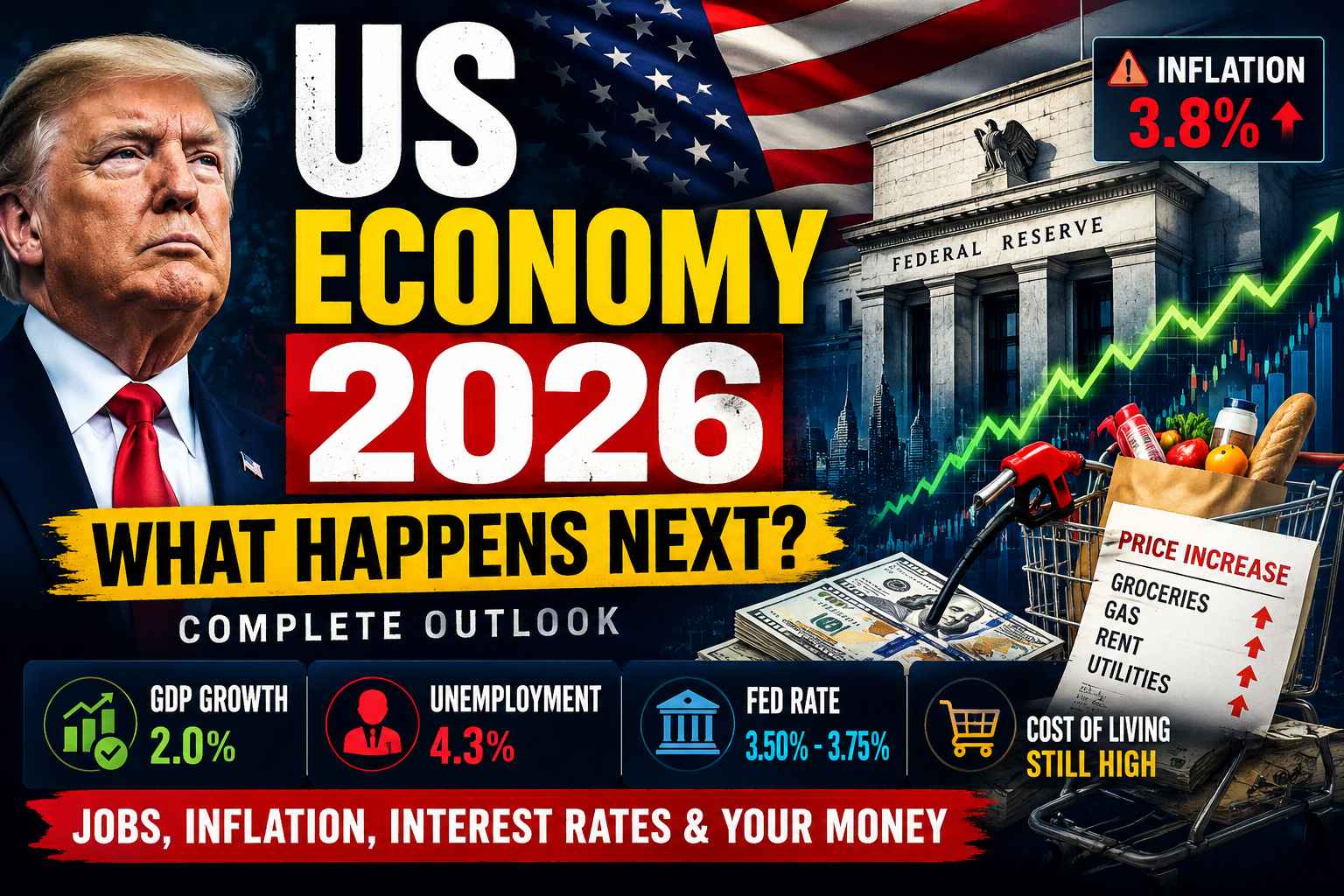
According to the Bureau of Economic Analysis, the US Economy demonstrates structural stability despite the headwinds of restrictive monetary policy. Real Gross Domestic Product (GDP) expanded at an annualized rate of 2.0 percent in the first quarter of 2026. This metric marks a measurable rebound from the 0.5 percent pace recorded in the final quarter of 2025, temporarily easing concerns of an imminent recessionary cycle.
However, an examination of the underlying GDP components reveals that this expansion was notably supported by targeted corporate expenditures rather than a broad-based surge in consumer demand. Business fixed investment increased by approximately 10 percent early in the year. Bureau of Economic Analysis data shows this capital expenditure was concentrated heavily in intellectual property products, new equipment, and automation software. Corporations are actively investing in technology to structurally lower operational overhead and protect profit margins against rising input costs.
This corporate defensive posture carries broader implications for the economy. Management teams are increasingly prioritizing efficiency over speculative market share expansion. The flow of institutional capital aligns with this strategy, rewarding businesses that demonstrate strong free cash flow generation and disciplined capital allocation. Rather than funding unproven growth initiatives, the prevailing sentiment across corporate boardrooms emphasizes fiscal conservatism and balance-sheet durability.
Consumer Spending: Shifting Priorities in a High-Cost Environment
Consumer behavior, which traditionally drives over two-thirds of domestic economic activity, has adapted to the realities of a higher-cost environment. While aggregate retail sales have maintained a steady baseline, the composition of consumer spending has undergone a notable transformation. Recent earnings commentary from major retailers suggests that shoppers are exhibiting heightened price sensitivity, frequently trading down to store brands and delaying purchases of durable goods such as appliances and furniture.
Economic reports indicate that essential expenses—specifically housing, utilities, insurance, and energy—are requiring a larger allocation of monthly household income. As these fixed costs consume more capital, discretionary spending naturally moderates. Major retail chains report steady foot traffic but note a decrease in average basket size, prompting them to manage inventory levels conservatively and deploy targeted promotional strategies to maintain sales volumes.
What This Means For Consumers
- Elevated borrowing costs: With credit card interest rates and auto loan yields remaining near multi-year highs, financing consumer purchases requires a larger portion of monthly income, encouraging households to prioritize cash transactions where possible.
- Rotation to essentials: The sustained cost of shelter and groceries means that sectors reliant on discretionary income, including luxury goods and premium travel, are likely to face continuing revenue headwinds throughout the year.
- Value-oriented shopping: Consumers can expect retailers to offer strategic discounts. As businesses compete for a moderated pool of disposable income, consumers gain slight leverage in finding value, particularly in overstocked apparel and electronics.
- Savings normalization: Lower- and middle-income demographics have largely normalized their pandemic-era savings buffers, making them more reliant on current wage income to fund daily expenditures.
Labor Market Normalization: The End of the Hiring Frenzy
The domestic job market remains a stabilizing force for the broader US Economy, though the accelerated hiring pace of previous years has visibly cooled. Recent Bureau of Labor Statistics data shows the national unemployment rate at 4.3 percent as of April 2026. While this figure remains historically consistent with a functional economy, it reflects a gradual softening in overall labor demand and a return to pre-pandemic employment dynamics.
Across multiple sectors, employers are adopting a measured approach to workforce management. Companies are generally retaining their existing, productive employees, acknowledging the high costs associated with recruiting and onboarding. Concurrently, the volume of new job postings has decreased, and the time required to fill open requisitions has lengthened. The rapid wage escalations and broad sign-on bonuses that characterized the early recovery phase have largely subsided.
According to the Bureau of Labor Statistics, annual wage growth has moderated to approximately 2.3 percent. Because this wage growth is currently trailing behind headline inflation, the average worker is experiencing a slight reduction in real purchasing power. Federal Reserve officials view this specific labor market stabilization as a necessary development to prevent a secondary cycle of wage-driven inflation, even as it results in a more competitive environment for job seekers.
The Inflation Hurdle: Energy, Shelter, and the Fed’s Dilemma
Inflation remains a persistent challenge for domestic economic stability. In April 2026, the headline Consumer Price Index (CPI) recorded an annual increase of 3.8 percent. A substantial driver of this recent metric was a nearly 18 percent year-over-year rise in energy costs. Global supply chain complexities and geopolitical developments have maintained upward pressure on energy markets, effectively acting as a headwind for both consumer discretionary income and industrial manufacturing margins.
When excluding the volatile food and energy sectors, core CPI remains steady at 2.8 percent—still above the Federal Reserve’s long-term target of 2.0 percent. Shelter costs continue to be a primary contributor to the core index, driven by a structural shortage of available housing inventory and elevated mortgage rates that restrict residential mobility.
In response to these resilient inflation metrics, the Federal Reserve has maintained its benchmark interest rate target range at 3.50 to 3.75 percent through May 2026. Federal Reserve officials have repeatedly signaled that cutting rates too early could risk renewed inflationary pressure. Market participants have largely adjusted their forecasts, pricing in a higher-for-longer interest rate environment. Consequently, Treasury yields remain elevated, continuing to influence the overarching cost of corporate debt refinancing and consumer credit.
Wall Street’s Response: Defensive Capital Rotation
Institutional asset managers are systematically adapting to this extended high-rate environment through calculated portfolio adjustments. Analysts point out a notable rotation of capital beneath the surface of the major equity indices. Portfolio managers are redirecting allocations away from speculative growth equities toward established companies that offer strong balance sheets, predictable revenue streams, and reliable dividend yields.
The fixed-income market provides significant competition for investment capital. With short-term Treasury instruments and high-quality corporate bonds offering attractive, risk-adjusted returns, equities face a higher threshold to attract institutional inflows. Institutional investors are meticulously screening the corporate credit markets, assessing the capacity of mid-sized companies to manage debt servicing costs as lower-rate loans mature and require refinancing at current market yields.
Corporate capital allocation strategies mirror this defensive positioning. Excess free cash flow is frequently directed toward debt reduction and strategic share repurchases. Funding for expansive new projects or large-scale acquisitions remains restrained. Financial markets are currently rewarding operational discipline and fiscal prudence, requiring executive teams to thoroughly justify capital expenditure initiatives.
Emerging Risks and Systemic Vulnerabilities
Looking toward the second half of 2026, several variables present potential risks to the economic outlook. Energy market volatility remains a primary external factor. Should geopolitical events further constrain global oil supplies, the resulting increase in transportation and manufacturing costs could push headline inflation higher, complicating the Federal Reserve’s policy timeline and straining consumer budgets.
Credit market conditions warrant continuous monitoring. While large corporations generally secured long-term, fixed-rate debt in previous years, smaller enterprises often rely on floating-rate financing. These businesses face sustained pressure as their debt servicing obligations remain high. Additionally, the commercial real estate sector, particularly urban office segments, continues to navigate refinancing challenges amidst evolving occupancy trends and adjusted property valuations.
Consumer credit metrics also indicate areas of developing vulnerability. Delinquency rates on auto loans and credit cards have shown measured increases as household liquidity normalizes. A key consideration for the broader economy is whether consumer spending can remain resilient if labor market conditions soften further while living costs remain elevated.
Forward Economic Outlook: Navigating the Second Half of 2026
The economic trajectory for the remainder of 2026 points toward continued, albeit moderated, growth. Analysts expect baseline economic activity to proceed at a more deliberate pace than the 2.0 percent expansion seen in the first quarter. Market leadership will likely be defined by organizations that effectively leverage technology and supply chain optimization to maintain margins in a restrictive monetary environment.
The Federal Reserve is anticipated to maintain a data-dependent stance, evaluating incoming economic reports closely. Policy adjustments are expected only when there is sustained evidence that core inflation is trending firmly toward the central bank’s mandate. Until such conditions are met, the US Economy will continue to operate under the parameters of elevated borrowing costs, relying on corporate adaptability and the foundational stability of the consumer sector.
Frequently Asked Questions
Is the US economy slowing down in 2026?
While the economy continues to expand, its forward momentum is moderating. First-quarter GDP showed a resilient 2.0 percent growth rate, but leading indicators such as normalizing wage growth, elevated credit costs, and cautious consumer spending patterns point toward a more deliberate pace of economic activity for the remainder of the year.
Will the Federal Reserve cut interest rates this year?
Market expectations for near-term interest rate reductions have been significantly revised. With headline inflation at 3.8 percent as of April 2026, the Federal Reserve is broadly expected to maintain its benchmark rate in the 3.50 to 3.75 percent range until core price pressures demonstrate a sustained and definitive downward trajectory.
Why is inflation still above the Fed’s target?
Current inflation is driven by a combination of external factors and domestic structural dynamics. Energy costs rose nearly 18 percent year-over-year in April due to global supply constraints. Furthermore, persistent shelter costs, influenced by limited housing inventory and high mortgage rates, continue to keep core inflation elevated.
Is the labor market weakening?
The labor market is undergoing a period of normalization rather than severe contraction. The national unemployment rate is steady at 4.3 percent. However, employers have reduced new job postings and lengthened hiring cycles, which has moderated annual wage growth to approximately 2.3 percent, signaling a shift toward strict cost containment.
What could negatively affect economic growth in the second half of 2026?
Variables that could impact future growth include further volatility in global energy markets, the capacity of consumers to manage elevated credit card balances, and the refinancing challenges facing the commercial real estate sector. The ability of small and medium-sized businesses to absorb sustained borrowing costs also remains a critical factor.
Conclusion and Key Takeaways
Evaluating the current state of the US Economy requires monitoring the ongoing balance between baseline growth, inflationary pressures, and monetary policy. The following data matrix outlines the primary macroeconomic indicators defining the financial landscape as of May 2026:
| Economic Indicator | Current Status (As of May 2026) | Market Implication |
| Gross Domestic Product (GDP) | 2.0% Annualized Growth (1Q26) | Demonstrates resilient baseline expansion, supported largely by corporate efficiency investments. |
| Headline Consumer Price Index | 3.8% Year-over-Year (April 2026) | Influenced heavily by energy costs; limits the Federal Reserve’s flexibility regarding rate reductions. |
| National Unemployment Rate | 4.3% (April 2026) | Reflects a normalizing labor market, reducing the risk of secondary wage-driven inflation. |
| Federal Funds Rate | 3.50% – 3.75% Target Range | Maintains elevated borrowing costs for consumers, homebuyers, and corporations. |
| Business Investment | +10% Expansion (1Q26) | Indicates that corporations are prioritizing capital expenditures that enhance operational productivity. |
Upcoming data releases concerning inflation, labor market conditions, and retail sales will be instrumental in shaping financial expectations for the remainder of the year. For households, a primary focus will be managing daily expenses as wage growth normalizes.
For institutional investors, attention remains fixed on corporate earnings durability and the capacity of businesses to operate efficiently within a high-rate environment.
As the transition continues, both the private sector and the broader financial markets must navigate an economic landscape where diligent risk management and operational adaptability are essential for sustained success.
About the Author