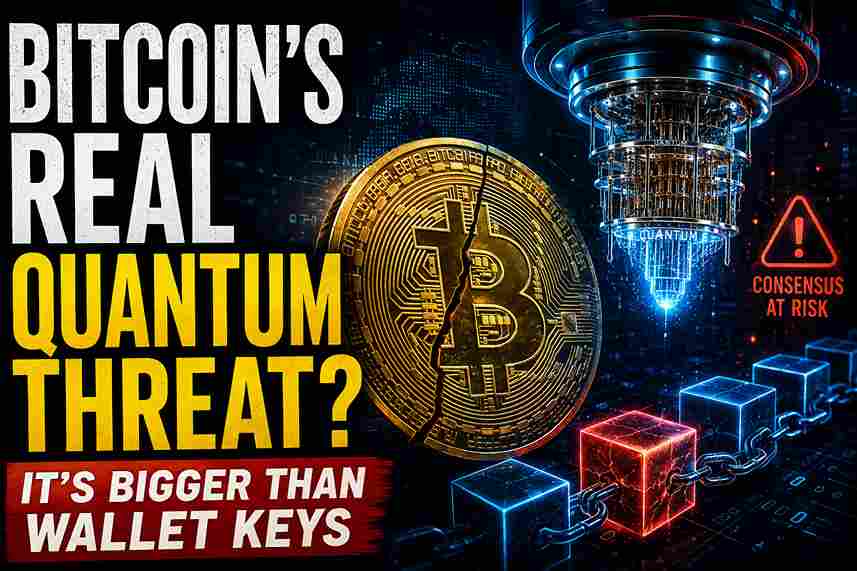
Quantum computing may threaten more than Bitcoin wallet security. Experts now warn that the network's consensus layer could face a larger long-term challenge.
Bitcoin Quantum Threat: Why the Bigger Risk May Not Be Wallet Keys
The Quantum Computing Horizon and Digital Asset Security
For years, Bitcoin investors worried that quantum computers could someday crack wallet keys. Now, early Bitcoin participants and cryptographic experts believe the bigger danger may be something far more fundamental—the mechanism that keeps the entire decentralized network trustworthy. A recent technical report published by CoinDesk highlights a structural vulnerability that shifts the conversation away from individual address security toward global ledger integrity.
The core of this systemic concern rests on the timeline of quantum computing development. Based on current cryptographic research, public-key vulnerability is a localized issue that the developer community can gradually mitigate. The deep architectural risk, however, targets the network’s consensus layer, potentially altering the competitive balance of block production. Industry data suggests that if processing power shifts unevenly, the core trust model of the blockchain faces an unprecedented technical challenge.
When an ecosystem relies entirely on decentralized validation, the chronological order of transactions must remain uniformly secure. If an asymmetric processing advantage is introduced, the immutability of the entire ledger is compromised. This technical analysis breaks down the precise threat vectors that early network participants fear could destabilize the protocol’s double-spending protection.
Why This Debate Matters Right Now
Quantum computing remains years away from mainstream commercial deployment, but institutional investors are increasingly asking whether blockchain networks are preparing quickly enough. The latest discussion highlighted by CoinDesk has shifted attention from localized wallet security toward the deeper mechanics that keep decentralized ledgers trustworthy and operational.
For asset managers and long-term holders, understanding this pivot in the threat landscape is essential for future risk modeling. Financial markets price in future risks long before they materialize. If the broader market perceives a structural vulnerability in the consensus mechanism, it could impact institutional capital allocation strategies today. Addressing these concerns proactively is a mandatory step for the maturation of the digital asset sector.
The Standard Signature Narrative vs. Structural Reality
Most market participants are familiar with the risk associated with the Elliptic Curve Digital Signature Algorithm (ECDSA). Under traditional threat modeling, a quantum computer running Shor’s algorithm could theoretically reverse a public key to find its corresponding private key. This specific method would primarily threaten stale or exposed addresses that do not utilize advanced address hashing protocols.
While this public-key vulnerability is a legitimate long-term concern for legacy addresses holding large quantities of unspent transaction outputs (UTXOs), it represents a patchable risk. The network can mitigate this by implementing post-quantum cryptographic upgrades or forcing a migration to new signature schemes before functional quantum processors reach the market. The structural reality of the protocol, however, contains deeper hardware and software dependencies that a simple signature update cannot fully resolve.
The true threat involves the network’s consensus timing and block creation velocity. The CoinDesk analysis emphasizes that if an entity can solve cryptographic puzzles at a speed that outpaces the rest of the global network combined, the balance of power shifts. The decentralized system would face an immediate threat of processing centralization, fundamentally changing how transactions are validated.
Consensus Mechanics Under Asymmetric Processing Pressure
To understand the depth of this systemic risk, one must examine the proof-of-work baseline that keeps the ledger immutable. The network uses a cryptographic hash function to ensure that block generation occurs roughly every ten minutes. This difficulty adjustment algorithm is designed to recalibrate based on the total computational capacity of the network.
When processing power increases linearly, the network adjusts smoothly, maintaining competitive equilibrium among mining participants. However, quantum processing units do not offer a linear increase in efficiency; they introduce an entirely different mathematical approach to solving specific optimization problems. By utilizing Grover’s algorithm, a quantum system could drastically reduce the time required to find a target hash value.
This massive processing advantage could potentially allow a single entity to consistently solve blocks ahead of the global network. When one participant controls block creation, they gain the technical capability to rewrite recent transaction history, creating a profound crisis of confidence in the finality of the ledger.
The Economics of the Block Rewards System
The entire economic model of the digital asset network is sustained by the distribution of block rewards and transaction fees. Mining participants invest significant capital into specialized application-specific integrated circuits (ASICs) and energy infrastructure to secure the network in exchange for these rewards.
If a quantum operator enters the ecosystem with a superior processing method, traditional hardware configurations could instantly become economically non-viable. This would trigger a massive capitulation among standard mining operators, leading to a rapid centralization of the network’s physical security infrastructure. As smaller operations power down their facilities, the network becomes increasingly vulnerable to the remaining centralized players.
| Threat Vector Category | Traditional Cryptographic Mitigation Strategy | The Systemic Consensus Risk Profile |
|---|---|---|
| Public-Key Vulnerability | Migration to post-quantum signature schemes (e.g., lattice-based cryptography). | Affects individual addresses; can be patched via user-end wallet updates. |
| Hash Function Acceleration | Upgrading the network’s hash function to higher bit-lengths (SHA-384 or SHA-512). | Alters the core mining algorithm; requires a comprehensive network fork. |
| Consensus Monopolization | Dynamic difficulty adjustment modification strategies. | Threatens ledger immutability, transaction finality, and double-spend protection. |
Why Market Synchronization Is At Risk
The decentralized nature of the network depends entirely on node synchronization. Nodes across the globe must agree on the chronological order of transactions to maintain a single version of the truth. When a block is found, it is broadcast to all nodes, which verify the data and append it to their local copy of the blockchain.
If an advanced processing system can generate valid blocks at an accelerated velocity, it could create a private chain that grows faster than the public ledger. Under the network’s longest-chain rule, nodes are programmed to accept the chain with the most accumulated proof of work as the valid history. This mechanism, designed to resolve natural network splits, becomes a structural vulnerability when facing an asymmetric technological opponent.
By releasing a longer, privately generated chain to the network, an operator could potentially invalidate transactions that were previously considered settled by the public. This method completely undermines the reliability of merchant transactions, institutional settlements, and automated smart contracts across the ecosystem.
The Early Investor Perspective: Structural Fears Explained
Data indicates that long-term asset holders and early pioneers of the web3 space are shifting their attention away from simple wallet security. As highlighted in the CoinDesk report, early network participants emphasize that the true value of the digital asset is its absolute immutability. If a nation-state or a well-funded enterprise develops a quantum system capable of dominating the block creation process, they do not need to access your private keys to disrupt your holdings.
A general industry assessment reveals that the primary focus must center on the institutional trust required to sustain a global financial asset. If a single entity can manipulate the order of transactions, the value proposition of a trustless, decentralized ledger evaporates. They could simply exclude your transactions from the ledger entirely or reverse your payments to merchants.
This scenario represents a structural failure mode that cannot be easily fixed by changing a user password or moving funds to a hardware wallet. It targets the collective agreement that gives the digital token its monetary properties. Without a trusted consensus layer, the asset loses its utility as a reliable store of value for corporate treasuries and individual investors alike.
Technical Realities of Upgrading Core Network Code
Fixing a public-key vulnerability is relatively straightforward because it can be done gradually as users update their client software. In contrast, changing the core hash function or the consensus model requires a coordinated protocol upgrade that all node operators must adopt simultaneously. This type of shift often results in a permanent network split if there is any disagreement within the global community.
The process of researching, testing, and implementing a post-quantum consensus mechanism requires years of careful development. The network community must achieve absolute alignment on the new technical specifications before deployment. If the upgrade is rushed, it introduces the risk of critical software bugs that could leave the network vulnerable to standard operational exploits.
Comparing Cryptographic Functions Across Top Networks
| Blockchain Network | Current Primary Signature Method | Consensus Hash Algorithm | Quantum Resilience Level |
|---|---|---|---|
| Bitcoin Network | ECDSA (secp256k1) | SHA-256 (Double) | Moderate for hash layers; Low for unhashed public addresses. |
| Ethereum Network | ECDSA (secp256k1) | Keccak-256 | Low for signature layers; requires ongoing transition planning. |
| Solana Network | Ed25519 | SHA-256 | High processing speed requirements compound the signature migration timeline. |
Note: These network assessments reflect broad industry discussions and current structural research, not official security ratings. They are based on general threat modeling regarding future computational capabilities.
The Sovereign State Threat Vector
While commercial quantum computing is still in its development phase, sovereign research laboratories operate with significantly larger budgets and distinct motivations. A government entity may not be interested in accumulating wealth by selling digital tokens on an open exchange. Instead, their strategic objective might involve destabilizing an alternative financial network that operates outside of traditional regulatory controls.
If a state-backed entity utilizes an advanced processing system to execute continuous consensus disruptions, they could effectively halt the network’s global utility. By constantly reorganizing the chain, they render the network unusable for international trade or institutional treasury management. This risk profile transitions the quantum conversation from a technical puzzle into a geopolitical consideration.
The strategy required to protect the network from state-level disruption involves constant monitoring of block production patterns. If unusual concentrations of processing efficiency are detected, the developer community must have contingency plans ready to alter the protocol’s core parameters immediately, ensuring the network can fork safely away from the attacker’s chain.
Strategic Takeaways for Digital Asset Custodians
Institutions and retail investors alike must adapt their long-term security posture to match the changing nature of technological risk. Relying on standard cold storage methods is no longer a complete defense against structural network transformations.
- Monitor Protocol Developments: Investors must closely track the progress of core developer working groups focused on post-quantum cryptographic standards and consensus stability upgrades.
- Evaluate Network Diversity: Diversifying exposure across networks that are actively testing alternative, quantum-resistant validation systems can mitigate localized protocol risks.
- Assess Confirmation Timelines: Trillions of dollars in institutional volume may require longer transaction confirmation windows to ensure complete finality against potential chain reorganization methods.
- Support Onshore Technical Infrastructure: Ensuring that robust, decentralized node networks remain operational within transparent regulatory jurisdictions helps defend against centralized processing threats.
- Understand the Moat: The primary value of a decentralized network is its immutability; any threat to the consensus model must be treated with the highest priority by the risk management team.
Frequently Asked Questions Regarding Quantum Blockchain Risks
Can a quantum computer compromise my private key right now?
No, current publicly known quantum systems do not possess the necessary qubit count or error-correction capabilities to compromise standard cryptographic signatures. Current data indicates that a functional system capable of executing Shor’s algorithm at that scale remains a multi-year technical challenge for both commercial and state entities.
What is the difference between Grover’s algorithm and Shor’s algorithm?
Shor’s algorithm is specifically designed to find the prime factors of an integer, which threatens asymmetric encryption methods like ECDSA used for wallet signatures. Grover’s algorithm provides a quadratic speedup for searching unsorted databases, which applies directly to symmetric cryptography and hash functions used in block generation and network consensus.
How can a blockchain network patch its consensus mechanism against quantum threats?
The network can execute a coordinated protocol upgrade to implement larger hash structures, such as SHA-512, or transition to lattice-based cryptographic methods. This strategy requires absolute alignment among node operators, developers, and mining participants to avoid a permanent split in the network during the software transition.
Will my digital tokens become worthless if a quantum computer disrupts the network?
The value of any digital asset relies entirely on the security and immutability of its ledger. If the consensus mechanism is successfully compromised, the trust required to sustain the asset’s market value would face a severe crisis. This is why proactive protocol upgrades are essential for long-term value preservation across the ecosystem.
Are hardware wallets completely safe from future computing advancements?
Hardware wallets protect your private keys from standard internet-based exploits and unauthorized local access. However, if the underlying blockchain network’s signature method is vulnerable to algorithmic reversal, the physical safety of the device cannot prevent an exploit at the fundamental protocol layer.
The Long-Term Outlook for Distributed Ledgers
The technical evolution of decentralized networks has always been defined by a constant arms race between security design and computational capacity. The transition toward quantum computing represents the next logical phase of this ongoing progression. While the challenges facing the consensus layer are profound, they are not inherently unsolvable if the developer community maintains a proactive and unified development strategy.
The networks that survive the next decade will be those that prioritize structural adaptability over short-term market speculation. By building flexible protocol layers that can integrate new cryptographic standards without fracturing their user base, web3 platforms can secure their position in the future financial architecture. Investors must focus their analysis on these structural realities when evaluating the longevity of any digital asset class.
Comprehensive Financial Disclaimer
This market analysis is prepared strictly for educational, informational, and historical research purposes based on publicly available technical disclosures and industry commentary, including reports from CoinDesk. It does not constitute direct financial advice, investment recommendations, legal counsel, or an endorsement to buy, sell, hold, or trade any specific cryptocurrency, digital asset, or financial security token. The digital asset sector is subject to extreme price volatility, regulatory shifts, and technical protocol risks that can result in a total loss of deployed capital.
All technical assessments, cryptographic overviews, and threat modeling scenarios mentioned are current as of the publication date and reflect broad industry consensus rather than absolute guarantees of future performance. Readers must perform independent due diligence, execute comprehensive risk assessments, and consult with a certified, licensed financial professional before making any asset allocation decisions or implementing capital preservation systems. The author holds no specific commercial positions in the networks discussed throughout this report.
Stay ahead of the shifting technical developments in the digital asset space. Bookmark our homepage today to receive real-time, fact-checked editorial analyses covering the absolute latest updates in web3 infrastructure, cybersecurity, and enterprise financial systems.
About the Author