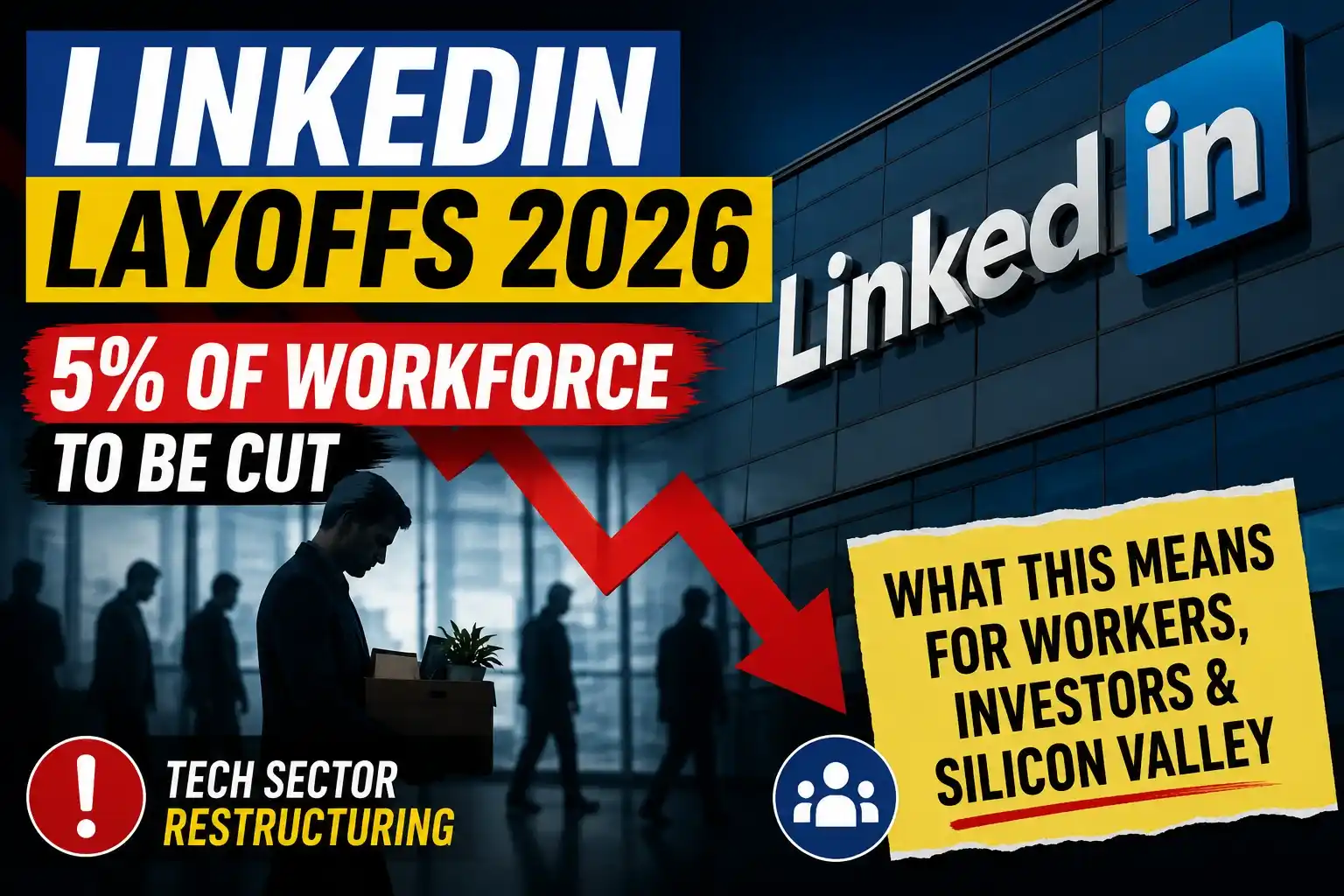
LinkedIn plans to cut around 5% of its workforce as Silicon Valley restructuring intensifies across the US technology sector in 2026.
The Technology Sector Faces Renewed Pressure
For many tech workers, LinkedIn has long represented the strength of the professional job market. That is exactly why these latest cuts are drawing so much attention across Silicon Valley.
Another major workforce reduction is sending fresh shockwaves through the US technology sector. Investors, recruiters, and white-collar professionals are once again confronting the reality of a slowing enterprise hiring environment. The timing matters. Hiring across the tech sector has slowed sharply since early 2026, and companies are feeling the squeeze.
On May 13, 2026, verified reporting from Times Now confirmed that LinkedIn plans to lay off around 5% of its workforce amid ongoing tech sector restructuring. The move immediately intensified concerns surrounding digital hiring demand, enterprise software growth, and broader labor market pressure.
Wall Street analysts are monitoring these developments closely. Executives across the industry are trimming the ranks, and market participants want to know if this signals deeper economic trouble for the broader US labor market.
Key Takeaways
- Verified reports confirm LinkedIn plans to lay off around 5% of its workforce.
- The breaking news surfaced on May 13, 2026, marking another notable event in the ongoing tech layoffs 2026 timeline.
- Industry observers note this action aligns with a continuous restructuring trend across Silicon Valley.
- Investors are evaluating how these LinkedIn workforce cuts might reflect on parent company Microsoft.
- Market analysts suggest the reduction indicates a broader pivot toward cutting costs and funding new AI initiatives.
Why This Matters for US Workers and Investors
The US labor market has historically relied on the technology sector as a primary engine for high-paying job growth. When a platform practically synonymous with professional employment initiates workforce reductions, the psychological impact is immediate.
For US workers, these LinkedIn job cuts are a reality check. The era of hyper-growth hiring is on pause. Tech professionals are navigating an environment where efficiency is the primary focus. The layoffs also reflect a broader slowdown in hiring across the tech industry. That means fewer open roles and increased competition for senior-level software and sales positions.
From an investment perspective, Wall Street often views cost-cutting favorably during periods of margin pressure. Major funds frequently interpret these reductions as a necessary step to protect profits. Investors analyzing the tech sector know that shedding 5% of a global workforce can meaningfully reduce recurring expenses.
However, analysts also caution that persistent layoffs can hint at revenue challenges. If corporate clients pull back on their internal hiring plans, platforms that make money on talent acquisition—like LinkedIn—will naturally feel the pinch. This delicate balance is exactly what analysts are trying to model following this latest shift.
What Happened at LinkedIn
The latest news confirms a specific, targeted reduction in headcount. According to verified reporting from Times Now on May 13, 2026, LinkedIn is set to lay off around 5% of its workforce. This move places the networking giant squarely in the middle of an ongoing industry reset.
A 5% workforce reduction is a calculated move. Analysts say cuts of this magnitude are typically designed to trim middle management, consolidate overlapping departments, and free up cash for higher-growth areas. It is a familiar playbook used during periods of tech sector pressure.
While the exact number of impacted employees remains tied to internal company charts, a 5% cut represents a meaningful shift. It shows that executive leadership is actively responding to changing market dynamics.
This event adds another chapter to the 2026 technology labor narrative. It serves as a stark reminder that even platforms deeply embedded in the daily routines of global professionals have to adapt to the current economy.
Related: Our latest coverage on enterprise software sector trends and corporate restructuring.
Why the Tech Sector Keeps Cutting Jobs
The technology industry is undergoing a historic transition. The broader sector has faced pressure as companies abandon the growth-at-all-costs mindset of the past decade. Today, generating cash and protecting margins are the top priorities for public shareholders.
One major driver behind the continued job cuts is the rapid acceleration of artificial intelligence. Many technology firms are heavily increasing their investments in AI infrastructure. To fund these massive, resource-heavy projects, companies are pulling capital away from legacy operations.
Broader economic concerns are also tightening corporate budgets. Enterprise clients are carefully scrutinizing their software subscriptions and service contracts. When client budgets tighten, vendors have to adjust their own operational costs to stay profitable.
Employment trends in Silicon Valley are simply normalizing. After years of aggressive hiring to capture pandemic-era digital demand, companies are finally aligning their headcounts with realistic revenue growth. The LinkedIn workforce cuts appear to be a direct symptom of this industry-wide normalization process.
Wall Street Analyst Perspective
Analysts are monitoring the LinkedIn reset as a potential leading indicator for the broader software sector. When a major player initiates a 5% headcount reduction, it provides a clear window into current corporate spending habits and hiring demand.
Financial institutions generally view these workforce adjustments as a standard tool for short-term financial management. Reducing payroll directly impacts the bottom line. Major investors appear cautious, yet generally supportive of management teams willing to make difficult decisions to preserve capital.
However, the long-term outlook remains measured. Analysts are actively questioning whether deep cuts across the industry might eventually hurt product innovation or customer service. There is a fine line between cutting the fat and cutting into the operational muscle of a business.
Traders and analysts expect the market to closely watch upcoming earnings reports. Investors are also watching closely to see whether these workforce cuts ultimately improve margins for parent company Microsoft.
Impact on Microsoft and Enterprise Tech
As a high-profile subsidiary, any LinkedIn news carries weight for Microsoft. The tech giant acquired the platform to integrate professional networking into its vast enterprise ecosystem. Structural changes at LinkedIn naturally reflect the broader priorities of the Microsoft portfolio.
Market analysts suggest that recent workforce trends across Microsoft’s divisions demonstrate a centralized push for efficiency. The LinkedIn workforce cuts may be part of a coordinated strategy to ensure business units meet strict internal margin requirements. Wall Street expects massive conglomerates to actively manage subsidiary costs during periods of slower revenue growth.
Within the enterprise software space, this event sends a notable signal. If a dominant platform backed by a heavily capitalized parent company executes a 5% workforce reduction, smaller competitors are likely feeling the exact same pressure.
This could easily trigger a cascading effect. Smaller tech firms frequently mirror the financial discipline of industry leaders. This restructuring might give other software companies the necessary cover to quietly execute their own layoffs in the coming months.
Silicon Valley Workforce Restructuring Trend
The concept of Silicon Valley layoffs has become a standard operational reality in 2026. The cultural fabric of major tech hubs is shifting as companies embrace leaner operating models. The era of excessive corporate perks and rapidly expanding teams is essentially over.
Tech industry resets are actively reshaping local economies. From commercial real estate to local service industries, the ripple effects are highly visible. When tech professionals lose their jobs, consumer spending in tech hubs often drops, leading to secondary economic effects.
Current employment trends point toward a more industrialized technology sector. The industry is behaving more like traditional finance or manufacturing. Headcounts are adjusting strictly in line with quarterly demand forecasts and specific profit targets.
This industry shift also highlights the reality of the digital hiring slowdown. Job seekers are navigating a tough market. Highly qualified candidates are competing for fewer open roles, shifting the hiring leverage firmly back to employers.
What Tech Employees Should Watch Next
- A potential slowdown in enterprise hiring activity across major US technology firms as budgets are scrutinized.
- Increasing demand for AI-related technical skills and infrastructure expertise as companies reallocate capital.
- Greater competition for remote and senior-level software positions due to increased talent supply.
- A continued focus on operational efficiency and “doing more with less” across Silicon Valley companies.
- Potential acceleration of restructuring discussions throughout the broader enterprise software sector if revenue growth stays flat.
Verified Timeline and Event Summary
| Date | Verified Event | Reporting Source |
|---|---|---|
| May 13, 2026 | Reports confirm LinkedIn plans to lay off around 5% of its workforce. | Times Now |
| May 13, 2026 | The action is attributed to ongoing tech sector restructuring. | Times Now |
What Investors Are Watching Next
- Upcoming Microsoft commentary regarding the efficiency and revenue trajectory of the LinkedIn segment.
- Enterprise hiring demand trends during the second half of 2026, which drive LinkedIn’s Talent Solutions revenue.
- Additional restructuring announcements from competitors in the professional networking and enterprise software space.
- Artificial intelligence spending trends and the release of new AI-integrated features that could drive premium subscriptions.
- Potential labor market impact and unemployment data related specifically to the technology and professional services sectors.
Industry Recalibration Context
| Industry Theme | Market Driver | Analyst Interpretation |
|---|---|---|
| Workforce Cost-Cutting | Margin protection and shareholder expectations | Viewed as essential for maintaining profitability during periods of slower revenue expansion. |
| AI-Driven Shifts | Capital reallocation toward machine learning talent | Companies are sacrificing legacy operational roles to fund expensive AI infrastructure development. |
| Labor Market Adjustment | Macroeconomic uncertainty and interest rates | Enterprise clients are scrutinizing budgets, leading to reduced demand for third-party talent acquisition tools. |
Wall Street and Major Investor Perspective
Major investors are key stakeholders driving the current pressure on the tech sector. Pension funds, mutual funds, and private equity firms demand consistent returns even in challenging markets. When revenue growth slows down, these funds look for expense reductions to bridge the gap and maintain valuations.
Market analysts say that cost-cutting measures are frequently a direct response to these expectations. Professional investment reports regularly highlight headcount-to-revenue ratios as a key health metric. Companies that look bloated compared to their peers quickly face pressure in the public stock market.
The LinkedIn job cuts of around 5% appear to align with this desire for fiscal discipline. Portfolio managers often reward companies that demonstrate a willingness to streamline operations. The stock market reaction to such news can lean positive if investors believe it will lead to future margin improvements.
However, major investors remain cautious regarding long-term growth engines. Cutting costs can engineer stronger earnings in the near term, but sustainable value creation requires genuine product innovation. Wall Street is looking for proof that these shifts will lead to a more agile, competitive business capable of capturing the next wave of tech demand.
What Happens Next
As the market digests the May 2026 announcement, observers are looking toward the next phase of the corporate cycle. The immediate focus will shift to how smoothly LinkedIn can execute these reductions while maintaining platform stability and user engagement.
Wall Street analysts are monitoring upcoming tech industry conferences and earnings calls for further guidance. Executives are likely to face questions regarding whether this 5% reduction represents the end of the workforce reset, or merely one phase of a broader organizational overhaul.
The broader implications for US tech layoffs remain a major focus for economists. If economic concerns persist through the remainder of the year, market participants expect other technology firms to maintain tight cost controls. The situation is fluid, and corporate agility remains a primary focus for management teams everywhere.
For LinkedIn employees and the wider Silicon Valley ecosystem, the remainder of 2026 will be defined by resilience. The labor market adjustment requires professionals to continually upgrade their skill sets, particularly in areas aligning with the ongoing pivot toward automated and AI-driven services.
FAQ Section
When were the LinkedIn layoffs reported?
Verified reporting from Times Now confirmed the workforce reductions on May 13, 2026. This news aligns with the broader tech sector restructuring trends observed across the industry this year.
How much of the workforce is impacted by these job cuts?
The company plans to lay off approximately 5% of its total workforce. Market analysts suggest this percentage is significant enough to impact operational costs while aiming to preserve core business functions.
Why is the company executing these workforce cuts?
Reports attribute the cuts to ongoing tech sector restructuring. Industry observers suggest additional factors include a normalization of hiring after pandemic-era expansion and a strategic shift of capital toward AI-driven initiatives.
Does this impact parent company Microsoft?
As a high-profile subsidiary, the LinkedIn restructuring reflects the priorities of the parent company’s portfolio. Investors monitor Microsoft’s management of LinkedIn to gauge the overall efficiency and health of the entire enterprise.
Are more US tech layoffs expected in 2026?
While specific future cuts are not guaranteed, analysts are monitoring the environment closely. Ongoing economic uncertainty and technology sector pressure suggest that many companies will remain focused on operational efficiency through the end of the year.
Strategic Outlook
The technology industry continues to operate in a completely new, efficiency-focused paradigm. The LinkedIn layoffs of May 2026 serve as an indicator that operational discipline remains a top priority for legacy platforms and their parent companies. Corporate boards across Silicon Valley are heavily prioritizing sustainable, profitable growth over market share acquisition at any price.
Market analysts say this industry reset, while incredibly challenging for impacted employees, is viewed by some investors as healthy for the long-term viability of the sector. Operating leaner models aims to ensure that capital is directed toward the most promising innovations, particularly within the rapidly expanding artificial intelligence space.
As investors process the long-term tech outlook, the focus remains firmly on execution. Companies that can successfully navigate cost-cutting measures while maintaining product excellence are best positioned for the future. The LinkedIn restructuring represents one highly visible move within a much larger, global macroeconomic adjustment occurring in 2026.
Source Transparency
This article incorporates verified reporting published by Times Now on May 13, 2026, confirming that LinkedIn plans to reduce approximately 5% of its workforce amid broader technology sector restructuring.
Additional sections discussing labor market conditions, institutional investor sentiment, artificial intelligence investment trends, enterprise software pressure, and Silicon Valley employment patterns represent independent financial analysis and broader industry interpretation. No unverified internal company figures, executive statements, revenue estimates, or confidential corporate data have been presented as confirmed fact.
Financial Disclaimer
This article is provided for informational and educational purposes only and does not constitute investment, legal, or financial advice. Market analysis, institutional commentary, and employment trend observations reflect independent editorial interpretation based on publicly available reporting. Readers should conduct independent research and consult qualified financial professionals before making investment or business decisions.
About the Author