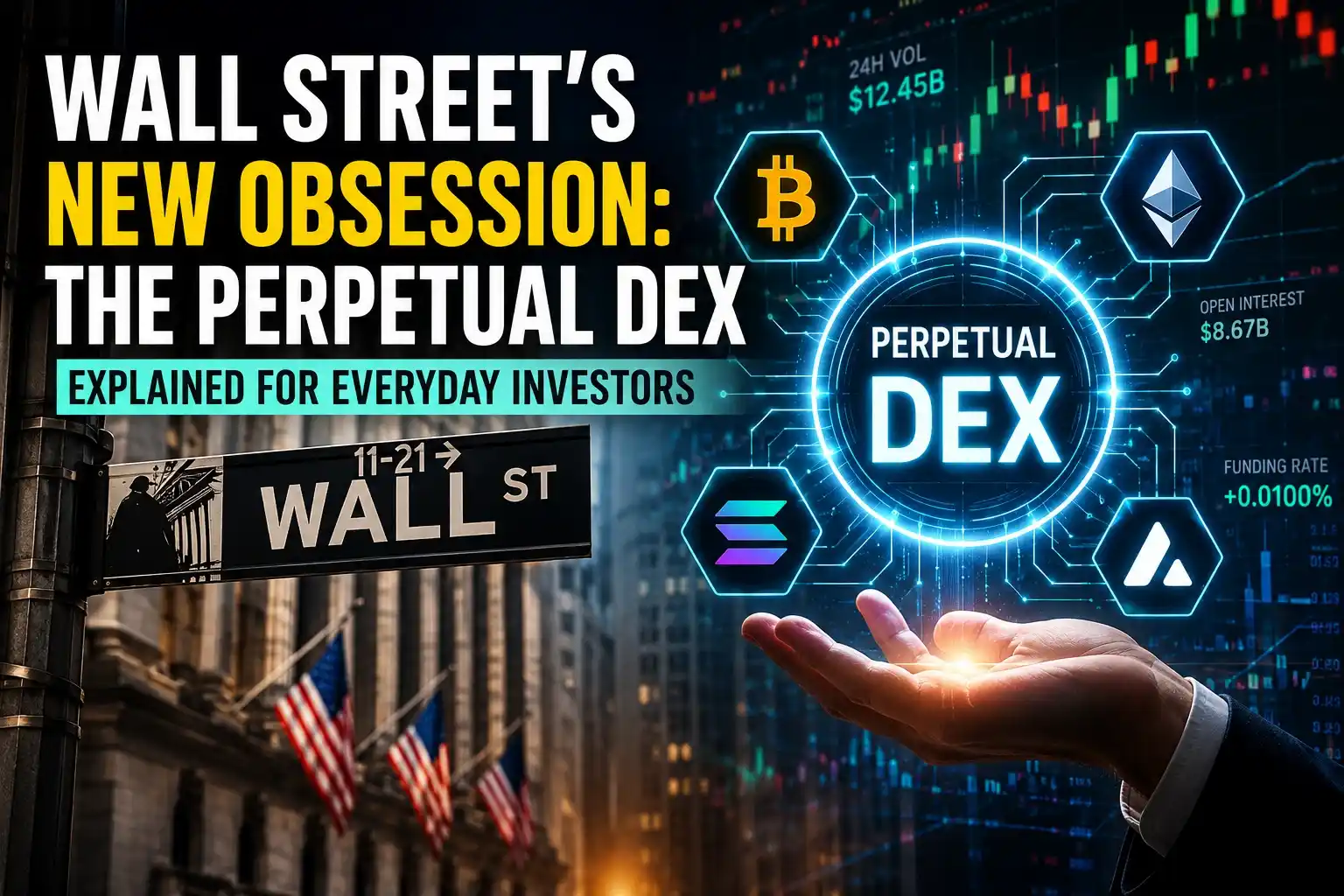
Wall Street firms are increasingly paying attention to perpetual decentralized exchanges as institutional demand for transparent crypto derivatives trading continues to grow in 2026.
Introduction: The Structural Shift in Financial Markets
Wall Street spent decades building centralized trading systems. Now, a new generation of decentralized platforms is beginning to challenge that model directly. In my analysis of global market trends, this technological advancement is one of the most significant structural shifts in digital asset trading we have seen in recent years.
For generations, institutional finance has relied on a vast web of trusted intermediaries. Clearinghouses, prime brokers, and centralized exchanges have traditionally acted as the gatekeepers of capital. However, data indicates a massive transition is currently taking place across the financial landscape.
We are witnessing the accelerated rise of the Perpetual Decentralized Exchange, or “Perp DEX”. This technology has moved far beyond its experimental phases. In 2026, decentralized perpetual exchanges are processing billions in daily trading volume, directly challenging traditional trading venues.
Recently, a comprehensive report published by Yahoo Finance titled “Explained: What is a perpetual DEX? A Wall Street primer featuring Decibel” brought this exact topic to the forefront of mainstream financial discussions. As an analyst observing this transition, I frequently receive questions from traditional investors trying to understand why highly sophisticated traders are rapidly adopting these platforms.
This comprehensive guide breaks down the mechanics of platforms like Decibel in simple American English. We will explore how these platforms operate, why they are capturing institutional market share, and what specific risks investors need to understand before allocating capital.
Decoding the Basics: Spot Markets vs. Derivatives
To fully grasp how a decentralized derivatives exchange operates, we must first build a foundation of basic market terminology. The easiest way to start is by distinguishing between “spot trading” and “derivatives trading.”
Spot trading is the most traditional form of commerce. If you buy a share of a publicly traded company or purchase a physical gold bar, you own that asset immediately. The transaction occurs “on the spot.” Your primary goal is to hold the asset and hope its value increases over time.
Derivatives trading operates on a completely different premise. A derivative is a financial contract that derives its value from an underlying asset, such as a stock, a commodity, or a digital currency. When you trade a derivative, you do not actually own the underlying asset. Instead, you are entering into a binding agreement to speculate on its future price movement.
Strategic Market Analysis: Gold and Silver Prices: Fed Pressure and Market Analysis for 2026
Traditional futures contracts are a common type of derivative. Two parties agree to buy or sell an asset at a predetermined price on a specific future date. When the expiration date arrives, the contract must be settled. In modern digital markets, the primary innovation is the complete removal of that expiration date.
What Makes a Contract “Perpetual”?
In traditional finance, the expiration date forces the settlement of the contract. However, managing expiration dates requires constant attention. Traders who wish to hold a position for a long time must constantly sell their expiring contracts and buy new ones. This logistical headache is known as “rolling over” a contract.
The cryptocurrency industry solved this friction by inventing the “perpetual futures contract,” often just called a “perp.”
As the name suggests, a perpetual contract has no expiration date. You can open a trade and hold it open indefinitely. This innovation allows traders to speculate on the price of digital assets with immense flexibility. You do not have to worry about managing contract lifecycles, rolling over dates, or dealing with physical settlement.
Platforms like Decibel allow users to access these markets with high efficiency. Because the contracts never expire, the user experience feels much closer to trading a regular asset, but with the added structural benefits of derivatives.
The Power and Danger of Leverage
The primary reason traders utilize perpetual contracts is to access leverage. Leverage allows an investor to control a large financial position using a relatively small amount of their own capital.
Think of leverage exactly like securing a mortgage to purchase real estate. If you want to buy a $500,000 house, you do not need half a million dollars in cash. You might put down $50,000 as a deposit, and the bank loans you the remaining $450,000. You now control a $500,000 asset with only a 10% down payment.
A perpetual trading platform operates on a similar principle. A trader can deposit $1,000 of their own capital—known as “margin”—and use 10x leverage to open a $10,000 trading position.
Leverage is a double-edged sword. It amplifies both profits and losses. If the asset’s price moves in the trader’s favor by 10%, the $10,000 position gains $1,000. The trader has just doubled their initial investment. However, if the market moves against the trader by just 10%, the $1,000 loss completely wipes out their initial margin deposit.
When a trader’s margin is depleted, the platform’s automated risk system steps in and closes the trade. This process is known as liquidation. In every professional trading guide, maintaining conservative leverage is highlighted as the absolute cornerstone of professional risk management.
The Shift to Decentralization: Why the Decibel Model Matters
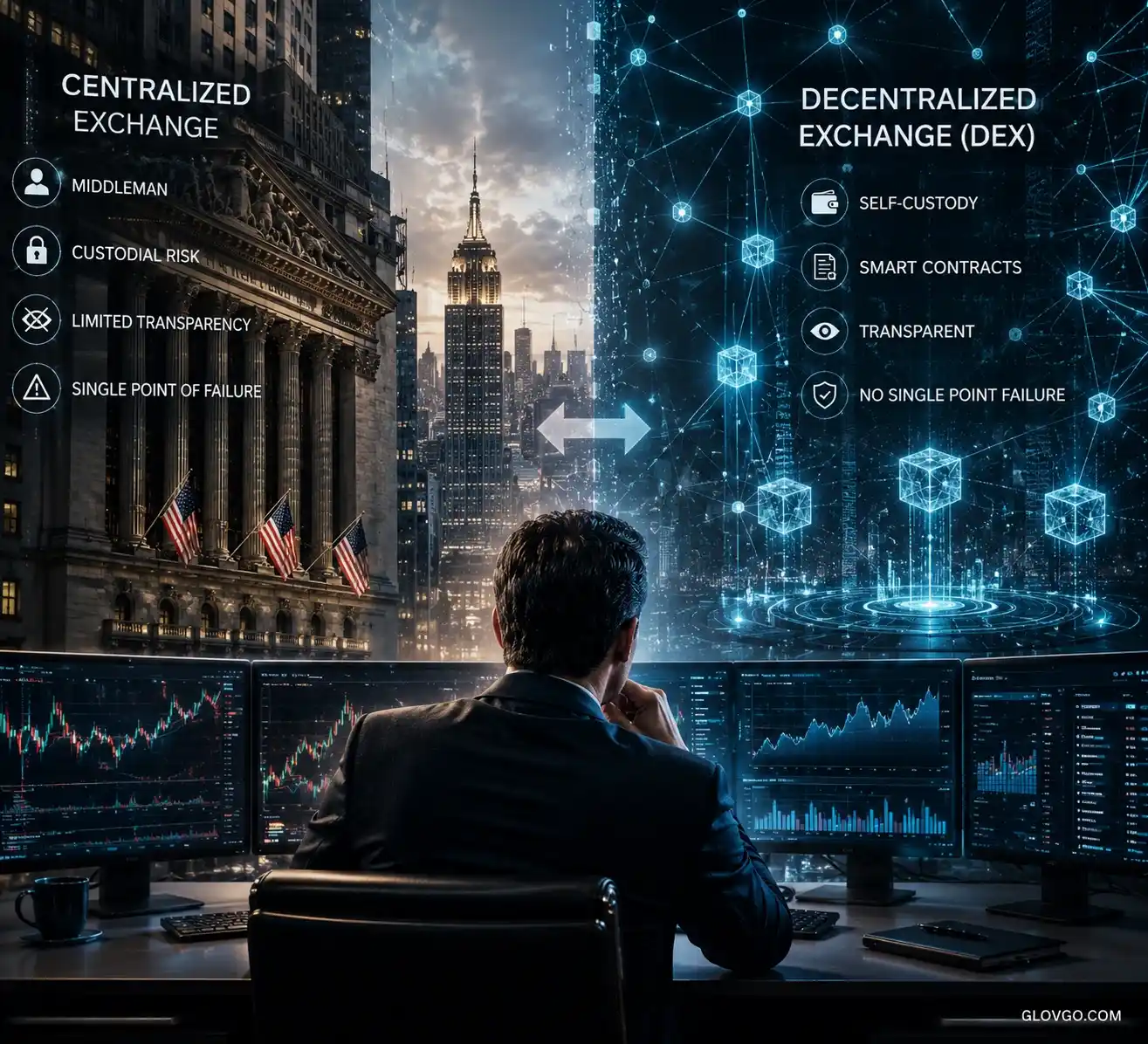
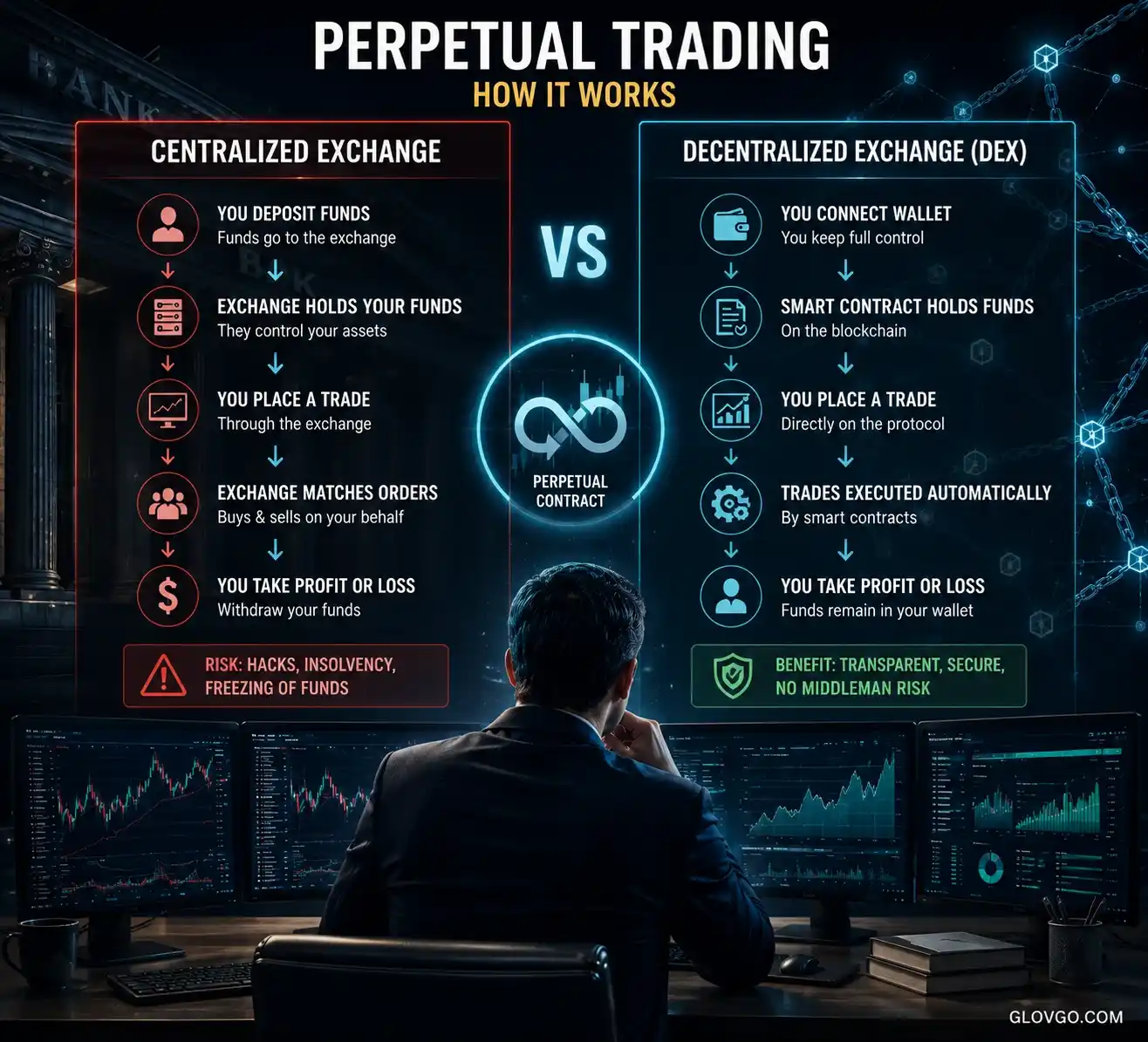
For years, traders could only access perpetual contracts through Centralized Exchanges (CEXs). These platforms act as traditional corporate brokers. When you use a centralized exchange, you must deposit your money directly into their corporate bank accounts or digital wallets. The company holds custody of your assets.
The fundamental flaw in this model is counterparty risk. If the centralized exchange mismanages customer deposits or goes bankrupt, the users lose their money. The catastrophic collapse of major centralized trading platforms over the past few years highlighted this exact vulnerability.
A Decentralized Exchange (DEX) eliminates the middleman. Instead of relying on a corporation, a DEX runs on blockchain technology using “smart contracts”. Smart contracts are simply computer programs that automatically execute transactions when specific mathematical conditions are met.
Blockchain Infrastructure Update: Solana Alpenglow Testnet Upgrade: Enhancing Scalability for DeFi Trading
When you trade on a decentralized futures platform, you never hand your money over to a company. You connect your own private digital wallet to the platform. The smart contract locks your required margin deposit and executes your trades directly on the public blockchain. This is called “self-custody.” It is the primary reason institutional investors are shifting capital toward decentralized infrastructure today.
Decibel and the Pursuit of Greater Transparency
The Yahoo Finance article featuring Decibel illustrates exactly why Wall Street is paying close attention to this specific sector. In the early days of decentralized finance, these platforms were generally slow, expensive to use, and lacked the sophisticated features required by professional traders.
By 2026, the technology has matured. Platforms highlighted in institutional primers, such as Decibel, represent a new generation of market infrastructure. They are actively solving the core accountability problems that currently plague centralized markets.
In centralized systems, risk parameters and liquidation engines operate behind closed doors. The exchange operator can modify rules retroactively or halt trading during volatile events. This lack of transparency erodes user confidence.
Modern platforms offer what the industry calls “greater transparency”. The rules governing margin, trade execution, and liquidations are hard-coded into public smart contracts. Anyone can audit the code to ensure the system is treating all participants equally. Liquidations occur deterministically based on pure mathematics, completely removing human bias from the equation.
The Secret Anchor: How Funding Rates Work
One of the most common questions analysts receive is: If a perpetual contract never expires, how does its price stay aligned with the actual asset? The answer is a mechanical balancing system known as the “Funding Rate”.
Because perpetual contracts trade independently of the actual underlying asset, the price of the contract can occasionally drift away from the true market price based on trader demand. Think of the funding rate as a financial seesaw.
- When the contract price is higher than the spot price: This means there are too many buyers (long positions). To restore balance, the system forces the buyers to pay a small recurring fee to the sellers (short positions). This positive funding rate creates a financial incentive for new sellers to enter the market.
- When the contract price is lower than the spot price: This means there are too many sellers. The system flips, forcing the sellers to pay a fee to the buyers. This negative funding rate incentivizes new buyers to step in and push the price back up.
These funding payments are exchanged directly between traders. The exchange does not keep this money. While the percentage fee per interval appears small, these costs can compound significantly over time for traders utilizing high leverage.
How Orders are Matched in a Crypto Perpetual Market
Behind the scenes, a trading platform must have a method for matching buyers with sellers. The market currently utilizes two primary architectures to achieve this. Both have their own sets of benefits for different types of investors.
1. The Order Book Model
This is the traditional system used by the New York Stock Exchange. The exchange maintains a public list of all the prices at which people are willing to buy (bids) and sell (asks). When a buyer’s price matches a seller’s price, the trade is executed. Some modern decentralized exchanges have successfully brought this high-speed matching engine directly onto the blockchain.
2. Automated Market Makers (AMMs) and Liquidity Pools
This is a unique invention of decentralized finance. Instead of matching a buyer directly with a seller, AMMs use a “liquidity pool”. Investors, known as Liquidity Providers, deposit their own capital into a massive digital pool controlled by a smart contract. When a trader wants to open a position, they trade directly against this pool of money, ensuring instant execution without waiting for a counterparty.
Centralized vs. Decentralized: A 2026 Data Comparison
To understand why the market is shifting, we must compare the operational realities of both environments. The following table provides a professional breakdown of how traditional Centralized Exchanges (CEXs) compare to modern decentralized derivatives platforms in 2026.
| Operational Metric | Centralized Exchange (CEX) | Decentralized Derivatives Exchange (DEX) |
|---|---|---|
| Asset Custody | Exchange holds your funds. | You hold your own funds. |
| Transparency | Opaque risk engines. | Public smart contracts. |
| User Onboarding | Requires extensive identity verification (KYC). | Wallet connection only. |
| Counterparty Risk | High corporate risk. | Dependent on code security. |
Perpetual DEX Risk Overview
As a data-driven analyst, I must state clearly that decentralized finance is not without risk. While we focus heavily on the structural benefits, you must also respect the technical vulnerabilities. These are the current operational realities.
| Risk Type | What It Means for Investors |
|---|---|
| Leverage Risk | Small price movements against your position can trigger rapid liquidation and total loss of margin. |
| Smart Contract Risk | Code vulnerabilities could allow bad actors to compromise the liquidity pools, putting funds at risk. |
| Liquidity Risk | Periods of exceptionally low liquidity can increase volatility and cause slippage during trade execution. |
| Oracle Risk | If external pricing feeds (Oracles) provide incorrect data, the platform may execute trades at the wrong price. |
Frequently Asked Questions (FAQ)
Can I lose more money than I deposit on a decentralized platform?
No. Modern platforms feature automated risk management. If your losses approach the total amount of margin you deposited, the liquidation engine will automatically close your position. This ensures your losses cannot exceed your initial deposit, preventing you from falling into debt with the exchange.
Why use derivatives instead of buying the asset directly?
Spot trading is the safest approach for long-term investors. However, professional traders use perpetual contracts for two specific reasons: the ability to use leverage to increase capital efficiency, and the ability to “short sell” the market to generate potential profit when asset prices are falling.
Do I need a traditional brokerage account to trade?
No. A decentralized trading platform operates entirely outside the traditional banking system. You only need a secure digital wallet and an internet connection. This removes geographical and institutional barriers to entry for global investors.
Are funding rates paid daily?
Funding rates are typically calculated multiple times per day. The standard interval on many platforms is every eight hours. However, some modern protocols settle funding on an hourly basis to maintain tighter price alignment with the spot market.
Conclusion: The Future of Institutional Trading
The financial markets are undergoing a fundamental infrastructure upgrade. The transition from trusting opaque corporate entities to trusting transparent mathematical systems is a massive leap forward. As the Yahoo Finance primer on Decibel clearly indicates, Wall Street is no longer viewing decentralized finance as a fringe experiment. They are viewing it as the baseline future of derivative execution.
Perpetual decentralized exchanges have matured significantly. They now offer the speed, liquidity, and leverage required by professional trading desks without forcing users to surrender custody of their capital. The ability to trade seamlessly with greater transparency is fundamentally reshaping our markets.
This new landscape demands a higher level of personal responsibility. Investors must educate themselves on the mechanics of margin, the compounding costs of funding rates, and the realities of smart contract risks. The tools of Wall Street are now available to anyone, but the discipline required to use them successfully remains unchanged.
Financial Disclaimer
This article is provided for informational and educational purposes only. It does not constitute financial, investment, legal, or tax advice. Digital assets and derivative products are highly volatile and carry a high degree of risk. You could lose all of your deposited capital. Always perform your own due diligence and consult with a certified financial professional before making any investment decisions. No educational guide can guarantee financial success or protect against market losses. Past performance is not indicative of future results.
About the Author