The May 2026 Pivot in Video Monetization
The creator economy may have entered a new phase on May 12, 2026. A report published by The New York Times suggests YouTube is taking a far more active role in connecting advertisers directly with video creators. This move could potentially reshape how billions in sponsorship dollars move across the digital media industry.
Industry observers have been monitoring signs of this shift for several quarters. YouTube appears to be expanding its focus well beyond traditional pre-roll and mid-roll programmatic advertisements. The network is now acting as a deal broker to facilitate high-value brand integrations.
Analysts suggest this model is designed to streamline the connection between sponsors and channels. This platform-native sponsorship model has the potential to alter the traditional reliance on third-party talent agencies and external influencer marketing networks permanently.
What YouTube Has Officially Confirmed So Far
As of May 2026, public reporting has confirmed YouTube’s increasing focus on creator-brand matchmaking tools. However, the company has not publicly disclosed the full operational structure or exact commission rates. The complete long-term rollout timeline for every tier of the system also remains unconfirmed.
Much of the current industry analysis stems from reports published by major media organizations, including The New York Times. Additional commentary comes from creator economy observers and advertising executives reacting to the new infrastructure.
Industry observers believe the strategy could help retain more creator advertising budgets inside Google’s ecosystem. By building the tools natively, the platform aims to create a frictionless environment for media buyers.
Why Major Advertisers Are Paying Attention
- More accurate audience targeting utilizing first-party data
- Reduced reliance on external influencer agencies
- Improved campaign attribution and conversion tracking
- Potentially faster campaign deployment timelines
- Better alignment with advertiser-friendly content standards
The Challenges of the Traditional Agency Model
For the last decade, brand integration on video networks has often been a fragmented process. Marketers historically relied on a patchwork of external agencies, influencer platforms, or direct cold outreach. Advertising executives frequently noted that this method was inefficient and difficult to scale.
One primary concern was the lack of verifiable, pre-campaign audience data. Brands often had to base investments on self-reported media kits, which carried inherent risks regarding demographic accuracy. This lack of transparency has been a consistent friction point for enterprise-level sponsors.
Pricing structures within the traditional agency model were notoriously opaque. Intermediary fees often inflated the total cost of a campaign, leaving marketers frustrated by the lack of clear return-on-investment metrics.
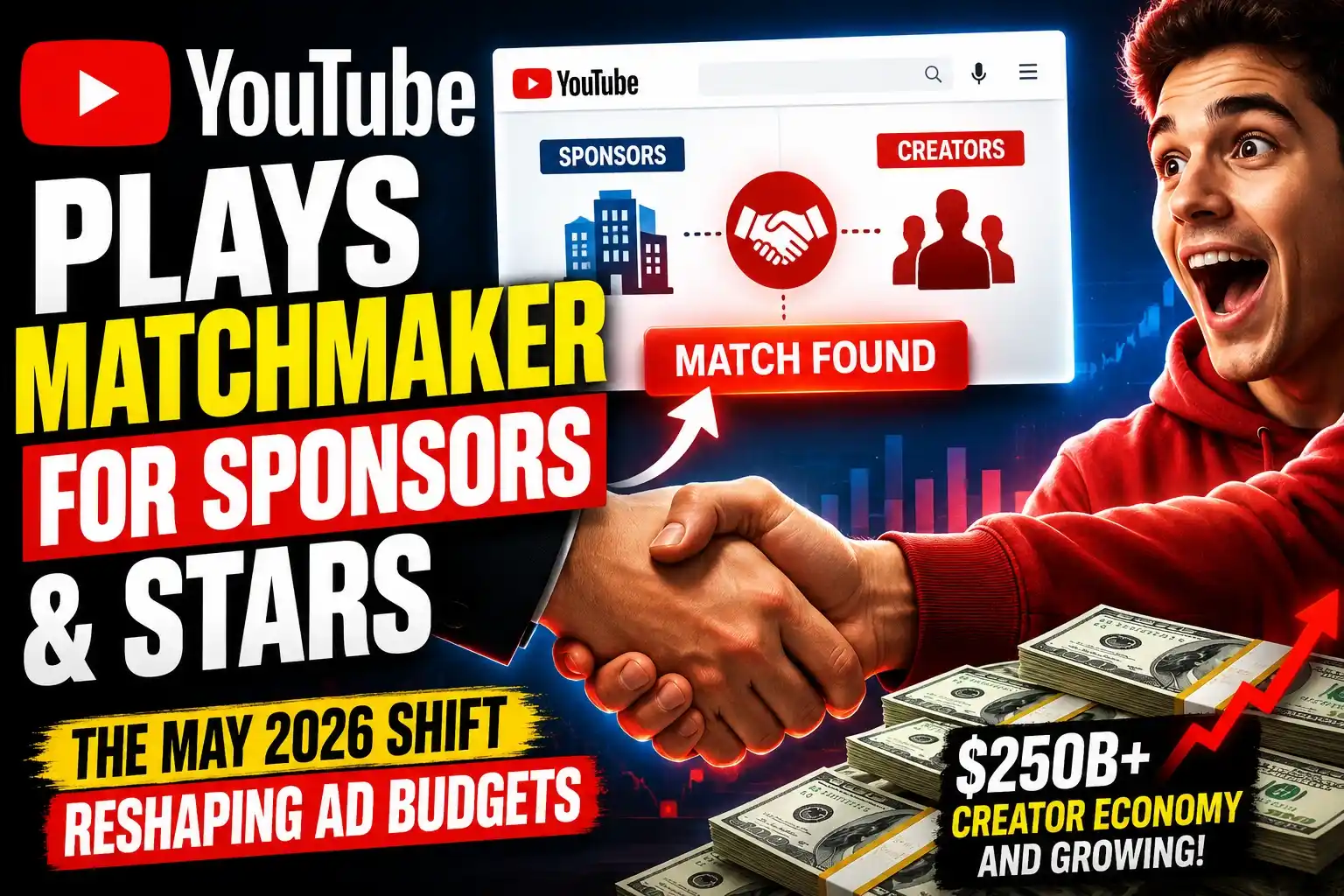
How YouTube Plays Matchmaker Sponsors Stars
The core concept behind the YouTube Plays Matchmaker Sponsors Stars initiative relies on utilizing the company’s extensive first-party data. The goal is to align brands with specific publishers whose viewers closely match the advertiser’s exact target demographic. This data-driven approach aims to remove the guesswork from campaign planning.
When a sponsor initiates a campaign, it is believed the internal system leverages metrics such as watch time, audience retention, and geographic distribution to identify suitable channels. This allows media buyers to deploy capital with the same precision they currently apply to search engine marketing.
For the video talent, this infrastructure offers the potential for verified, legitimate partnership offers delivered directly through their management dashboards. This theoretically reduces the friction of negotiating with external brokers and chasing delayed payments.
Key Details of the Industry Shift
| Data Point | Verified Details |
|---|---|
| Source Publication | The New York Times |
| Publication Date | May 12, 2026 |
| Report Focus | YouTube directly facilitating deals for creators and sponsors |
| Core Objective | Connecting advertisers natively with video talent |
How a Mid-Sized Creator Could Benefit
A technology reviewer with 200,000 subscribers, for example, may historically have relied on outbound outreach or agency representation to secure sponsorships. Under a platform-native matching system, advertisers searching for highly engaged American tech audiences could theoretically discover and contact that creator directly.
This levels the playing field for publishers who produce high-quality content but lack elite Hollywood representation. Instead of spending hours pitching brands, the creator can focus entirely on video production while the algorithm handles the lead generation.
Ultimately, this creates a more sustainable career path for independent media entrepreneurs. A predictable pipeline of direct brand deals provides financial stability that volatile programmatic ad rates simply cannot guarantee.
Why This Matters for the $250 Billion Creator Economy
In Silicon Valley, platform longevity is often tied to the financial stability of the “middle class” of creators. While mega-stars maintain dedicated management, channels with mid-tier subscriber bases often struggle to secure consistent, high-paying brand deals.
Industry analysts believe this creator-brand system could disproportionately benefit these mid-tier publishers. By providing curated sponsorship opportunities, the video network offers a monetization path that supplements traditional revenue streams.
Some observers suggest this is also a highly effective retention strategy. If publishers receive consistent brand integrations directly through the platform’s infrastructure, they are far less incentivized to migrate their primary content focus to competing short-form video applications.
The Appeal for Enterprise Sponsors
Brand safety remains a paramount concern for Fortune 500 marketers in 2026. Sponsoring a creator independently carries the inherent risk of brand association with unmoderated or controversial content. The internal matchmaking system aims to mitigate this risk significantly.
It is understood that the platform’s infrastructure includes mechanisms to ensure a creator’s historical content aligns with established advertiser-friendly guidelines before a match is finalized. This level of automated vetting is incredibly difficult for independent agencies to replicate at scale.
For large advertisers, reliable attribution data now matters more than avoiding small platform fees. Because the transaction and the video hosting occur within the same environment, sponsors expect highly precise conversion tracking and campaign analytics.
Analyzing the Market Impact
| Feature | Traditional Agency Method | Platform-Native System (Expected) |
|---|---|---|
| Data Sourcing | Self-reported media kits | Verified first-party platform data |
| Brand Safety | Manual vetting required | Automated advertiser-friendly screening |
| Payment Processing | Varied external timelines (e.g., Net-60) | Integrated platform payouts |
| Targeting Precision | Broad niche categories | Granular audience retention metrics |
The Potential Impact on Ad-Tech Startups
The reporting surrounding the YouTube matchmaking initiative has prompted serious discussions regarding the future of independent ad-tech firms. For years, venture capital has funded software platforms designed exclusively to connect brands with influencers.
If the primary video network builds a highly efficient native integration tool, third-party software may face significant headwinds. Industry analysts expect increased consolidation pressure across influencer marketing software firms if platform-native sponsorship systems continue expanding.
It is highly likely that smaller ad-tech companies will need to pivot their service offerings quickly. They may need to focus on platforms lacking native matchmaking tools or position themselves strategically for potential acquisitions by larger marketing conglomerates.
Skepticism from the Advertising Industry
Some advertising executives caution that increased platform control over sponsorship relationships could eventually reduce pricing flexibility for creators and agencies. Placing too much power in a single centralized system always carries risks for the broader free market.
There are also concerns regarding data portability and negotiation leverage. If a platform completely controls the introduction, the analytics, and the payment processing, publishers may find it difficult to negotiate higher rates based on external metrics.
Whether the system ultimately benefits all participants equally remains an open question. Early signals indicate massive efficiency gains, but long-term market dynamics will depend heavily on the final fee structures implemented by the platform.
How Publishers Can Optimize for the New Model
To maximize visibility within an algorithm-driven matching framework, digital video talent must refine their channel strategies. A clear, consistent content vertical is generally more attractive to automated systems than a disorganized mix of topics.
- Maintain a highly defined niche to attract specific corporate sponsor categories.
- Ensure historical videos comply strictly with advertiser-friendly guidelines to facilitate smoother automated vetting.
- Prioritize audience retention and engagement metrics over pure click-through rates.
- Accurately define and update audience demographics within available channel settings.
By structuring their channels as focused, professional media properties, publishers significantly increase their likelihood of being selected by the automated infrastructure.
The Future of Pricing Standardization
A persistent issue in influencer marketing has been the wild inconsistency of sponsorship rates. Marketers frequently note that creators with nearly identical viewership metrics often charge vastly different fees, heavily complicating quarterly budget forecasting.
If a centralized system takes a more dominant role in brokering deals, industry executives anticipate a potential normalization of sponsorship rates. By leveraging extensive historical performance data, the platform could theoretically establish clear, transparent market baselines.
This potential for increased predictability is highly attractive to Wall Street. It may encourage larger advertisers to allocate more substantial portions of their traditional television media budgets directly toward digital creator partnerships.
The Evolution of Talent Management
Traditional talent agencies in Los Angeles have aggressively expanded their digital creator rosters over the past five years. Their business model typically relies heavily on commissions earned from sourcing and negotiating brand partnerships.
If lucrative deals are increasingly served directly to a creator’s dashboard, the perceived value of external brokering may diminish rapidly. Agencies will be forced to pivot their value propositions away from simple deal sourcing and email forwarding.
Forward-looking management firms are expected to focus more heavily on intellectual property development, consumer product lines, and offline event production. They must offer services that an algorithm simply cannot replicate to justify their commission structures.
Looking Ahead: The Integrated Video Economy
The broader implications of this creator partnership infrastructure point toward a fully integrated advertising environment. Analysts predict future iterations may include deeper artificial intelligence tools that allow sponsors to generate automated creator rosters based on a single campaign brief.
Performance-based pricing models may also become the industry standard. Instead of flat upfront fees, marketers might eventually pay dynamically based on verified sales generated through native tracking tools. This shifts the financial risk away from the advertiser entirely.
The Final Verdict on Platform Monetization
When YouTube Plays Matchmaker Sponsors Stars, it signals a massive maturation phase in the digital video ecosystem. As networks build more sophisticated internal tools, the reliance on external intermediaries is likely to decrease dramatically over the next few years.
Whether YouTube’s matchmaking infrastructure becomes the dominant sponsorship model or simply another layer in the creator economy, the direction is becoming increasingly clear. Platforms no longer want to just host content; they want to control the business relationships built around it.
Publisher Disclaimer
Disclaimer: The information provided in this article is for educational and informational purposes only and does not constitute financial, legal, or professional business advice. While data and market projections are sourced from verified public reports as of May 2026, the digital advertising market is highly volatile and subject to rapid regulatory and structural changes. Readers should consult with certified financial advisors or legal counsel before making investment decisions or restructuring business operations based on industry trends.
About the Author