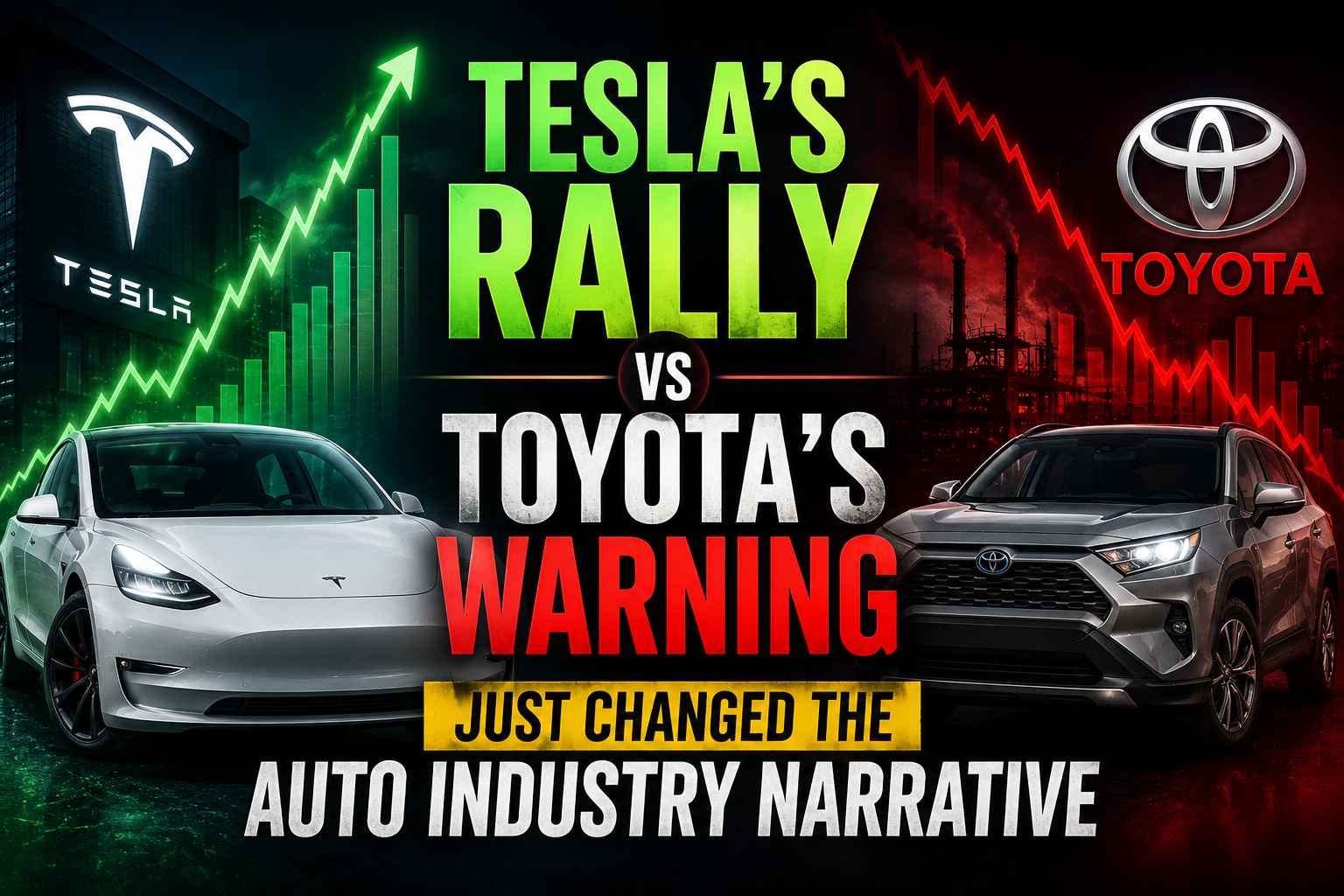
Tesla’s market rally and Toyota’s profit warning reveal how software, EV strategy, and supply-chain intelligence are reshaping the global auto industry.
For Years, Wall Street Assumed the Auto Industry Was a Simple Race for EV Volume. May 15, 2026, Just Shattered That Story.
On May 15, 2026, two companies long cast as opposites delivered the same blunt message: the future of the automobile will not be decided by who builds the most cars. It will be decided by who builds the smartest system around them.
Toyota, the world’s largest automaker by volume with more than 11 million vehicles sold annually, reported fiscal 2026 operating income of roughly $24 billion — missing Wall Street estimates by about $2 billion. The real jolt came in guidance. For fiscal 2027, Toyota projected operating profit of only $19 billion, a number 37 percent below analyst consensus and implying a 21 percent drop from this year and a 42 percent decline from recent peaks. Tariffs alone wiped out an estimated $9 billion from this year’s results.
At the same time, Tesla shares rose 4 percent to close at $428.35. The market wasn’t reacting to noise. It was rendering a verdict on which business model investors now believe will compound value over the next decade.
The Earnings Shock That Exposed Legacy Vulnerabilities
Toyota spent decades perfecting lean manufacturing, global supply chains, and operational discipline. Those strengths are now colliding with forces no amount of factory efficiency can fully neutralize. Tariffs, geopolitical friction, and softening demand have created margin compression that even the most disciplined legacy manufacturer cannot ignore.
The $9 billion tariff hit alone represented more than one-third of Toyota’s fiscal 2026 operating profit. This isn’t a passing storm. Investors are beginning to realize this pressure may last longer than many expected. When the world’s most efficient automaker signals that even it cannot fully absorb these costs, every other legacy player has to recalibrate what “scale” actually protects in an era of policy volatility.
Tesla’s Quiet Verdict and the Software Premium
Tesla’s 4 percent gain on the same day Toyota lowered guidance spoke volumes. Capital is quietly moving toward companies that treat the vehicle as a platform for recurring revenue, data, and autonomy instead of a one-time hardware transaction.
Tesla has already proven that software and energy businesses can deliver gross margins well above the 8–12 percent typical of traditional vehicle sales. Full Self-Driving subscriptions, over-the-air updates, and Megapack energy storage now generate meaningful high-margin revenue that legacy automakers have only started exploring at scale. The market is pricing in the possibility that Tesla’s logic — future cash flows from software and autonomy — may prove more durable than the operational-stability story that once shielded companies like Toyota.
The Real Problem May Not Be EV Demand
While headlines focus on slowing EV sales, the deeper issue is more mundane and more stubborn. Many middle-income households are not rejecting electric vehicles outright. They are simply hitting practical walls that executives often under-estimate: financing costs at current interest rates, charging infrastructure gaps in daily life, higher insurance premiums, and uncertainty about long-term battery value.
Used EV prices have fallen sharply in 2026, reflecting both rising supply and buyer hesitation. Hybrid models, by contrast, continue posting double-digit gains in the U.S. and Europe as buyers seek electrification without the full leap. The transition is not reversing — it is proving slower and more complicated than the simple “EV volume race” narrative once promised. That complexity is now showing up in earnings calls and guidance revisions across the industry.
Consumer Reality Behind the Numbers
Institutional investors track margins and multiples. Retail investors feel the friction every time they shop for a car. Elevated interest rates have made monthly payments on new vehicles feel punishing for many households. At the same time, charging infrastructure outside major metros still creates daily anxiety for potential buyers. The result is a market that is electrifying, but not at the speed or uniformity that early forecasts assumed.
Industry data for early 2026 shows EV adoption growth decelerating from the torrid pace of prior years, while hybrids post strong gains. This consumer caution is feeding directly into slower demand and inventory pressure for pure battery-electric models.
Industry Pressure Points Defining 2026
The auto sector is navigating multiple stresses at once. The table below captures the key forces reshaping profitability across legacy and new entrants alike.
| Pressure Point | Impact on Automakers | 2026 Reality |
|---|---|---|
| Tariffs and Trade Policy | Margin compression | $9B+ direct hit to Toyota; similar exposure across global supply chains |
| EV Demand Slowdown | Inventory risk and pricing pressure | Adoption growth decelerating; used EV prices down sharply year-over-year |
| High Interest Rates | Lower affordability | Auto loan rates remain elevated, pushing buyers toward hybrids or used vehicles |
| Battery and Component Costs | Pricing pressure | Raw material volatility continues to squeeze hardware margins |
| Chinese EV Competition | Market-share erosion in key regions | BYD and others expanding aggressively in Europe and emerging markets |
The Software-Defined Vehicle Thesis
For most of automotive history, competitive advantage came from factories and hardware precision. That equation is now changing. The next leaders will combine world-class manufacturing with software platforms that generate recurring revenue long after the vehicle leaves the factory.
Tesla has already shown the economics: software subscriptions and autonomy features can deliver gross margins significantly higher than traditional vehicle sales. Legacy manufacturers are racing to close this gap through partnerships, acquisitions, and internal development of over-the-air capabilities. The companies that succeed will treat the automobile as a rolling data and service node rather than a finished product.
Where Future Auto Profits Are Likely to Come From
The revenue migration is already visible. The table below shows how profit pools are shifting.
| Revenue Stream | Traditional Model | Next-Gen Model |
|---|---|---|
| Vehicle Sales | Primary profit driver | Secondary; lower margin |
| Software Subscriptions | Minimal | High-growth, high-margin |
| Data Monetization | Limited | Strategic and expanding |
| Fleet and Mobility Services | Low | Significant growth opportunity |
| Autonomous Systems | Experimental | Long-term competitive moat |
Supply-Chain Intelligence Becomes a Core Competency
Forward-thinking automakers are no longer treating supply-chain management as a back-office function. They are embedding advanced enterprise systems that provide real-time visibility and predictive modeling across global operations. Platforms from providers such as SAP and specialized analytics environments are being deployed to simulate tariff scenarios, geopolitical disruptions, and demand shocks before they hit earnings.
Manufacturing execution systems and digital twin technologies now allow factories to model production changes in hours rather than weeks. Predictive logistics tools help reroute components around sudden policy shifts. Companies investing in these capabilities are gaining measurable advantages in margin protection and responsiveness — advantages that pure manufacturing scale can no longer guarantee on its own.
Tesla vs Toyota: The New Competitive Reality
| Metric | Tesla | Toyota |
|---|---|---|
| Market Narrative | Software-led growth | Manufacturing scale |
| Revenue Driver | EV + software + energy | Vehicle sales |
| Margin Pressure | Price cuts and R&D intensity | Tariffs and macro headwinds |
| Investor Focus | AI, FSD, autonomy, energy | Global volume and operational stability |
| Valuation Logic | Future cash flow from software and services | Current earnings and dividend stability |
Why Wall Street — and Retail Investors — Are Paying Close Attention
Institutional investors are re-evaluating capital allocation across the auto sector. Valuation multiples are expanding for companies demonstrating clear paths to recurring software revenue and contracting for those still dependent on one-time hardware sales. Software margins, autonomous capability roadmaps, and exposure to high-growth energy storage are now central to how analysts model long-term returns.
Retail investors who once viewed automakers as simple cyclical businesses are now being forced to evaluate them more like software infrastructure companies. The macro environment — elevated interest rates, policy uncertainty, and uneven EV adoption — is pushing everyone toward a more disciplined view of where durable profits will actually come from in the decade ahead.
Long-Term Outlook: The Companies That Will Dominate
The evidence that emerged on May 15, 2026, is difficult to ignore. The auto industry is moving from a volume-driven business to a system-driven business. Manufacturing excellence remains essential, but it is no longer enough on its own. The organizations that combine world-class production with intelligent software platforms, resilient supply chains, and recurring revenue models will capture disproportionate value.
Hybrid demand, slower-than-expected EV adoption in key markets, and persistent trade tensions are not temporary noise. They are signals that the simple race for electric vehicle volume has given way to a more complex competition around intelligence, adaptability, and ecosystem control.
The companies that dominate the next decade may not be the ones building the most cars. They may be the ones building the smartest transportation systems around them.
— Elite B2B Market Strategist & Wall Street Analyst
Data current as of May 15, 2026. All figures sourced from company earnings releases and verified market reports.
Article Description
Tesla’s 4% stock rally and Toyota’s sharply lower fiscal 2027 profit guidance on May 15, 2026, exposed a fundamental shift in the global auto industry. This in-depth analysis examines the earnings shock, the real consumer barriers behind slower EV adoption, the rise of software-defined vehicles, supply-chain intelligence investments, and what it means for both institutional and retail investors. Includes detailed comparative tables and forward-looking profit-pool migration. Essential reading for anyone tracking the automotive transition and the new economics of transportation in 2026.
About the Author