A social media image shared by Donald Trump featuring the word “Adios” has sparked debate over Iran, regional security, and the strategic importance of the Strait of Hormuz.
Trump’s ‘Adios’ Post Draws Attention as Questions Swirl Over Iran and the Strait of Hormuz
A dramatic image shared on social media reignited debate over Iran, maritime security, and the future of one of the world’s most important oil transit routes.
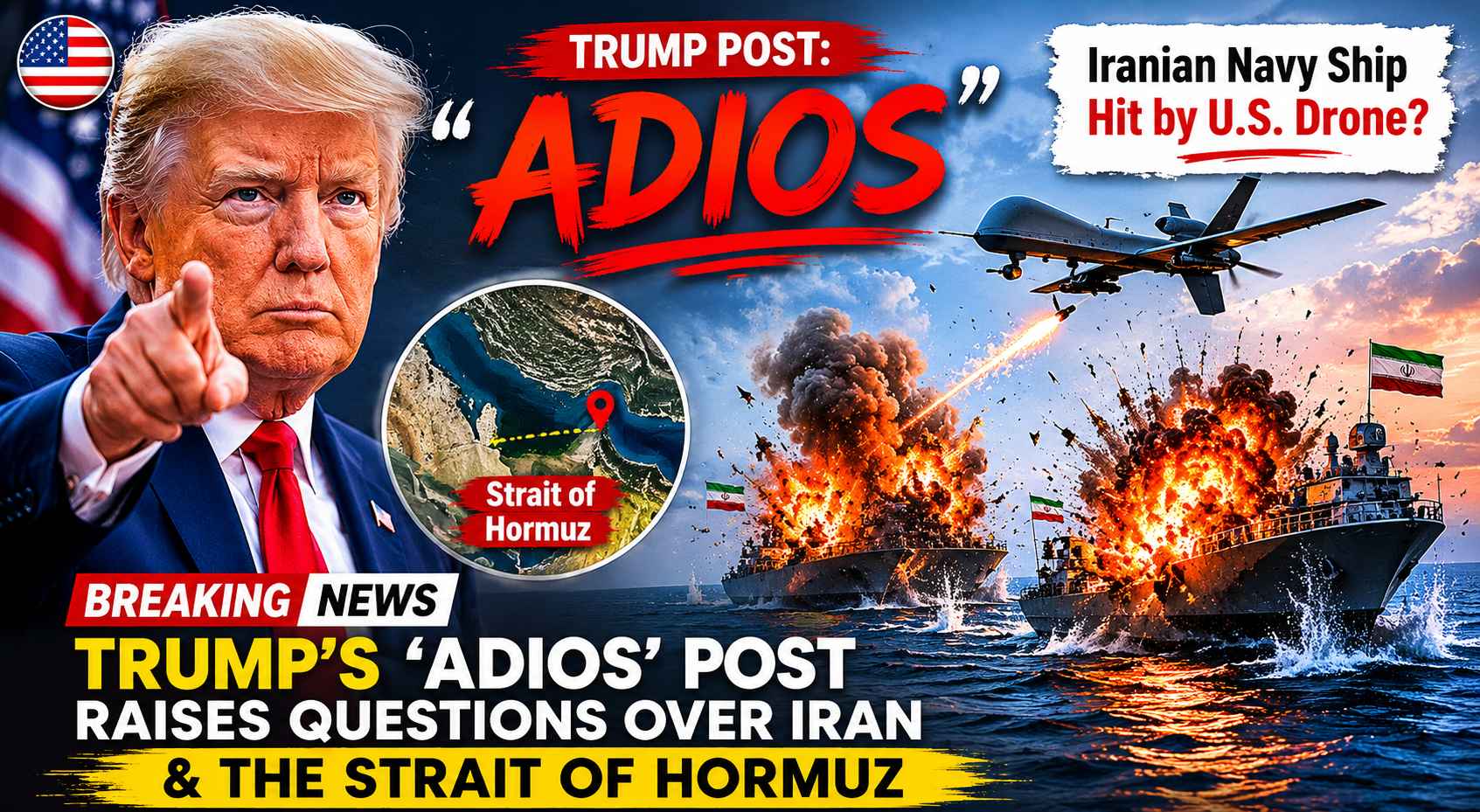
Donald Trump has once again drawn international attention through his social media activity. On Truth Social, the former president shared a dramatic image depicting a U.S. military drone striking an Iranian vessel. Positioned above the fiery maritime scene was a single word: “Adios.” The post quickly generated discussion among political observers, foreign policy analysts, and social media users as they debated its meaning and timing.
The image attracted attention well beyond political circles. In today’s geopolitical environment, digital messages from prominent public figures are often examined for clues about policy priorities, political positioning, and broader strategic narratives. The timing of the post fueled additional discussion because it appeared shortly after a very different narrative had been circulating online.
The post followed reports and social media discussions regarding potential diplomatic developments involving regional security and maritime transit routes. Some online claims suggested that a “memorandum of understanding for PEACE” had been reached and that the Strait of Hormuz could see greater stability and openness for commercial shipping. While those claims remained unverified at the time of publication, the contrast between discussions of diplomacy and imagery depicting military action sparked significant debate about the broader direction of U.S.–Iran relations and regional security.
What Trump Posted and the Rise of Digital Political Imagery
The image shared on Truth Social portrays a dramatic military-style scenario. It shows an unmanned aircraft flying above a body of water while naval vessels displaying Iranian flags appear caught in a powerful explosion. The scene is cinematic, visually striking, and designed to command attention.
The image appeared to be a digitally created illustration rather than a real-world photograph. Its rapid circulation highlights how digital imagery is becoming an increasingly influential tool in modern political communication. Rather than relying solely on traditional photographs or official footage, public figures and political movements are increasingly using visually compelling digital content to communicate messages and shape online discussion.
In an election year, digital imagery has increasingly become a tool for political communication, allowing campaigns and public figures to share visual narratives directly with their audiences. Such content often spreads rapidly online, shaping public discussion far beyond the platform where it first appears. The combination of military symbolism and the brief caption “Adios” transformed a single image into a widely debated political statement.
Why This Story Is Getting Attention Worldwide
The widespread interest surrounding the post stems from the convergence of several major geopolitical themes: Donald Trump, Iran, the Strait of Hormuz, global energy markets, and the growing role of digital imagery in political communication.
Each of these topics individually attracts significant international attention. Combined, they create a story with implications extending beyond social media. Energy traders, political observers, diplomats, and journalists closely monitor developments involving the Strait of Hormuz because of its strategic importance to global trade and energy supplies.
At the same time, the use of dramatic digital imagery reflects broader changes in how political narratives are communicated. In an era where online content can influence public perception within minutes, visual messaging often becomes part of the geopolitical conversation itself.
The Meaning Behind the “Adios” Message
The timing of the post remains one of its most discussed aspects. Releasing imagery depicting a military strike shortly after online discussions of diplomatic progress naturally invited questions about the intended message.
Political communication frequently combines contrasting themes such as strength and diplomacy. While some observers interpreted the image as a projection of military power, others viewed it primarily as symbolic political messaging directed toward supporters and online audiences. Because no official policy announcement accompanied the image, interpretations largely depended on individual political perspectives.
Either way, the post underscored how military-themed imagery continues to influence public perceptions of national security, deterrence, and foreign policy in an increasingly digital political environment.
Why the Strait of Hormuz Matters to the Global Economy
Understanding the significance of this discussion requires understanding the importance of the Strait of Hormuz. Situated between Iran and Oman, the narrow waterway serves as one of the world’s most critical maritime trade routes, connecting the Persian Gulf with global markets.
According to international energy data, roughly one-fifth of global oil consumption passes through the Strait each day. Any disruption involving shipping traffic can immediately affect energy prices, supply chains, and market sentiment around the world.
Because of this strategic importance, discussions regarding security, stability, and freedom of navigation in the region attract close international attention. Against this backdrop, the social media post added another layer to an already complex discussion surrounding regional security, maritime stability, and the protection of global trade routes.
The Broader Context of U.S.–Iran Tensions
The relationship between the United States and Iran has been shaped by decades of political disagreements, economic sanctions, regional conflicts, and periodic military tensions. The Persian Gulf has often served as one of the most visible arenas where these tensions play out.
Iran’s Islamic Revolutionary Guard Corps (IRGC) Navy has previously been involved in incidents involving commercial shipping and encounters with Western naval forces operating in the region. At the same time, the United States has maintained a significant military presence aimed at protecting maritime navigation and regional stability.
The imagery used in the recent Truth Social post inevitably evokes memories of previous periods of confrontation. Historical events such as tanker-related conflicts in the Persian Gulf and more recent military incidents continue to influence how observers interpret modern political messaging. The image therefore resonates not only because of what it depicts, but because of the historical context surrounding U.S.–Iran relations.
Timeline of Recent Developments
Observers tracking the discussion have highlighted the following sequence of events:
- Day 1: Online discussions and reports circulate claiming potential diplomatic progress related to regional stability and maritime transit through the Strait of Hormuz.
- Day 2: Donald Trump shares the “Adios” image on Truth Social, depicting a military-style strike involving an Iranian vessel.
- Following Hours: Political commentators, journalists, and social media users debate the meaning of the image and its relationship to broader regional developments.
Potential Impact and Strategic Questions
For analysts, the significance of the post lies less in the image itself and more in the questions it raises about communication, perception, and geopolitical signaling. Modern financial markets often react not only to concrete events but also to uncertainty and rapidly spreading narratives.
As a result, visually striking political content can influence discussions surrounding energy markets, security policy, and diplomatic developments even when no official policy changes have occurred. This dynamic reflects the growing intersection between social media communication and international affairs.
Foreign policy experts have long noted that public messaging can shape perceptions among allies, rivals, investors, and voters. In highly sensitive regions such as the Middle East, symbolic messaging is frequently analyzed alongside formal diplomatic statements and official government actions.
Conclusion
Whether the image was intended as political symbolism, strategic messaging, or simple social media provocation, it succeeded in attracting attention far beyond the platform where it was posted. The discussion surrounding the post illustrates how digital communication continues to influence public understanding of international affairs, often blurring the boundaries between political messaging, public perception, and geopolitical debate.
As conversations surrounding maritime security, regional stability, and U.S.–Iran relations continue, observers will be watching both official policy developments and the online narratives that increasingly shape public discourse. In an age where a single image can dominate headlines around the world, the relationship between digital rhetoric and geopolitical reality remains a subject of growing importance.
Source Note: The social media post discussed in this article was shared on Truth Social and later circulated across X and other online platforms. Information regarding diplomatic developments referenced in online discussions had not been independently verified at the time of publication. Readers should distinguish between official government statements and claims circulating on social media, as online discussions may evolve rapidly and may not reflect formal policy positions.
About the Author