Bitcoin retail demand weakens sharply as futures traders increase bearish positioning across the crypto market.
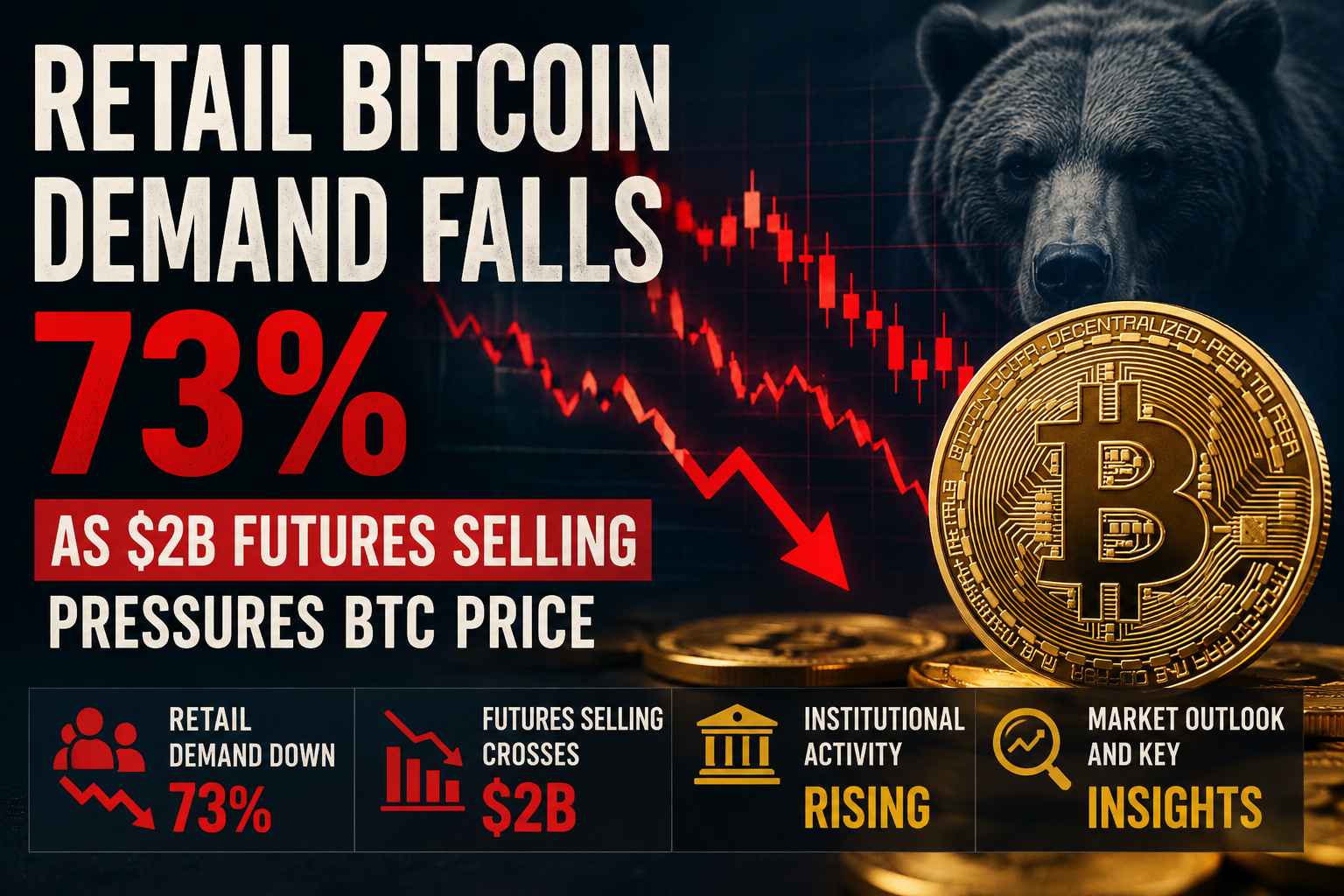
Retail Bitcoin Demand Falls 73% as $2 Billion Futures Selling Pressures BTC Price
Bitcoin’s retail momentum is fading fast. New exchange data shows everyday investors stepping back from the spot market just as futures traders ramp up bearish positioning worth billions.
It is a stark contrast that has trading desks asking a familiar question: Are the bears officially back in control?
A recent market report highlighting a 73% drop in retail Bitcoin demand on major exchanges has raised immediate concerns regarding near-term price stability. Concurrently, futures selling pressure spiked, with taker sell volume surpassing the $2 billion mark.
A superficial reading of this data might suggest a simple return to a bear market. A closer examination of the underlying metrics reveals a much more nuanced reality. The market structure is shifting. Custody preferences are changing. And the derivatives market is heavily influencing daily price action.
Key Takeaways
- Retail Bitcoin demand on Binance has fallen sharply in recent weeks, hitting historical lows.
- Futures selling pressure crossed the $2 billion threshold during the exact same period.
- Spot ETF adoption may be fundamentally changing how retail participation is measured.
- Thin liquidity conditions continue to increase the risk of short-term volatility.
Analyst Perspective
One of the most important shifts in the current market cycle is that offshore exchange activity no longer reflects total retail exposure to Bitcoin. Spot ETF adoption has significantly altered how participation is distributed across the broader financial system. Analysts tracking exchange flows are only seeing a fraction of the actual capital movement.
Deconstructing the Retail Sentiment Pullback
Understanding the current market environment requires a precise look at how retail investor sentiment is actually quantified.
Analysts generally measure retail participation by tracking wallet addresses holding less than one full Bitcoin, alongside fiat inflows from non-institutional accounts on primary exchanges. Recent figures provided by on-chain analysts paint a clear picture of retail exhaustion.
The 30-day net demand growth for retail investors plummeted by 73% during a brief three-week window in early 2026. Specifically, the 30-day change in retail investor demand dropped to 3.12%, down sharply from 7.39% just weeks prior. That earlier 7.39% reading had marked the strongest expansion in retail demand since August of the previous year.
The rapid decline points to a significant weakening in spot participation.
When spot demand from smaller participants evaporates this rapidly, it removes a critical layer of foundational support. Retail buyers typically act as organic spot accumulators. Their sudden absence leaves the asset highly vulnerable to the outsized influence of leveraged entities operating within the futures market.
Historical Context: Binance Activity Across Market Cycles
To accurately gauge the severity of the current retail pullback, current exchange activity must be measured against historical baselines. Binance serves as one of the most reliable barometers for global retail crypto engagement.
Current metrics indicate that retail activity on the platform has fallen to some of the lowest levels recorded in its operational history.
Monthly retail BTC inflows on Binance currently average a mere 314 BTC. To put this figure into perspective, during the local market top in March 2024, retail inflows averaged around 1,200 BTC per month. Even during the darkest depths of the 2022 bear market, retail inflows hovered near 1,800 BTC.
Looking back at previous cycles reveals an even starker contrast. During the retail-driven euphoria of 2021, inflows peaked near 2,600 BTC. The 2018 cycle saw peaks approaching 5,400 BTC.
The current 314 BTC average represents a fundamental departure from historical retail behavior. It suggests that while overall market capitalization remains elevated, the composition of the market participants driving that value has profoundly changed.
The ETF Migration: A Structural Shift in Retail Custody
While the nominal drop in exchange inflows appears alarming, the data requires critical contextualization. A decline in direct exchange deposits does not automatically mean that retail capital is exiting the asset class entirely.
A significant portion of this shift is structurally tied to the maturation of spot Bitcoin exchange-traded funds (ETFs) in the United States and other regulated markets.
Prior to the approval of spot ETFs, everyday investors seeking exposure to Bitcoin had little choice but to create accounts on native cryptocurrency exchanges, fund those accounts, and manage direct spot purchases. That activity was easily trackable via on-chain analytics.
Today, a retail investor can gain exposure to Bitcoin price movements directly through their traditional retirement accounts or standard brokerage platforms. Buying shares of a regulated ETF removes the friction of self-custody. Consequently, as retail capital migrates toward traditional financial infrastructure, native exchange inflows naturally decline.
Everyday buyers haven’t necessarily abandoned crypto. They are just using Wall Street’s plumbing instead of offshore exchanges.
Treasury Yields Spook Crypto: $550M Wiped in Overnight Market Correction
Analyzing the $2 Billion Futures Market Pressure
While retail spot purchasing has slowed to a crawl, activity in the derivatives market remains highly elevated.
Recent exchange data highlighted by market analysts noted two massive spikes in Bitcoin taker sell volume, culminating in over $2 billion in futures selling pressure. Understanding the mechanics of taker sell volume is essential for assessing short-term market direction.
In orderbook mechanics, a “taker” is a market participant who executes an order immediately against the resting liquidity on the order book. When taker sell volume spikes aggressively, it indicates that traders are willing to cross the spread and accept the current bid price to enter short positions or exit long positions rapidly.
This behavior signifies urgency. Historically, it acts as a leading indicator of downward price momentum.
The injection of $2 billion in futures selling creates a heavy gravitational pull on the spot price. When large entities deploy capital on the short side of the derivatives market, the underlying spot market must absorb the corresponding pressure. Without a robust presence of retail spot buyers to act as a counterweight, prices typically trend downward to find new areas of liquidity.
Why Wall Street is Watching the Rise of Programmable Bitcoin Privacy
Spot vs Futures Analysis: The Growing Market Divergence
The current cryptocurrency landscape is characterized by a distinct divergence between spot market lethargy and futures market aggression.
When spot demand lags behind futures positioning, the market is described as derivative-led. Derivative-led markets are inherently unstable because price action is driven by leverage rather than the organic transfer of the underlying asset.
This divergence often leads to complex basis trading strategies. An institutional fund might hold a long position in a spot Bitcoin ETF while simultaneously opening a short position in the futures market to capture the yield spread or hedge against downside risk.
Institutional hedging can appear as massive selling pressure on futures exchanges, even if the entity maintains a neutral or slightly bullish long-term outlook on the asset.
However, if the spot price fails to hold technical support levels, the downward momentum initiated by the futures market can trigger cascading liquidations among over-leveraged long traders, accelerating the price decline.
Macroeconomic Conditions Dictating Market Liquidity
The contraction in retail demand cannot be analyzed in a vacuum.
It is heavily influenced by the broader macroeconomic conditions currently shaping global financial markets. The transition from an era of zero-percent interest rates to a restrictive monetary policy environment has fundamentally altered capital allocation strategies.
High interest rates set by central banks directly impact the discretionary income of the average consumer. As the cost of housing, credit, and daily living expenses remains elevated, retail investors simply have less disposable capital to allocate toward high-risk, volatile assets.
Additionally, the current yield curve offers attractive, risk-free returns in traditional fixed-income markets. When retail and institutional investors can secure stable yields in money market funds or short-term treasury bills, the opportunity cost of holding non-yielding digital assets increases.
Until macroeconomic indicators signal a definitive shift toward global liquidity expansion, organic retail participation in the spot crypto market may remain subdued.
[Wall Street’s $109 Oil Shock: Why the Hormuz Crisis Just Broke the Soft Landing Narrative
The Impact of Thin Liquidity on Crypto Volatility
One of the primary consequences of reduced retail spot demand is the thinning of exchange order books.
Market depth refers to the volume of resting buy and sell orders at various price levels. When retail participants step away from the market, the overall liquidity on primary exchanges typically decreases.
Thin liquidity environments amplify crypto volatility. In a highly liquid market, a $50 million sell order might move the price by a fraction of a percent. In an illiquid market, that same order can slice through multiple price levels, causing a sudden and severe price drop.
This dynamic is particularly concerning when combined with elevated futures market pressure. Institutional traders are highly aware of this dynamic and often utilize periods of low liquidity to execute algorithmic strategies designed to test critical support and resistance levels.
Evaluating Risks in a Derivative-Heavy Environment
Navigating a market characterized by low spot demand and high derivatives activity requires a clear understanding of the associated risks.
The primary risk in this environment is the potential for liquidation cascades. When the market is derivative-led, a significant portion of the open interest is built on borrowed capital.
If the aggressive short selling pushes the spot price below key technical thresholds, traders holding leveraged long positions will face margin calls. To cover these margin requirements, exchanges will automatically close their positions by selling the underlying asset at market price. This forced selling introduces new downward pressure, which can trigger further liquidations.
Conversely, if spot buyers suddenly step in and drive the price upward, the heavy concentration of short positions can lead to a short squeeze. Short sellers would be forced to buy back the asset to cover their positions, resulting in a rapid upward price spike.
Bitcoin Price Outlook: Structural Market Scenarios
Given the current data points—suppressed retail inflows, aggressive futures selling, and a shifting custody landscape—analysts are closely monitoring several potential trajectories.
| Market Scenario | Underlying Conditions | Potential Market Reaction |
|---|---|---|
| Bearish Continuation | Futures selling pressure remains aggressive while spot liquidity continues to dry up. Macroeconomic indicators show persistent inflation. | The spot price may break through established support levels, leading to long liquidations and a retest of lower technical valuation zones. |
| Consolidation & Hedging | The $2 billion futures volume represents institutional hedging rather than directional shorting. Spot ETF inflows offset the lack of exchange demand. | Price action remains range-bound as institutions quietly accumulate spot assets while suppressing volatility via derivatives. |
| Mean Reversion Rally | The futures market becomes overly saturated with short positions. A minor positive macroeconomic catalyst triggers forced short covering. | Rapid, upward price volatility as short sellers are forced to buy the asset at market price to close their positions. |
Frequently Asked Questions
Why is retail Bitcoin demand falling?
Analysts point to a combination of high interest rates, weaker consumer risk appetite, and the growing use of spot Bitcoin ETFs instead of direct exchange purchases.
Does futures selling always mean Bitcoin will fall?
Not necessarily. While it can drive short-term price action downward, some futures activity reflects institutional hedging strategies rather than outright bearish directional betting.
Why does low liquidity increase volatility?
Thin order books mean there are fewer resting bids and asks. This makes it significantly easier for large buy or sell orders to move prices aggressively in either direction.
A Maturing Market Ecosystem
The steep decline in retail engagement paired with a surge in futures selling naturally prompts questions about a returning bear market.
The market is undoubtedly facing near-term headwinds. The absence of organic retail spot buying removes the upward momentum necessary to sustain prolonged rallies. Furthermore, the willingness of large entities to execute billions of dollars in taker sell volume indicates a defensive posture among sophisticated market participants.
However, declaring a long-term bear market based solely on the decline of Binance retail inflows ignores the structural evolution of the asset class.
The migration of capital toward regulated spot ETFs, the maturation of institutional hedging strategies, and the impact of restrictive macroeconomic policy all contribute to the current metric anomalies. The market isn’t necessarily stalling; it is professionalizing. In doing so, it is leaving the traditional metrics of retail exuberance behind.
For market observers, the current environment underscores the importance of monitoring broader macroeconomic indicators and the balance between spot ETF accumulation and derivative open interest. The mechanics of price discovery have decisively shifted away from offshore retail exchanges and toward regulated, institutional venues. Understanding this transition is essential for navigating the next phase of the digital asset economy.
About the Author