The Silicon Valley Take on Audi’s New Giant
In the world of high-end tech and luxury transit, we often talk about “platform shifts.” Usually, that refers to software, but today, it applies to the literal physical space we occupy while moving from Palo Alto to Tahoe. As of May 12, 2026, the automotive world has shifted its gaze toward Ingolstadt’s latest move: the 2027 Audi Q9.
For years, the Audi Q8 stood as the brand’s style icon—a sleek, coupe-like SUV for those who prioritized aesthetics over raw utility. But while the Audi Q8 captured the hearts of design enthusiasts, it lacked the sheer volume needed for a true three-row flagship. The Q9 is Audi’s direct answer to the long-standing dominance of the BMW X7 and the Mercedes-Benz GLS.
Intel Stock Keeps Hitting Highs: Why Wall Street Analysts are Raising Their 2026 Targets
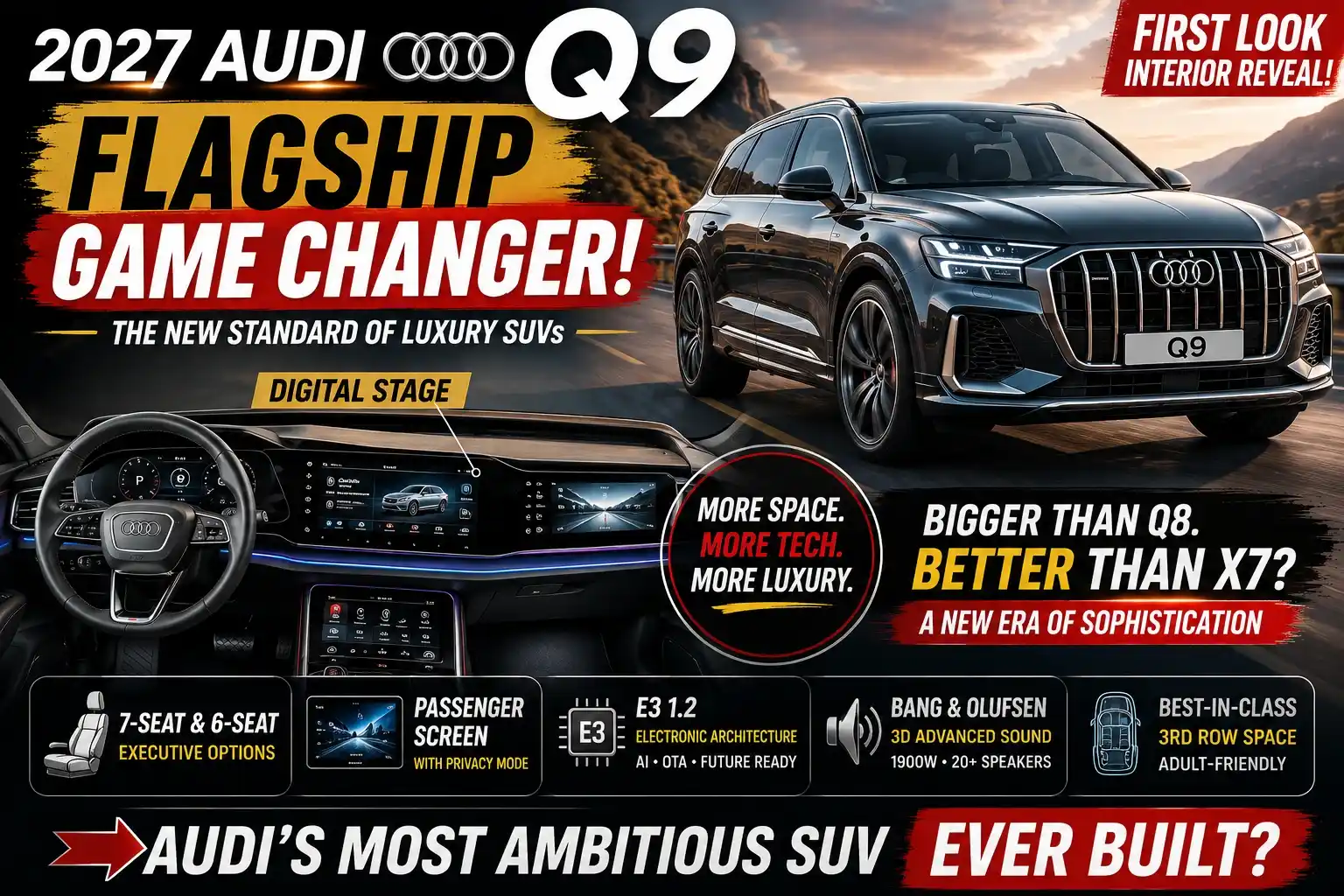
Recent images and reports from industry sources have finally given us a clear view of the 2027 Audi flagship SUVs interior. This is not just a larger version of what we have seen before; it is a fundamental redesign of how a driver interacts with a vehicle. From the “Digital Stage” dashboard to the executive seating in the back, the Q9 is clearly aiming for the top of the pyramid.
The “Digital Stage”: A User Experience Revolution
The core of the 2027 Audi flagship SUVs interior is what the company calls the Digital Stage. This design philosophy moves away from traditional recessed gauges and toward a free-standing, panoramic display system. It consists of a massive curved OLED screen that houses both the virtual cockpit and the primary infotainment interface.
This layout is a direct nod to the user experience standards we expect from high-end consumer electronics. The glass is slim, the refresh rates are high, and the system feels more like a premium smartphone than a traditional car interface. It is a clean, minimalist approach that removes clutter while increasing utility.
Additionally, the front passenger now gets their own dedicated screen. This display features a specialized shutter technology—what we call “contextual privacy.” This allows the passenger to stream content or navigate without distracting the driver. It is a smart solution to a modern problem, ensuring the driver’s focus remains on the road while the passenger stays entertained.
Q8 vs. Q9: Understanding the Hierarchy
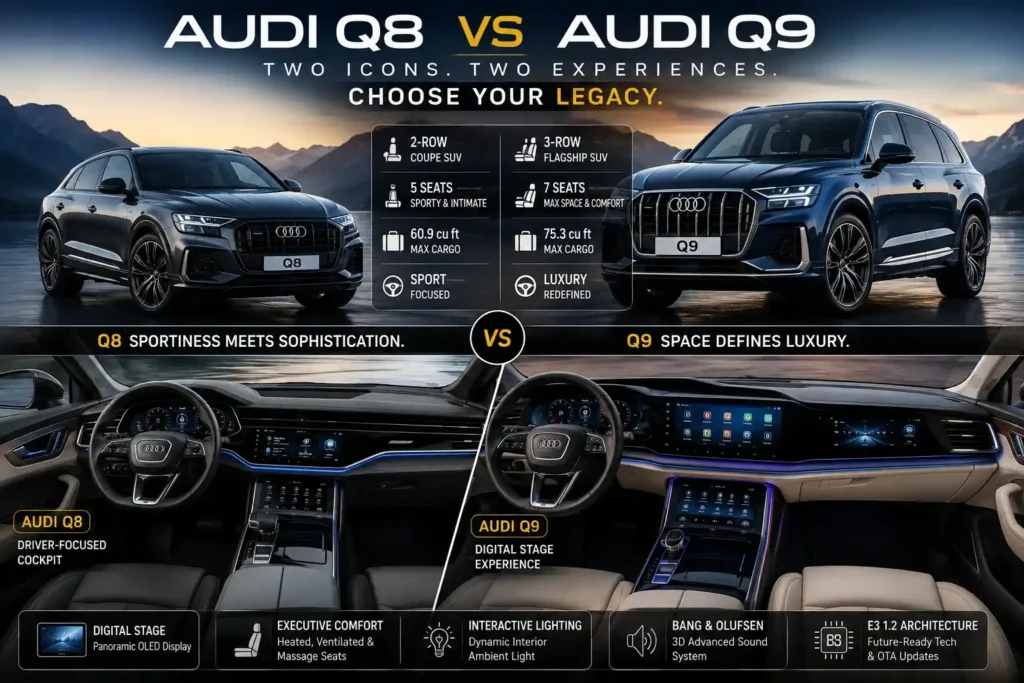
Many buyers ask why Audi needs a Q9 when the Audi Q8 is already so impressive. The answer lies in the use case. The Audi Q8 is about sportiness and presence; it is a two-row statement piece. The Q9, however, is about total cabin dominance and passenger luxury.
While the Audi Q8 serves the executive who wants a sharp-handling daily driver, the Q9 is for the family that refuses to compromise on space. The Q9 utilizes a significantly longer wheelbase and a taller rear roofline than any previous Audi SUV. This ensures that the third row isn’t just an afterthought but a viable space for adults.
This added length does not just help passengers; it increases cargo capacity behind the third row. Even with all seats occupied, the Q9 appears to offer enough space for several carry-on bags or a full grocery run. This practical optimization is essential for winning over buyers who might otherwise look at an Escalade or a Navigator.
2027 Audi Q9 Interior vs. Competition Expectations
| Feature | 2027 Audi Q9 | BMW X7 (Current) | Mercedes GLS (Current) |
|---|---|---|---|
| Primary Display | Curved OLED Panoramic | BMW Curved Display | MBUX Hyperscreen (Opt) |
| Passenger Screen | Dedicated Shutter Tech | Not Available | Available on High Tiers |
| Third Row Space | Adult-Friendly (Full Size) | Moderate | Adult-Friendly |
| Architecture | E3 1.2 Electronic | SP21 Architecture | MHA Platform |
Silicon Valley Logic: The E3 1.2 Electronic System
The “brain” behind the 2027 Audi flagship SUVs interior is the E3 1.2 electronic architecture. In the software space, we call this a “future-proof” system. It is designed to handle massive over-the-air (OTA) updates that can change the car’s behavior, efficiency, and entertainment options long after it leaves the lot.
This architecture supports a high-bandwidth data bus that ensures zero lag between the driver’s input and the screen’s reaction. It also integrates AI-driven voice commands. Audi has moved away from rigid voice scripts toward a natural language processing system that understands intent rather than just specific keywords.
The interior lighting system is also tied into this E3 logic. It is not just for ambiance anymore. The dynamic interaction light wraps around the cabin and communicates with the driver. It flashes to warn of a car in the blind spot, pulses during charging, and welcomes the driver with a specific light sequence based on their profile settings.
Luxury Tactility: The “Mechanical HMI”
Despite the digital heavy focus, Audi has not forgotten the importance of physical touch. Inside the cabin, they have implemented what we call “mechanical HMI”—or Human-Machine Interface. This refers to the physical knobs and switches that provide a premium tactile feel. Every dial and switch is made of knurled metal or high-quality glass.
The luxury segment is also moving away from “old-world” leather toward “new-world” sustainability. Inside the Q9, we expect to see recycled materials that feel every bit as premium as traditional hides. Audi is experimenting with microfiber and yarns made from reclaimed materials, which aligns with the ethical luxury trends seen across the United States.
However, for the traditionalists, high-grade Valcona leather and open-pore wood will still be available. The difference here is the sourcing. Audi is moving toward a transparent supply chain where every piece of trim can be traced back to its origin. This level of detail is what separates a standard SUV from a true flagship.
Audi Q9: Market Positioning and Pricing
The Q9 is a clear play for the ultra-profitable full-size luxury segment. While the Audi Q8 remains a strong player in the $75,000 to $95,000 range, the Q9 will likely push well into six-figure territory. This puts it in direct competition with the Range Rover and upcoming ultra-luxury electric SUVs.
For the American buyer, the Q9 offers a balanced solution. It provides the size of a domestic SUV with the precision of a German sport sedan. With the interior finally revealed to be a tech-forward masterpiece, the value proposition has become much stronger.
Projected US Launch and Pricing Data
| Milestone/Metric | Details | Projected Timing/Cost |
|---|---|---|
| Official World Premiere | Late 2026 | Q4 2026 |
| US Market Arrival | 2027 Model Year | Early 2027 |
| Estimated Base MSRP | Q9 55 TFSI | $94,000 – $99,000 |
| Top-Tier SQ9 MSRP | SQ9 V8 or Hybrid | $118,000 – $128,000 |
The SQ9: Performance Meets the Flagship Cabin
While the standard Q9 focuses on comfort and tech, the SQ9 variant is where the hardware gets an upgrade. We expect the SQ9 to feature a version of the twin-turbocharged 4.0-liter V8, likely paired with a sophisticated hybrid system. The interior of the SQ9 will distinguish itself with Carbon Atlas inlays and S-branded sport seats.
The SQ9 will also likely debut the most advanced version of Audi’s air suspension. By linking the suspension to the front-facing cameras, the car can “read” the road and adjust the damping for a pothole before the tires ever touch it. This predictive comfort is a key differentiator in the flagship space, making the ride feel more like a “cocoon of sound.”
The SQ9’s cabin will also feature a robust sound system. While the standard Q9 will come with a premium Bang & Olufsen setup, the SQ9 could offer a “3D Advanced” system with over 20 speakers and 1,900 watts of power. It is designed to isolate the passengers from the outside world, creating a high-fidelity sanctuary.
Audi’s Strategy to Take the US Crown
Audi has historically been the third member of the German “Big Three” in the US. However, their recent focus on lighting tech and interior UX has started to win over a younger, tech-savvy demographic. The Q9 is the final piece of that puzzle. It fills the “size gap” that has kept some American buyers in the Mercedes or BMW camps for decades.
The strategy here is to out-tech the competition. By launching the Q9 with the E3 1.2 architecture and a class-leading interior, Audi is positioning itself as the “smart” luxury choice. They aren’t just selling a car; they are selling a mobile office and a private lounge that feels more advanced than the Audi Q8 or Q7.
Additionally, the Q9 is expected to offer a high-output Plug-in Hybrid (PHEV) version. This will allow for significant all-electric range for daily commutes—perfect for markets like California—while still offering the long-distance capability that American road trips require. This dual-purpose strategy is pivotal as the US moves toward a more electrified future.
The Verdict: Is the 2027 Audi Q9 Worth the Wait?
If you are in the market for a flagship SUV, the revealed interior of the 2027 Audi Q9 suggests that patience will be rewarded. The combination of the Digital Stage interface, the expanded three-row cabin, and the cutting-edge electronic backbone makes it a formidable contender. It addresses every weakness of the current Audi lineup while doubling down on the brand’s strengths.
For the professional or the executive, the Q9 represents the next evolution of the luxury daily driver. It is a vehicle that understands that in 2027, luxury is defined by the quality of the software and the serenity of the space. Audi has clearly done their homework, and the Q9 is poised to be a dominant force on American roads.
What You Should Do Next
- Contact Your Local Dealer: While official orders aren’t open, getting on an “interest list” for the 2027 Q9 is a smart move to secure an early allocation.
- Evaluate Your Charging Strategy: If you are eyeing the PHEV version, now is the time to consider installing a Level 2 charger in your garage to maximize that electric range.
- Compare the Tech: Visit a showroom to experience the current “Digital Stage” in the new Q6 e-tron; it will give you a very good idea of what the Q9’s interface will feel like.
The luxury SUV segment is about to get much more crowded, and for Audi, the Q9 is the flagship they have needed for a long time. The interior reveal is just the beginning. As we move closer to the 2027 launch, expect more details on the powertrain and the advanced driver assistance systems that will make this SUV a true powerhouse.
About the Author