Trillion-Dollar Table: Why Musk, Cook, and Schwarzman are Joining Trump’s High-Stakes Xi Summit
At the time of publication, official details regarding the structure and agenda of the meeting remain limited, and several discussions are being interpreted through broader market analysis and publicly available reporting. However, the movement of significant capital and the involvement of high-level executives suggest a major shift in how economic diplomacy is being approached.
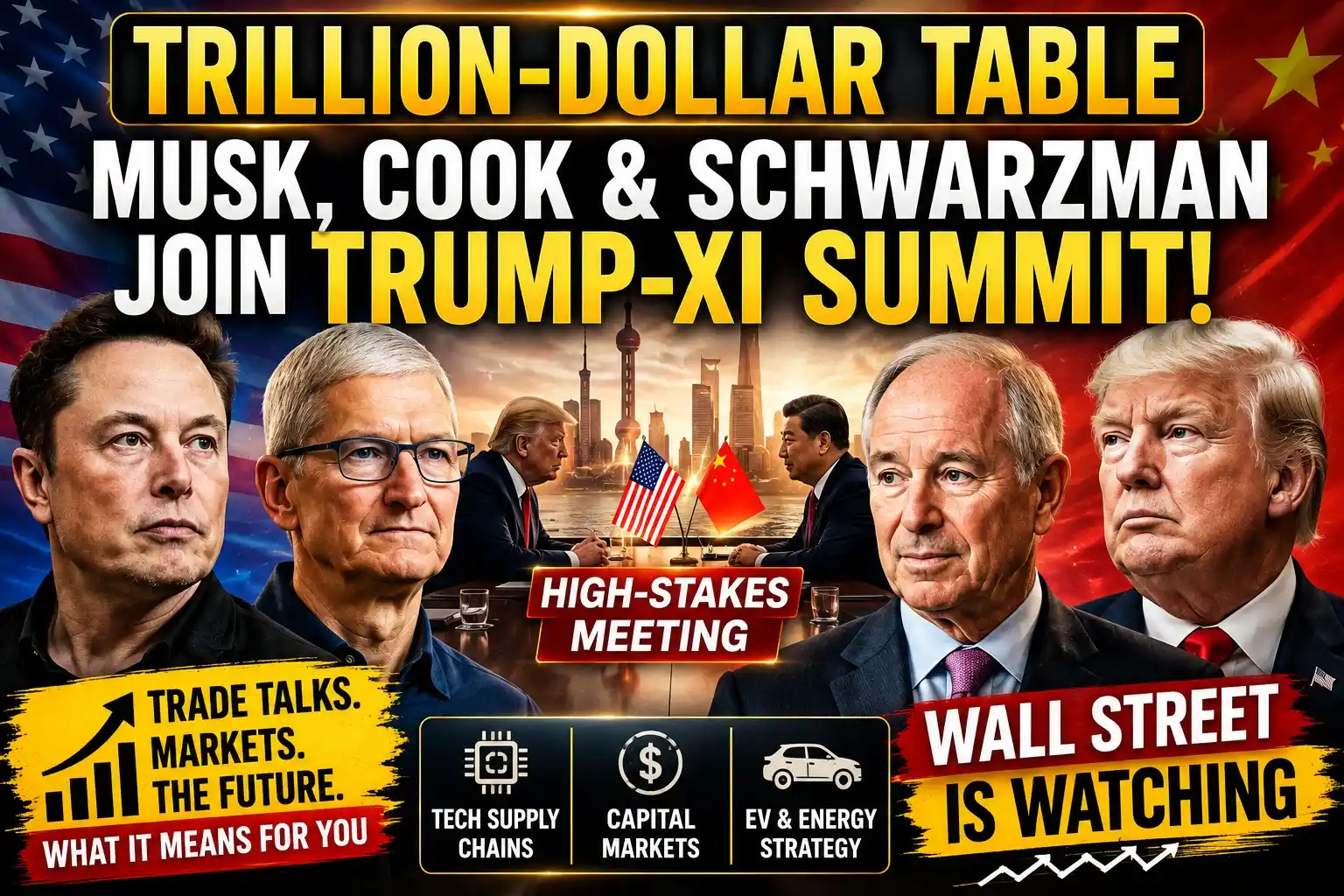
The intersection of American capital and global diplomacy has entered a highly sensitive phase. Reports circulating this afternoon, May 11, 2026, indicate a significant evolution in how the United States handles its most complex trade relationship. Sources familiar with the situation suggest that a delegation of the world’s most powerful billionaires has been invited to join the upcoming meeting between Donald Trump and Chinese leader Xi Jinping.
In my analysis, this is not just a standard diplomatic gathering; it is an operational model for modern statecraft. By bringing names like Elon Musk, Tim Cook, and Stephen Schwarzman to the table, the administration is signaling that economic interests will lead the conversation. Market data suggests that the presence of these individuals could stabilize volatile trade expectations that have rocked Wall Street over the last quarter.
Industry observers believe this move represents a “business-first” strategy intended to bypass traditional bureaucratic hurdles. Instead of relying solely on career diplomats, the plan utilizes the existing frameworks these CEOs have already established within the Chinese market. This is a high-stakes play designed to protect American manufacturing and investment interests at the highest level.
Why Wall Street Cares About US-China Executive Diplomacy
Wall Street has seen this pattern before, but the scale today is unprecedented. The health of the S&P 500 is inextricably linked to the stability of the US-China corridor. When CEOs of this caliber are involved in state-level talks, it provides a level of “corporate insurance” that career politicians simply cannot offer.
The primary concern for institutional investors is the predictability of supply chains and tariff structures. A sudden policy shift can wipe out billions in market cap overnight. By including Tim Cook and Elon Musk, the administration provides a direct line of communication between the factory floor in Shanghai and the policy desk in Washington.
Additionally, investor confidence relies on the transparency of capital markets. Stephen Schwarzman’s inclusion signals that the flow of private equity and institutional investment remains a top priority. For the analyst community, this delegation is a sign that “decoupling” may be replaced by a more nuanced strategy of “strategic integration.”
| Company | Primary China Exposure | Primary Investor Concern |
|---|---|---|
| Tesla | High-Volume Manufacturing (Giga Shanghai) | EV supply chain stability and regulatory parity |
| Apple | Complex Assembly & Hardware Production | Tariff impact and production diversification risk |
| Blackstone | Institutional Capital & Real Estate | Market access and currency stability |
The Power Trio: Analysis of the Delegation
The invitation of these specific leaders is highly strategic and measured. Each represents a vital pillar of the American economy that is deeply intertwined with Chinese infrastructure. This creates a multi-layered strategy for the negotiations.
- Elon Musk (Tesla/SpaceX): Musk holds a unique position due to his role in advanced manufacturing. His presence suggests that potential focus areas linked to electric vehicle manufacturing and advanced technology policy will be primary talking points.
- Tim Cook (Apple): As the architect of the world’s most complex supply chain, Cook’s involvement is essential for tech stability. Apple’s reliance on Chinese assembly remains a significant leverage point for both nations in any trade discussion.
- Stephen Schwarzman (Blackstone): Schwarzman acts as the financial conduit. His deep ties to the Chinese leadership and Blackstone’s massive investment footprint make him a key figure in capital flow discussions.
This delegation is not just for optics. These individuals possess the operational knowledge to navigate the nuances of the Chinese regulatory landscape. Their goal is to help shape a strategy that protects American intellectual property while maintaining continued access to the Chinese consumer market.
Market Implications: Decoding the Asset Class Reaction
Wall Street is watching these developments with intense focus. The announcement has already triggered ripples across the tech and finance sectors. When the world’s largest economy meets the world’s largest manufacturing hub, the stakes for your portfolio are astronomical.
Market data suggests that the presence of these executives provides a buffer against the most extreme trade outcomes. If this delegation can facilitate a broader trade understanding, we might see a rally in tech stocks that have been hindered by geopolitical uncertainty. However, the risk remains that a failure to reach an agreement could lead to an even more aggressive trade strategy.
| Executive | Primary Sector | Potential Focus Area | Market Sentiment |
|---|---|---|---|
| Elon Musk | Automotive/Tech | Manufacturing Equity & AI Policy | Highly Bullish |
| Tim Cook | Consumer Electronics | Supply Chain Tariff Stability | Cautiously Optimistic |
| Stephen Schwarzman | Private Equity | Financial Market Access | Stable |
Investors should recognize that this meeting could lead to significant policy shifts regarding technology transfers. In my analysis, the goal is to create a “business-first” framework. This would allow for growth in key sectors like Green Energy and AI while maintaining strict national security boundaries.
A Strategic Framework: Moving Beyond Blunt Instruments
In the past, traditional tariffs have often acted as a blunt instrument. This new approach seems to favor a strategy of “reciprocal access.” This is a major shift in how economic diplomacy is being approached, where American companies gain better footing in China in exchange for continued market participation in the US.
Industry observers believe that the administration is looking to create a “managed competition” model. This reduces the risk of unintended consequences that often arise from broad-stroke regulation. By involving the leaders of these companies directly, the government can tailor trade policies to the actual needs of the technology industry.
That is where the debate gets more complicated. Critics argue that involving billionaires in state-level talks could prioritize corporate margins over national interests. However, from a practical standpoint, these CEOs have more on-the-ground data about the Chinese economy than any government agency. Using that data is a tactical advantage in a high-stakes negotiation.
The Geopolitical Chessboard: Navigating Xi’s Priorities
Negotiating with Xi Jinping requires a deep understanding of China’s long-term internal goals. Xi has focused on self-reliance in the technology sector. The billionaire delegation must navigate these priorities while advocating for American interests.
- Supply Chain Security: China’s push for internal manufacturing directly impacts Tesla’s market share and overall manufacturing strategy.
- Data Sovereignty: Apple’s data privacy standards often clash with Chinese regulatory requirements, a key point of friction for the tech sector.
- Investment Transparency: Blackstone’s ability to move capital depends on the stability of the Chinese yuan and long-term regulatory transparency.
These are not simple issues to resolve. The delegation will need to present a unified front that demonstrates the mutual benefits of cooperation. Industry observers believe that the goal is to create a scenario that allows both leaders to claim a policy victory to their domestic audiences.
Risks and Volatility: The Friction of Corporate Statecraft
While the presence of these titans offers hope for stability, it also introduces new layers of complexity. Skeptics argue that relying on billionaires for diplomacy creates a conflict of interest. The administration will need to ensure that the outcomes of this meeting benefit the average American worker, not just the shareholders of Apple and Tesla.
Market data suggests that any sign of disagreement within the delegation could lead to immediate market volatility. If Musk and Cook have differing views on manufacturing shifts, it could send mixed signals to Beijing. A cohesive strategy is vital for this mission to succeed.
Additionally, those metrics tend to provide a clearer long-term picture than short-term market sentiment. Institutional investors want to see absolute proof that these talks lead to actual policy changes, rather than just photo opportunities.
The Future of US-China Economic Relations
As we look toward the second half of 2026, the results of this meeting will likely define the decade. We are moving away from a world of total decoupling and toward a system of “strategic integration.” This is a more complex landscape that requires constant communication between business leaders and state actors.
Industry observers believe that if this billionaire delegation is successful, it could become a permanent part of the American diplomatic system. We might see similar groups formed for negotiations with other major economic blocks. It is a recognition that in the modern world, economic power is the ultimate form of influence.
From a platform economics perspective, this is a transition in the globalized world. The barriers between the boardroom and the Situation Room are effectively dissolving. For the savvy investor, this means staying attuned to the movements of these key individuals is more important than ever.
Final Analysis: Preparing for the Policy Pivot
What should the average American citizen or investor take away from this? First, recognize that the old rules of trade are being rewritten in real-time. Second, understand that the presence of Musk, Cook, and Schwarzman provides a layer of protection against radical, overnight policy shifts. These leaders have too much at stake to let the relationship crumble entirely.
In the coming days, watch for official statements from the White House and the participants. The language used in these press releases will offer a strategy for predicting market trends in June and July. This is a moment of immense transition, and those who understand the operational model behind this delegation will be best positioned to navigate the coming changes.
Key Takeaways for the Week Ahead
- Monitor Tesla and Apple stock for reaction to delegation updates.
- Watch for comments from the Treasury Department regarding financial market access.
- Observe the tone of Chinese state media for clues on Xi’s receptiveness to the billionaire group.
This is a developing story with massive implications for every American. The integration of corporate power into the heart of US-China diplomacy is a bold move that could either usher in a period of unprecedented stability or create new, complex layers of geopolitical tension. We will continue to track this high-stakes summit as new data emerges.
Conclusion
The invitation of Musk, Cook, and Schwarzman to the Trump-Xi meeting is a clear signal that the American diplomatic framework has evolved. By leveraging the expertise and influence of these billionaires, the administration is attempting to secure a future for American tech and finance in an increasingly competitive world. Whether this system will yield a lasting peace or further complicate the global landscape remains to be seen, but one thing is certain: the era of business-led statecraft has arrived.
Much of the broader market interpretation surrounding the delegation remains based on analyst commentary and public reporting available as of May 11, 2026. Investors should continue to monitor official channels for verified policy updates.
About the Author