TikTok’s new UK subscription model highlights the growing shift from ad-supported social media toward recurring revenue ecosystems.
Why TikTok’s Subscription Push Signals a Bigger Shift in Social Media
For years, the unspoken contract between social media platforms and consumers was simple: you give us your time and behavioral data, and we provide you with an endless algorithmic feed of entertainment.
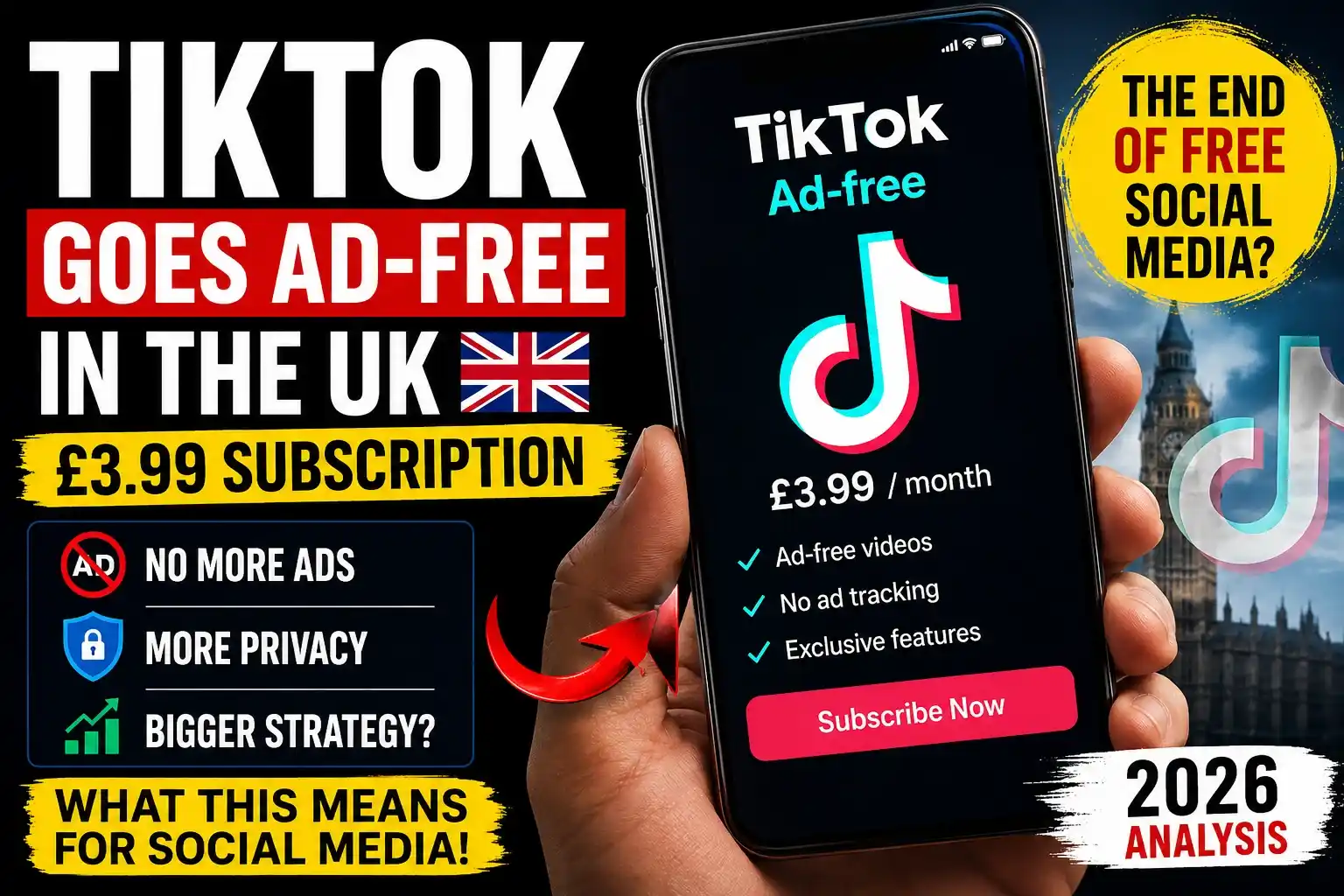
But as of May 11, 2026, TikTok has fundamentally altered that arrangement in the United Kingdom. By launching a £3.99 per month ad-free subscription plan, the ByteDance-owned giant is signaling a massive shift in its revenue model.
In my analysis of consumer technology and platform economics, this is not merely a feature update. It is a structural transformation of how the attention economy operates.
Recent monetization trends indicate that the economics of purely free social media platforms are becoming increasingly difficult to sustain. We have watched Meta deploy pay-or-consent models across Europe, X transition heavily into premium subscriptions, and YouTube aggressively push its Premium tier.
Now, TikTok is joining the ranks. Over my years analyzing these platforms, I have seen that when a company with billions of daily active users pivots to direct consumer billing, it is rarely a random experiment.
Market behavior suggests it is a calculated strategy born out of market saturation, regulatory pressure, and the relentless demand for quarterly revenue growth.
At first glance, £3.99 may not sound significant. But the real story is what this price reveals about the future of platform economics.
This deep-dive analysis will break down the exact mechanics of TikTok’s UK launch, the hidden economic drivers behind the decision, and what this means for the global creator economy. [INSERT_INTERNAL_LINK_HERE]
If you are a digital marketer, an investor, or simply a power user, understanding the architecture of this £3.99 subscription is critical to predicting the future of online consumption.
Deconstructing the £3.99 Ad-Free Tier: What Are You Actually Buying?
Before evaluating the psychological and financial implications of this rollout, we must establish the facts of the product itself.
TikTok’s new tier is elegantly simple on the surface, yet complex in its execution. What makes this launch especially interesting is the exact nature of what users are paying to remove.
Pricing and Immediate Availability
The service has launched strictly in the United Kingdom for users aged 18 and older, priced at £3.99 per month. It is positioned entirely as an opt-in experience.
Users who decline to open their wallets will continue to use the standard, ad-supported application they are accustomed to. There are no throttled features for free users, no restricted content algorithms, and no penalty for refusing to pay.
The core TikTok experience remains identical, save for the presence of commercial interruptions.
The Definition of “Ad-Free” in a Native Ecosystem
This is where TikTok’s strategy becomes more nuanced. When you pay for YouTube Premium, the value proposition is absolute: the video you clicked on will not be interrupted by a pre-roll or mid-roll commercial.
However, the nature of advertising on TikTok is fundamentally different. TikTok has spent years convincing brands that they should “make TikToks, not ads.” As a result, the platform is flooded with In-Feed native advertisements that look, sound, and feel exactly like organic user-generated content.
By paying £3.99, a user removes the official, platform-served advertisements from their For You Page (FYP). That distinction matters more than most users realize.
In my analysis of the creator ecosystem, this does not mean the feed becomes entirely commercial-free. Users will absolutely still encounter influencer sponsorships, brand integrations, and affiliate marketing videos.
If a creator is paid directly by a skincare brand to review a product, that video is organic content to TikTok’s servers, even if it is a commercial in reality.
Therefore, you are not paying to remove all marketing from your feed. You are specifically paying to remove the marketing that TikTok itself directly profits from via its ad network.
The Privacy Component
Beyond the visual experience of an uninterrupted scroll, there is a secondary benefit built into this subscription: data privacy.
According to early reporting surrounding the rollout, for users who subscribe to the Ad-Free tier, their behavioral data will not be utilized for targeted advertising purposes.
In a digital landscape where personal data is highly scrutinized, paying four pounds a month to reclaim a sliver of digital anonymity is a compelling angle for privacy-conscious consumers.
The Economic Reality Behind the Subscription Push
To understand why this is happening in 2026, we have to look past the PR statements about improving user experience. Platforms rarely introduce friction into their user base without significant financial incentives.
From a long-term platform perspective, there are three primary pillars supporting this strategic pivot.
1. The Ceiling of Ad Load Saturation
There is a mathematical limit to how many advertisements you can inject into a user’s feed before they close the application.
If you scroll through TikTok today, the frequency of In-Feed ads is carefully calibrated by machine learning to maximize revenue without triggering user abandonment. But what happens when a platform reaches that maximum ad load?
To grow revenue, they must either acquire millions of new users, charge advertisers a higher Cost Per Mille (CPM), or find a new way to monetize the existing user base.
Platform metrics historically show that user growth in mature markets like the UK and US has leveled off. Adding to this, macroeconomic conditions can restrict how much brands are willing to spend on digital ads.
Therefore, extracting direct subscription revenue from the top 5% of hyper-engaged power users is arguably the most logical method to maintain steady revenue scaling. [INSERT_INTERNAL_LINK_HERE]
2. The Regulatory Shield Strategy
In my experience analyzing tech policy, the timing of this launch is inextricably linked to European and UK regulatory frameworks.
Governments are aggressively pursuing tech giants over data collection practices, user tracking, and algorithmic transparency. By offering a paid tier that explicitly halts data collection for targeted advertising, TikTok creates a highly functional legal defense.
When regulators accuse a platform of exploiting user data without alternatives, the platform can now point to the £3.99 subscription. They can argue that users have a clear, accessible choice: pay with your data, or pay with your fiat currency.
This is not merely a product launch; industry analysts increasingly believe it is a meticulously engineered compliance system designed to appease lawmakers while simultaneously generating cash.
3. Stabilizing the Revenue Floor
Advertising revenue is notoriously volatile. It fluctuates based on economic recessions, holiday seasons, and shifting brand budgets.
Subscriptions, on the other hand, provide Monthly Recurring Revenue (MRR). MRR is highly coveted by technology companies because it is predictable, stable, and valued by Wall Street and private investors alike.
Securing a base of reliable monthly income helps insulate TikTok from the boom-and-bust cycles of the global digital advertising market.
Analyzing the Friction: Will the Market Actually Convert?
Having established the “why,” we must now address the most critical question: Will a significant portion of the UK user base actually pull out their credit cards?
I remain cautiously skeptical, and the underlying mechanics of platform consumption seem to support this skepticism.
The Psychology of the Micro-Scroll
The fundamental barrier to adoption is the nature of the TikTok interface. On a platform like Spotify, an audio ad physically prevents you from listening to the song you desire.
That friction is incredibly high, making the premium subscription highly attractive. On TikTok, an advertisement is just another vertical video.
If a user does not want to watch it, the physical effort required to bypass it is a flick of the thumb taking less than half a second.
Are millions of users going to pay £3.99 a month to save themselves a few thumb flicks per hour? Market behavior suggests that the perceived value of removing easily skippable content is drastically lower than the value of removing unskippable content.
TikTok’s own success in making ads “feel natural” is precisely what might challenge their subscription conversion rates.
The Comparative Landscape
To contextualize this, we must look at how TikTok’s offering stacks up against the broader market of digital subscriptions.
Users have finite subscription fatigue, and TikTok is competing for the same monthly budget as streaming services and other established social networks.
| Platform | Estimated UK Monthly Cost (2026) | Core Value Proposition | Ad-Interruption Level for Free Users |
|---|---|---|---|
| YouTube Premium | £12.99 | Removes highly intrusive pre/mid-roll ads, background play, offline downloads. | Severe (Unskippable video interruptions). |
| X Premium (Basic) | £3.00 – £8.00 | Algorithmic boost, edit button, reduced ads, verification mark. | Moderate (In-feed text/image ads). |
| Meta (Facebook/IG) | £9.99 | Removes ads, stops data usage for ad targeting. | Moderate (In-feed and Story ads). |
| TikTok Ad-Free | £3.99 | Removes platform-served ads, stops data usage for ad targeting. | Low (Easily skippable vertical video ads). |
As the table illustrates, TikTok is entering the market at a highly competitive price point. At £3.99, it is positioned more as a micro-transaction rather than a major monthly expense.
However, its core value proposition faces hurdles because its free ad-interruption level is relatively low friction. TikTok is effectively trying to sell an umbrella to someone standing in a light drizzle.
The Trojan Horse: E-Commerce and TikTok Shop
It is impossible to analyze this subscription model without discussing the most critical component: TikTok Shop.
Over the last two years, TikTok has aggressively pivoted from being strictly an entertainment platform to becoming a fully integrated social commerce engine. E-commerce is a massive revenue frontier for ByteDance.
Here is where the strategy becomes highly sophisticated. If a user pays £3.99, they remove standard digital advertisements. But they do not remove TikTok Shop integrations.
If a creator goes live to sell cosmetics, or posts an organic video with a yellow shopping cart icon anchored to the bottom left screen, that content remains entirely visible to the premium subscriber.
In my analysis, it seems probable that TikTok is willing to sacrifice traditional CPM (Cost Per Mille) ad revenue from a user if that user remains embedded in the TikTok Shop ecosystem.
The platform takes a percentage cut of transactions processed through its marketplace. A user who pays £3.99 for a premium experience is statistically likely to have disposable income.
By removing standard ads, TikTok is actually clearing the visual clutter so that its highest-value users can focus more intently on purchasing physical goods directly through the app. [INSERT_INTERNAL_LINK_HERE]
The Impact on the Global Creator Economy
A platform is nothing without its creators. Any major shift in monetization mechanics inevitably creates a ripple effect throughout the creator class.
The introduction of an ad-free tier introduces several complex variables that digital entrepreneurs and influencers must now navigate.
The Monetization Pool Dilemma
Currently, creators are compensated primarily through the Creator Rewards Program, which is fundamentally funded by the advertising revenue the platform generates.
If a massive swath of the highest-engaging users suddenly stops generating ad impressions because they upgraded to the £3.99 tier, the overall advertising revenue pool technically shrinks.
Historically, platforms like YouTube solved this by allocating a percentage of the subscription revenue directly to creators based on watch time.
TikTok will likely need to implement a similar model to ensure its top talent does not experience a sudden drop in monthly earnings.
If creator payouts decline because the most lucrative audience segment is no longer seeing ads, those creators might migrate their premium content back to YouTube Shorts or Instagram Reels.
Maintaining creator trust during this transition will be one of the most delicate operational challenges.
The Illusion of the “Organic” Reach Decline
There is already a growing concern among digital marketers that this update will disrupt organic reach.
The theory suggests that if users can opt out of ads, brands will be forced to rely entirely on organic viral marketing, saturating the algorithm and making it harder for everyday creators to break through.
Recent monetization trends indicate this fear is largely misplaced. As previously established, the subscription only removes platform-served ads. The demand for user-generated content (UGC) creators will likely accelerate.
Because brands can no longer guarantee placement in front of premium users via traditional media buying, they will have to funnel those advertising budgets directly into influencer sponsorships.
For creators who specialize in authentic product integration, the ad-free tier is not necessarily a threat. It could represent an expanding financial opportunity.
Will the American Market Be Next?
The decision to launch in the United Kingdom first is highly strategic. The UK represents a sophisticated, high-income market that mirrors the consumer behavior of the United States.
However, it does so without the immediate existential political threats currently hovering over TikTok in Washington.
In my professional estimation, the UK serves as a critical testing ground. TikTok is gathering telemetry on conversion rates, churn rates, and the impact on overall session length.
If the data proves that users will pay £3.99 without drastically reducing their daily app usage, a rollout in the United States seems highly probable by late 2026 or early 2027.
The US market, however, remains highly volatile. Any move to extract direct payments from American consumers will be heavily scrutinized by lawmakers who already view the platform with intense suspicion.
If TikTok can successfully frame the US version of this subscription as a pro-privacy, anti-tracking initiative, they may be able to leverage it as a political bargaining chip to prove their commitment to user data protection.
Final Analytical Verdict: Strategic Genius or Desperate Move?
So, we return to the core question: is the £3.99 UK ad-free tier a masterstroke or a sign of panic?
In my analysis, the move appears to be a highly calculated defensive strategy disguised as a consumer product.
TikTok does not actually need millions of people to subscribe to this service to deem it a success. The true victory lies in the optics and the optionality.
- It creates a robust legal defense against European data privacy regulators by making data tracking an explicit choice rather than an unavoidable mandate.
- It filters out the most affluent users and funnels their uninterrupted attention toward TikTok Shop integrations, driving high-margin e-commerce transactions.
- It establishes the necessary financial infrastructure to process direct consumer payments, a system that can easily be expanded into creator tipping, premium paywalled content, and digital asset ownership in the future.
For the average consumer scrolling through comedy sketches on their commute, £3.99 is likely an unnecessary expense.
The platform’s algorithm is simply too adept at making ads blend in with the entertainment. But for the platform itself, this launch is a critical evolution.
It marks the moment TikTok shifted from acting purely like a digital billboard and began acting more like an entrenched, diversified digital utility.
The rules of the attention economy are being rewritten in real-time. Platforms are no longer satisfied with just harvesting our data; they are actively testing our willingness to pay for the privilege of not being harvested.
The success or failure of TikTok’s UK experiment will serve as a definitive benchmark for the next decade of social media monetization.
What You Need to Do Next
If you are a brand or a creator, standing still is not a viable option. The algorithmic landscape is shifting beneath your feet.
You may no longer be able to rely strictly on traditional In-Feed ad buys to reach the most affluent segments of the audience.
- For Brands: Brands may need to gradually rebalance portions of their creator and performance marketing budgets as subscription-based ecosystems continue to evolve. Infiltrating the feed organically will become paramount.
- For Creators: Refining TikTok Shop affiliate strategies is more critical than ever. Premium users are currently being conditioned to view the platform as a seamless shopping experience. Positioning your content to serve that demand is key.
- For Consumers: It is time to evaluate your own digital habits. Are you willing to pay for your privacy, or have you accepted that your attention is the ultimate currency?
The digital ecosystem is evolving rapidly, and those who fail to adapt their strategies will face increasing challenges in the era of evolving media.
Stay sharp, watch the metrics, and prepare for the broader arrival of paid tiers across the applications you use daily.
About the Author