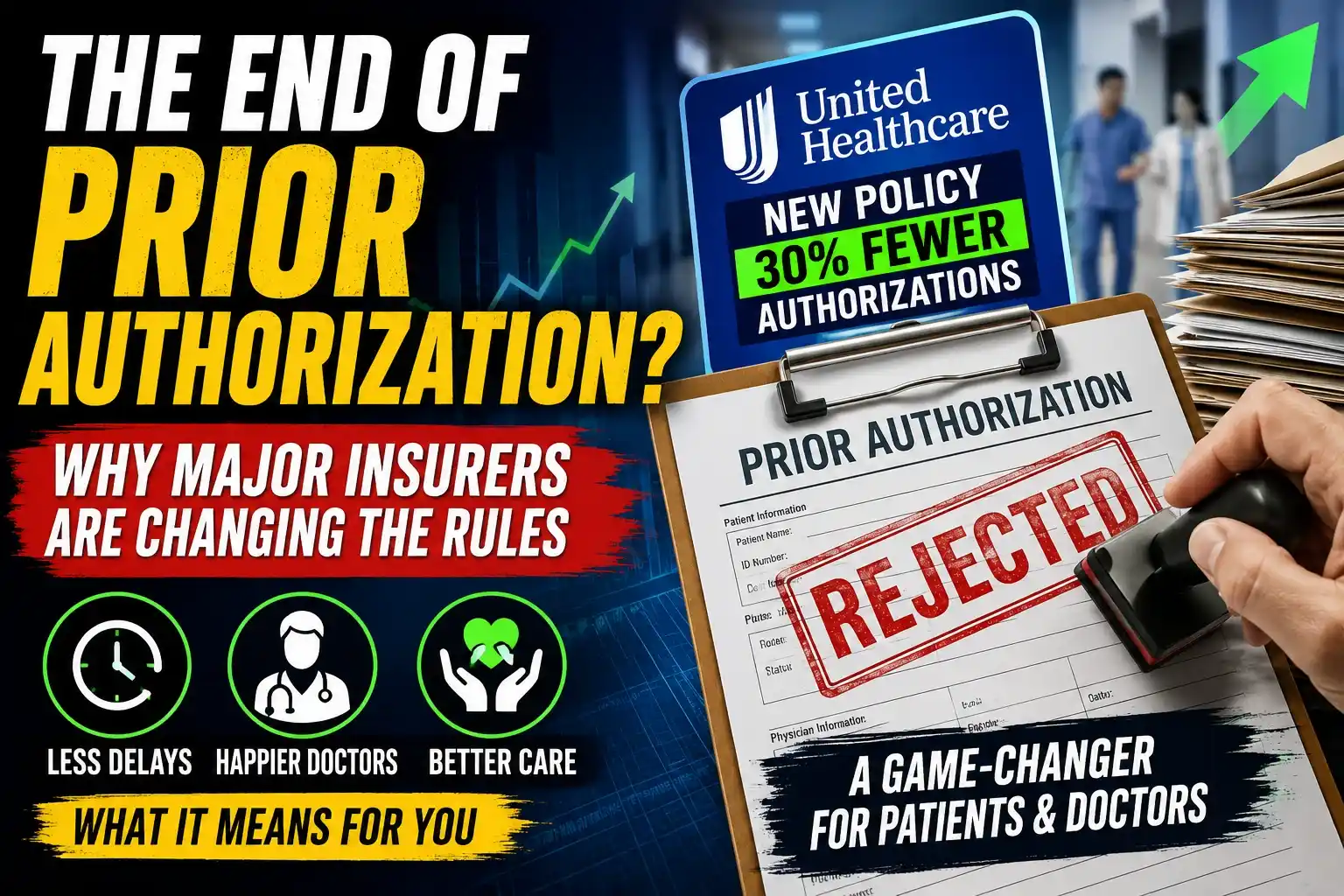
Why Major Health Insurers Are Dropping Prior Authorization Requirements
Updated May 2026 | Includes newly released healthcare utilization data, CMS policy updates, and the latest physician sentiment tracking.
Wall Street is beginning to view this as a turning point for the healthcare industry. For years, the medical approval process has acted as a bureaucratic bottleneck. Now, the operational mechanics are shifting.
UnitedHealthcare, the largest private health insurer in the United States covering over 50 million people, recently initiated a policy change. Announced in May 2026, the company confirmed it is eliminating prior authorization requirements for 30 percent of its medical services.
This reduction includes a wide range of essential outpatient procedures, routine diagnostic tests like echocardiograms, and various physical and chiropractic therapies. The transition marks a change in how medical care is governed and financed in America.
The shift comes amid growing federal scrutiny of Medicare Advantage denial practices and increasing public backlash over delayed treatment approvals. It is a decision that has sent immediate ripples through the medical community and the financial markets.
For doctors, this represents a hard-fought victory. For investors and market analysts, it is a clear signal that the underlying economics of healthcare administration are fundamentally changing.
To understand why this is happening right now, you have to look closely at the operational data. The American healthcare system had been suffocating under its own paperwork, and the system had become financially and operationally unsustainable.
The May 2026 Catalyst: The UnitedHealthcare Decision
The timing of this industry-wide pivot is calculated. The May 2026 announcement by UnitedHealthcare serves as a leading indicator for the managed care sector. When the largest player in the space alters its risk management strategy, competitors like Humana, Cigna, and Elevance Health often adapt to maintain parity within their provider networks.
UnitedHealthcare CEO Tim Noel addressed the policy directly, stating that while prior authorization remains a necessary tool, it should only be utilized when it genuinely protects patients and improves the quality of care. Eliminating these requirements is a strategic move to ensure doctors can spend more face-to-face time with their patients rather than managing administrative portals.
By the end of 2026, the company expects more than 70 percent of its remaining prior authorization volume to be integrated into a standardized electronic submission process. This sets the foundation for automation and interoperability across the sector.
This policy shift aligns with a broader push from the Department of Health and Human Services (HHS). Federal regulators have pressured the health insurance industry to cut red tape. Several large insurers have now voluntarily committed to implementing these changes across private commercial insurance, Medicare Advantage, and Medicaid plans.
Operational Failure: Why the Traditional Approval System Broke
Insurers originally built prior authorization systems decades ago to keep healthcare spending under control. The fundamental logic was straightforward: before an expensive test or surgery could happen, the insurance company needed clinical verification that the procedure was medically necessary.
It was engineered as a standard utilization management strategy. However, over the last decade, the process evolved into a friction engine that slowed down the clinical pipeline.
Doctors found themselves spending hours on the phone, sending faxes, and debating with insurance medical directors over routine care. In the majority of these cases, the care was ultimately approved, making the administrative delay inefficient from a financial savings perspective.
The latest numbers from the industry highlight the strain. According to the 2026 survey data compiled by the American Medical Association (AMA), the average medical practice now spends roughly 13 hours every week dealing with prior authorization tasks.
That figure translates to almost 40 individual administrative requests per physician, per week. A modern clinic cannot operate efficiently when highly compensated clinical experts spend over a full business day each week on data entry and appeals.
Healthcare analysts note that this administrative workload is a primary driver of clinical burnout. The AMA survey revealed that nearly 90 percent of doctors say this specific process contributes to their professional exhaustion. In a labor market where hospital systems are competing to retain clinical talent, this level of frustration represents an operational risk, prompting a closer look at the hospital staffing crisis.
The Clinical Reality and Patient Impact
While the financial metrics are clear, the human impact is what has forced the industry to course-correct. Millions of Americans have experienced this frustration firsthand. Prior authorization is no longer viewed solely as a billing issue; it is widely recognized as a clinical hurdle.
Consider the reality for cancer patients waiting on vital chemotherapy approvals. Even a few days of administrative delay can increase psychological stress and actual clinical risk. A patient fighting an oncology diagnosis is often forced to wait while a back-office administrator reviews paperwork that a specialized oncologist has already deemed necessary.
The AMA data supports these real-world scenarios. Fully 93 percent of surveyed physicians reported that prior authorization causes direct delays in patient care. More concerning, 82 percent stated that bureaucratic hurdles sometimes lead to patients abandoning their treatment programs entirely.
When patients skip preventive or maintenance care because the approval process is too difficult, they often require emergency intervention months later. These resulting emergency visits involve more severe, and more expensive, medical conditions. Insurers recognize that delaying routine, low-cost care often leads to higher emergency payouts down the road.
Payer Economics: The Strategy Behind the 30 Percent Cut
When a managed care organization drops 30 percent of its authorization requirements, it is a data-driven business decision designed to protect long-term operating margins.
Industry experts know that the 30 percent of services being removed from the review pipeline are almost exclusively low-variance, high-approval procedures. If a specific routine scan, such as an echocardiogram, has a historical approval rate of 98 percent across the network, spending human capital to manually review that request is an inefficient use of resources.
It costs insurance companies capital to process and deny claims. They employ teams of nurses, medical directors, and administrative support staff to read clinical charts and manage appeal calls from doctors.
When the administrative cost to review a routine claim exceeds the actual financial savings of an occasional denial, the utilization management system transitions from an asset into a liability.
By pruning the bottom 30 percent of the authorization burden, major insurers can begin to reduce their internal administrative headcount. They are eliminating low-yield friction to refocus their clinical review resources on the remaining 70 percent of services.
That remaining 70 percent includes primary cost drivers like specialty pharmaceuticals, complex inpatient hospital admissions, and gene therapies. By focusing oversight where the most expensive care happens, insurers can maintain their premium pricing structure while improving relationships with major hospital networks.
Implications for Hospital Systems and Independent Providers
Portfolio managers and healthcare sector analysts are tracking this administrative shift closely. The redistribution of administrative time and capital will create distinct operational changes in the equity markets over the next few quarters.
Hospital systems, regional surgical centers, and independent clinical practices are immediate beneficiaries. When essential medical procedures are not delayed by 7 to 14 days pending insurance approval, patient throughput increases.
Operating room schedules become more reliable, and last-minute cancellations due to pending authorizations drop. For hospital Chief Financial Officers, this policy change means they can optimize their back-office billing and coding departments.
Acute care providers will experience better cash flow dynamics as the time between providing a clinical service and receiving payment shrinks. Days in accounts receivable will drop, freeing up working capital that can be reinvested into advanced medical equipment or facility expansion.
For the managed care organizations, the financial math requires balancing. Eliminating the friction of prior authorization will likely cause an immediate increase in top-line medical utilization. Without the administrative barrier in place, procedures will happen faster.
Wall Street is paying close attention to the Medical Loss Ratio (MLR) of the major publicly traded insurers. The MLR tracks exactly how much of the collected premium dollars are spent on direct patient care versus administration and profits. Insurers that successfully replace human reviews with backend data audits will see their profit margins stabilize. Those that drop requirements without implementing a technological backup plan could see their medical costs rise in the short term.
Healthcare Technology: Replacing Faxes with Algorithms
The system is not disappearing entirely; it is being digitized. The manual, fax-based, peer-to-peer review process is being replaced by predictive software.
This operational transition has created a sustained expansion for specialized healthcare technology companies. Software vendors that focus on modern Revenue Cycle Management (RCM) are bridging the digital gap between clinical offices and insurance mainframes. Analysts monitoring healthcare techstocks see this as a primary growth vector.
Instead of forcing doctors to ask for permission before a procedure happens, insurers are shifting toward retrospective predictive analytics. They analyze medical claims after the fact to look for statistically strange billing patterns or deviations from standard care protocols.
If a specific orthopedic surgeon is performing 50 percent more MRI scans than their regional peers, the software flags that provider for a review. This targets the outliers rather than blanketing the entire network with administrative requirements.
We are also observing the integration of automated clinical guidelines. New software tools can passively read a patient’s Electronic Health Record (EHR) and verify if a planned procedure meets the established standard of care. If the criteria are met, the system issues an automated approval.
This removes the manual element from routine care decisions. Healthcare IT companies that can prove they reduce an insurer’s medical costs while speeding up a provider’s payment timeline are highly valued in the current macroeconomic environment.
The Rural Hospital Lifeline
An often overlooked aspect of these policy changes is the direct impact on rural healthcare. Alongside the 30 percent reduction in prior authorizations, major insurers are launching specific initiatives to support rural hospital infrastructure.
For example, UnitedHealthcare expanded a Rural Payment Acceleration Pilot program. Under this initiative, Medicare Advantage payments to rural hospitals were accelerated from taking 30 days down to fewer than 15 days on average.
By the fall of 2026, this program is slated to encompass approximately 1,500 rural hospitals and their associated practitioners nationwide, including designated Critical Access Hospitals. Many of these rural care providers are being completely exempted from standard prior authorization requirements.
This provides necessary support for facilities operating on thin margins. By accelerating payments and removing administrative blockades, insurers are helping ensure that populations outside of major metropolitan hubs retain access to emergency and surgical care centers.
The Washington Factor: CMS and Political Pressure
The decision by major health providers to drop these requirements is influenced by the threat of government intervention. Lawmakers on both sides of the political aisle have scrutinized the insurance industry over high denial rates.
This scrutiny has been intense regarding Medicare Advantage trends, which cover millions of seniors. Organizations like the Kaiser Family Foundation (KFF) and the American Hospital Association (AHA) have published reports highlighting how seniors are frequently denied necessary rehabilitation and post-acute care following hospitalizations.
In response, the Centers for Medicare & Medicaid Services (CMS) finalized new interoperability and authorization rules. These federal rules require certain payers to implement automated authorization processes and shorten the time allowed to make a clinical decision.
Under the new mandates, standard medical requests must be decided within 72 hours, and urgent clinical requests must be handled within 24 hours. By acting proactively, companies are attempting to control the public narrative and prove to Congress that the industry can effectively self-regulate.
It is a calculated defensive move. By giving up 30 percent of the authorization volume voluntarily, insurers aim to prevent more restrictive legislation from passing at the federal level.
The Shift Toward Value-Based Care
The sharp reduction in prior authorization is a clear financial signal that the US healthcare system is moving toward Value-Based Care (VBC) models.
In the traditional fee-for-service model, doctors received payment for every individual test and procedure. Because of this incentive structure, insurers used prior authorization to restrict the volume of tests. It established an adversarial relationship.
Under a Value-Based Care model, doctors are paid a capitated fee to manage a patient’s overall health for the year. They earn financial bonuses for keeping the patient healthy, managing chronic diseases, and minimizing expensive hospital admissions.
If a physician group takes on the financial risk for the patient’s total cost of care, the insurance company does not need to micromanage individual diagnostic tests. The doctor is already motivated to avoid unnecessary procedures because doing so protects their shared savings bonus pool.
The willingness of major insurers to let go of 30 percent of their authorization volume indicates confidence that their Value-Based Care contracts are mature enough to govern medical spending naturally.
Financial Metric Breakdown
To summarize how this macro shift impacts the balance sheets of healthcare players, consider the following structural comparison. This data highlights the specific metrics analysts track.
| Financial Metric | Impact on Insurance Companies | Impact on Hospital Systems |
|---|---|---|
| Administrative Overhead | Pressure to replace manual staff with analytics software to maintain margins. | Clear reduction in backend billing staff and compliance costs. |
| Cash Flow Velocity | Faster claim processing reduces the amount of time they hold premium cash float. | Improvement. Less time waiting for approvals translates to faster payments. |
| Operating Margins | Relies entirely on successfully deploying retrospective auditing tools. | Positive. Unblocked operating rooms increase daily revenue capture. |
| Regulatory Risk Profile | Decreased. Voluntary reductions keep CMS regulatory pressure manageable. | Stable. Allows hospitals to refocus on patient safety rather than compliance. |
Frequently Asked Questions (FAQ)
What exactly is prior authorization?
Prior authorization is a formal process where a doctor or hospital must obtain advance approval from a health insurance company before a specific medication, medical device, or surgical procedure is covered by the plan. Without this approval, the insurer typically refuses to pay the medical bill.
Why are major health insurers reducing these requirements right now?
The traditional system became inefficient to run. The administrative cost of paying clinical staff to manually review claims began to outweigh the money saved. Furthermore, insurers face pressure from doctors, patients, and federal regulators regarding delays in medical care.
Which specific medical services are affected by this 30 percent cut?
The cuts primarily target routine, high-approval procedures. Based on the latest announcements, this generally includes basic diagnostic imaging, standard physical therapy, genetic testing, chiropractic care, and routine outpatient surgeries that historically have high approval rates.
Will this policy change affect healthcare premiums?
Insurers state they can offset the cost of increased medical procedures by saving money on administrative staff and utilizing backend auditing software. If medical utilization rises without these checks firmly in place, excess costs are historically passed to employers and patients through higher annual premiums.
How does this structural shift impact healthcare stocks?
Market analysts are currently focused on hospital systems, ambulatory surgery centers, and healthcare technology companies that build automated billing software. For insurance companies, investors are monitoring whether managed care organizations can maintain their profit margins while reducing traditional cost-control tools.
The Future of Medical Approvals
The era of the manual medical fax is drawing to a close. The announcement that major US healthcare providers are walking away from portions of their prior authorization requirements is not a temporary trend. It is a structural evolution of the healthcare business model.
With an overwhelming majority of the clinical workforce demanding relief from administrative burdens, the industry is adapting. By moving away from bureaucratic friction and investing in data-driven management systems, the smartest companies in the sector are positioning themselves for modern medical administration.
This operational transition will unlock capital, speed up necessary care for patients, and compel the insurance industry to adopt advanced risk-management technologies. Investors and analysts will continue to monitor how healthcare insurers balance this administrative simplification with medical costs over the coming financial quarters.
Disclaimer: The comprehensive analysis provided in this article is for informational purposes only and does not constitute direct financial, investment, or medical advice. Market participants should always conduct independent due diligence before making capital allocation decisions.
About the Author