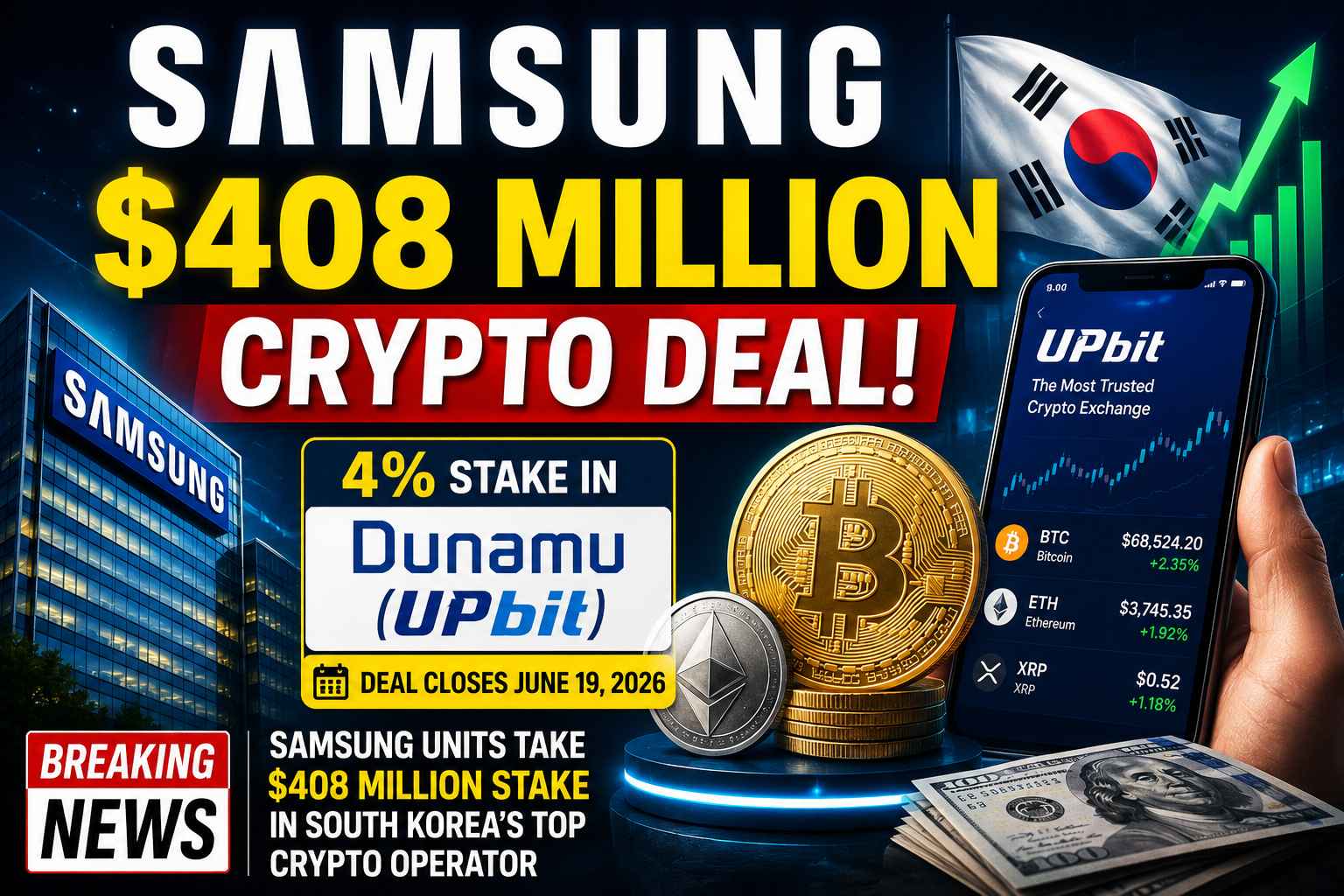
Samsung affiliates invest $408 million in Upbit operator Dunamu to expand blockchain infrastructure, tokenized securities, and stablecoin payment systems.
Inside the Deal: Why Samsung Just Dropped $408 Million on a Crypto Exchange
The Crypto Market Environment
The crypto sector is seeing a steady rotation toward established corporate infrastructure. According to regulatory filings released Thursday, multiple corporate affiliates within the Samsung ecosystem agreed to a substantial equity investment in Dunamu. Dunamu is the corporate operator of Upbit, which currently ranks as the leading cryptocurrency exchange in the region.
The transaction signals a calculated expansion into financial technology systems by one of the world’s major hardware conglomerates. The announcement drew significant attention in virtual asset markets, as the investment reflects growing enterprise interest in the space. Bitcoin traded near recent monthly highs following the announcement, while Asian crypto-related equities also saw increased trading activity.
For global investors tracking corporate blockchain expansion in Asia, the transaction offers insight into how traditional finance firms are approaching virtual assets. Rather than focusing purely on retail trading volume, this acquisition targets enterprise integration. It provides a clear framework for how legacy banking and payments continue to interface with new technology.
The Core Catalyst: A $408 Million Strategy
Based on corporate disclosures, the total transaction value is 612.8 billion won, equivalent to roughly $408 million. The three acquiring companies will purchase exactly 1.39 million shares. These shares are being acquired directly from a group of established corporate affiliates in an all-cash block sale.
This investment represents a combined 4 percent equity stake in Dunamu. Local South Korean media reports indicated that the primary objective is to build new business models aligned with the broader crypto market. These models move beyond standard exchange operations into traditional financial integrations.
The deal is fully structured and scheduled to close on June 19, 2026. Investors and market analysts are monitoring this timeline to track the official transfer of capital and equity. A well-structured buyout in a developing sector often sets a valuation benchmark for future mergers and acquisitions.
Inside the Numbers: The Equity Deal
| Transaction Detail | Disclosed Data |
|---|---|
| Total Investment Amount | $408 Million (612.8 Billion Won) |
| Total Shares Acquired | 1.39 Million Shares |
| Target Company | Dunamu (Upbit Operator) |
| Combined Stake Acquired | 4 Percent |
| Scheduled Closing Date | June 19, 2026 |
The Three Corporate Pillars: Who Bought What
The acquisition involves three distinct corporate units, each bringing specific technical or financial capabilities to the virtual asset space. Samsung Securities leads the group, acquiring a 2 percent stake in Dunamu. Their objective focuses on integrating crypto products into their existing wealth management services.
A company spokesperson noted their intention to strengthen cooperation in token securities issuance and digital distribution. They aim to expand virtual asset services tailored for high-net-worth and enterprise clients. This positions the securities division directly in the center of modern financial technology systems.
Samsung SDS and Samsung Card are each taking a 1 percent stake to round out the $408 million transaction. This structured division of equity indicates a multipronged approach to capturing different segments of the crypto ecosystem. The combined effort leverages hardware, software, and consumer finance capabilities.
Corporate Acquisition Breakdown
| Acquiring Affiliate | Stake Acquired | Primary Strategic Focus |
|---|---|---|
| Samsung Securities | 2 Percent | Token securities issuance and enterprise virtual asset services. |
| Samsung SDS | 1 Percent | Enterprise IT, cloud computing, and cybersecurity operations. |
| Samsung Card | 1 Percent | Stablecoin payments and Monimo platform integration. |
Samsung Securities and Tokenization
Tokenization involves placing traditional financial assets directly onto a distributed ledger network. This sector includes stocks, corporate bonds, real estate, and private equity funds. Samsung Securities is targeting this specific area heavily through their new Dunamu partnership.
Tokenized securities offer immediate settlement, highly accessible fractional ownership, and transparent trading records. They reduce the reliance on legacy clearinghouses that handle traditional financial trade settlements. Major Wall Street firms in New York are already deploying tokenized money market funds today.
By partnering with the operator of the region’s dominant exchange, the securities division can bypass the lengthy process of building a trading platform from scratch. They plan to leverage Upbit’s existing liquidity and technology framework. This accelerates their time to market in the evolving securities distribution sector.
Samsung SDS and Infrastructure
Samsung SDS operates as an enterprise IT and cloud services provider. Their 1 percent stake is accompanied by a mandate to integrate their cloud computing and data management expertise with Dunamu’s operations. The IT services company plans to expand next-generation financial technology systems for domestic banks.
A core component of this integration involves upgrading enterprise data protection. Corporate clients require rigorous compliance and security standards before deploying capital into virtual assets. The partnership may strengthen enterprise-level security capabilities for the exchange, facilitating safer scaling for large-scale trading volume.
This technical alliance ensures that the ecosystem operates under strict operational standards. It allows the platform to handle spikes in trading volume while maintaining system integrity. Stable IT operations are a baseline requirement for modern corporate finance.
Samsung Card and the Monimo Platform
Samsung Card represents the consumer-facing payments arm of this transaction. Their 1 percent stake ties directly to building a payment ecosystem using virtual assets. The primary target for this integration is Monimo, the unified financial application serving the Samsung Financial Networks ecosystem.
Management stated they are exploring crypto-based payment services on this specific platform. According to company statements, full integration would proceed more smoothly if won-based stablecoins are introduced into the domestic market. This highlights the growing utility of stablecoins in modern retail banking.
A stablecoin pegged to the national currency allows for frictionless transactions and eliminates the price volatility normally associated with assets like Bitcoin. This makes stablecoins highly practical for everyday consumer payments and corporate treasury management. The strategic move ensures the payment division has a direct line to exchange operations when these assets gain wider regulatory approval.
The Sellers: A Complete Corporate Exit
In this transaction, the sellers consist of a consortium of Kakao affiliates. According to filings, the list includes Kakao Investment, Kakao Ventures, the Kakao Youth Entrepreneurship Fund, and the KIF-Kakao Woori Bank Technology Finance Investment Fund. The block sale allows the seller to fully exit its ownership position in the exchange operator.
With this coordinated transfer of shares, Kakao is clearing its remaining equity in Dunamu. This allows the entity to recover capital and redeploy it into its own core technology initiatives. Analysts are tracking this transfer of ownership, as it reflects evolving corporate alignments within the region’s technology sector.
The exit shifts corporate influence over the exchange operator from the Kakao ecosystem to a new set of stakeholders. This transition is a standard outcome in corporate venture capital when early-stage investments mature into established enterprises.
Regulatory Environment and Market Caution
While the acquisition points to industry growth, some analysts remain cautious about regulatory uncertainty surrounding stablecoins and tokenized securities. Compliance standards continue evolving, particularly in Asian markets where authorities are carefully measuring the impact of virtual assets on traditional banking. Investors must weigh these regulatory variables when assessing the long-term value of financial technology systems.
Singapore and Hong Kong have introduced clearer licensing frameworks for crypto firms in recent years, prompting other jurisdictions to update their own financial guidelines. The transaction highlights increasing competition in Asian financial markets. The success of this corporate integration will depend heavily on upcoming regulatory decisions regarding fiat-pegged tokens and security classifications.
Strategic Takeaways for the US Investor
For US investors monitoring the broader technology and financial sectors, this transaction offers several actionable insights regarding industry direction. Tracking corporate capital flow provides a reliable method for identifying long-term financial trends.
- Corporate Investment: Companies are directing capital toward physical operations, including exchanges, data management, and payment rails, rather than just acquiring retail tokens.
- The Stablecoin Utility: The focus on won-based stablecoins indicates that frictionless fiat payments remain a primary goal for mass retail crypto adoption.
- Tokenization Trends: The push for tokenized securities confirms that traditional financial products are increasingly migrating to distributed ledger technology.
- Strategic Alliances: Partnering with established technology firms provides crypto exchanges with the operational credibility needed to attract enterprise clients.
- Regulatory Milestones: Market participants should monitor how regional regulatory bodies classify and govern these new virtual assets, as compliance will dictate the pace of integration.
Frequently Asked Questions (FAQ)
What exactly did the corporate affiliates purchase?
Based on regulatory disclosures, three distinct corporate units agreed to acquire a combined 4 percent equity stake in Dunamu. Dunamu is the corporate operator of Upbit, South Korea’s leading cryptocurrency exchange. The group purchased 1.39 million shares in an all-cash transaction.
How much did this equity acquisition cost?
The total transaction value is 612.8 billion won. In US currency, this equates to roughly $408 million. The deal represents a notable enterprise investment into financial technology systems and exchange operations.
Which specific corporate units are involved in the deal?
Samsung Securities is acquiring a 2 percent stake to focus on tokenized securities. Samsung SDS is taking a 1 percent stake to provide enterprise cloud and IT support. Samsung Card is acquiring a 1 percent stake to explore stablecoin integration within its payment platforms.
Who sold the 1.39 million shares to the group?
The shares were purchased directly from a consortium of Kakao affiliates, including Kakao Investment and Kakao Ventures. The block sale allows these sellers to fully exit their ownership position in the exchange operator and reallocate their capital.
When is the transaction officially scheduled to close?
According to company filings, the acquisition date is officially set for June 19, 2026. This timeline provides a clear window for the legal transfer of the 1.39 million shares and the final settlement of the $408 million payment.
Financial Disclaimer
This article is strictly for informational and educational purposes only. It does not constitute financial advice, investment recommendations, or an offer to buy or sell any virtual assets, securities, or corporate equities. The stock market and crypto sector involve significant financial risk, and past performance does not guarantee future results.
All financial metrics, equity stakes, and corporate announcements mentioned are based on publicly available filings. Always conduct independent research or consult with a licensed financial advisor before executing any market strategy. The author holds no positions in the aforementioned corporate entities at the time of publication.
About the Author