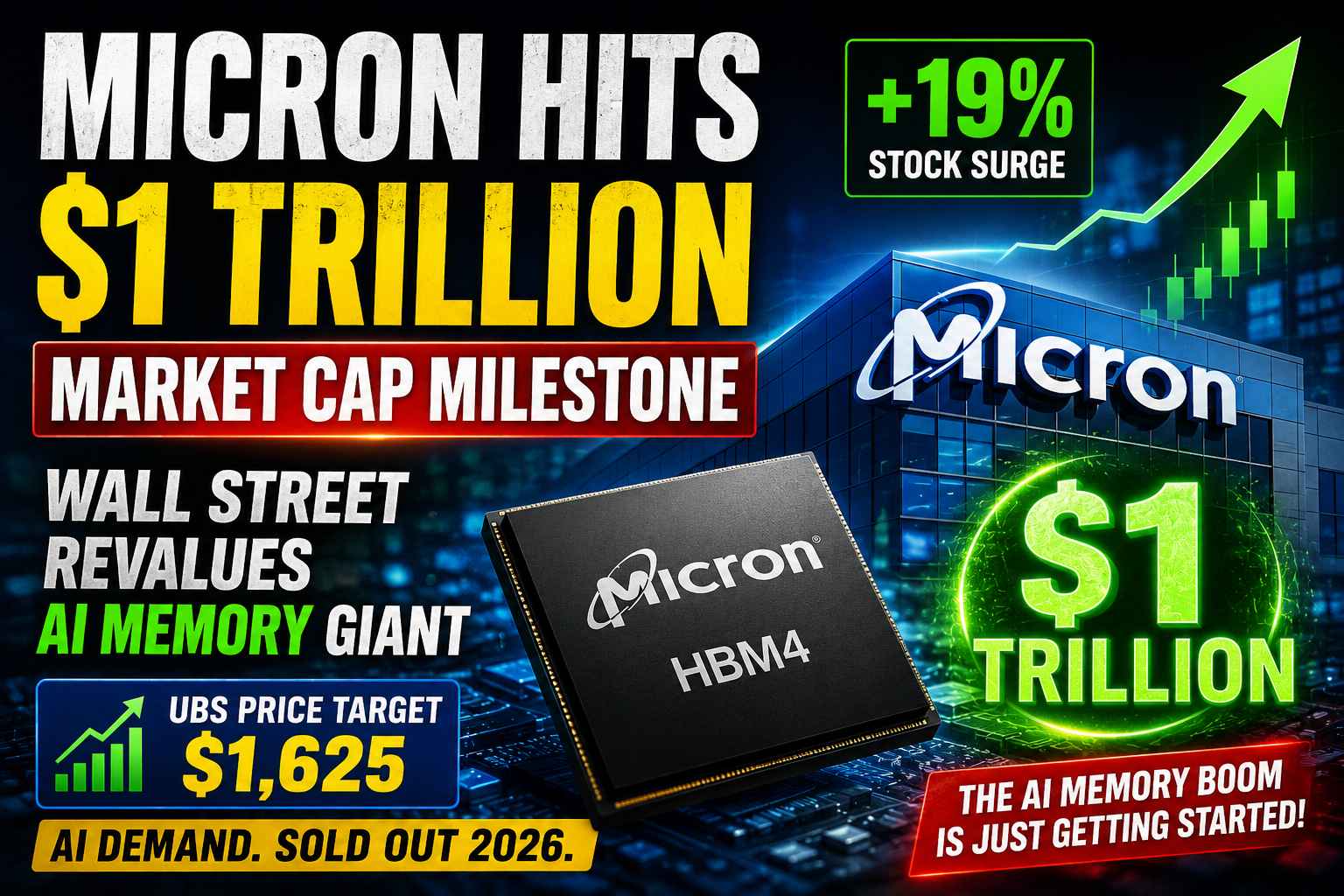
Micron Surges 19% as Wall Street Revalues the AI Memory Boom
Why Wall Street Is Revaluing Micron’s Role in the AI Infrastructure Build-Out
The semiconductor sector continues to command the attention of institutional and retail investors alike. On Tuesday, May 26, 2026, Micron Technology achieved a significant financial milestone, crossing the $1 trillion market capitalization threshold. According to data provided by LSEG, the stock closed the session at $895.88, representing a 19.29% single-day advance and pushing the company’s valuation to roughly $1.01 trillion.
For investors actively monitoring the technology landscape, the core question centers on the fundamental drivers behind this price action. Wall Street analysts increasingly believe the artificial intelligence era could structurally improve long-term memory pricing, altering the traditional cyclical nature of the business. As cloud service providers race to expand data center capacity, advanced memory components are becoming just as critical as the processing units themselves.
However, navigating a stock that has climbed from a 52-week low of $92.22 to near $900 requires careful analysis rather than pure momentum chasing. By examining recent earnings data, institutional fund flows, and analyst notes, investors can better understand whether this valuation reflects a permanent structural shift or a highly elevated cyclical peak.
Key Takeaways for Investors
- Historic Milestone: Micron’s market capitalization surpassed $1 trillion following a 19% single-session rally on May 26, 2026.
- Earnings Catalyst: The company’s recent quarterly revenue nearly tripled to $23.9 billion, significantly beating consensus estimates of $19.2 billion.
- Analyst Revisions: UBS raised its price target to a Street-high of $1,625, citing enhanced visibility from long-term memory supply agreements.
- Market Impact: The strong semiconductor performance helped push the Nasdaq Composite past the 26,600 mark and the Nasdaq 100 above 30,000 for the first time.
- Risk Factors: Despite the optimism, elevated options metrics like the SKEW index indicate institutions are actively hedging against potential downside volatility.
What Triggered the Recent Stock Surge?
The immediate catalyst for Tuesday’s strong performance was a combination of robust earnings data and a significant analyst upgrade. Before the market opened, UBS analyst Timothy Arcuri issued a research note that substantially revised the firm’s outlook on the memory manufacturer. According to the note, UBS raised its price target on Micron from $535 to $1,625 per share.
Price target adjustments of this magnitude are relatively uncommon for mega-cap equities. UBS justified the revision by highlighting that Micron should benefit from long-term memory supply agreements with major buyers, which could lock in pricing and demand visibility through 2029. The firm noted that these AI-driven changes improve the durability and stability of the memory market, potentially mitigating a key risk factor that has historically weighed on the stock’s valuation.
Furthermore, this upgrade arrived shortly after Micron released exceptional quarterly results. According to the company’s fiscal earnings report, operating margins expanded aggressively from 22% in the prior period to 67.6%. This margin expansion suggests that the higher prices commanded by advanced memory chips are flowing directly to the bottom line.
The Structural Shift in Memory Supply
To understand the institutional interest in Micron, investors must look at the underlying technology driving data center construction, specifically High Bandwidth Memory (HBM). Modern AI models process massive datasets, requiring memory architectures that can feed information to graphics processing units (GPUs) at unprecedented speeds.
HBM stacks memory chips vertically, drastically reducing power consumption while increasing data transfer rates. According to industry reports, major technology companies—including Nvidia, Google, and Amazon—are competing for limited HBM capacity. Micron management recently confirmed that the company’s HBM capacity is essentially sold out through calendar year 2026.
When a manufacturer cannot meet total market demand, it typically gains significant pricing power. Wall Street is currently modeling a scenario where hyperscalers are willing to sign multi-year contracts with fixed pricing simply to guarantee supply. This transition from volatile spot-market pricing to long-term infrastructure contracts is the primary thesis driving recent institutional upgrades.
Quick Stats: Micron’s May 2026 Financial Picture
- May 26 Closing Price: $895.88
- 52-Week Range: $92.22 – $956.16
- Quarterly Revenue: $23.9 Billion (Up 196% YoY)
- Adjusted EPS: $12.20 (vs. $8.65 Consensus Estimate)
- Forward P/E Ratio: Approximately 15x to 17x (Based on LSEG estimates)
How AI Demand is Reshaping the Semiconductor Industry
The semiconductor industry is experiencing a bifurcated recovery. While automotive and traditional consumer electronics chips face varying levels of demand, AI-focused silicon is in a severe supply deficit. According to Mizuho analyst Vijay Rakesh, who recently reiterated an Outperform rating on the stock, there is currently no clear line of sight on when the supply-demand imbalance for advanced memory will end.
This dynamic has forced the market to revalue companies involved in the AI supply chain. Historically, investors applied low price-to-earnings multiples to memory manufacturers due to the boom-and-bust nature of the commodity cycle. During down cycles, such as the one experienced in fiscal 2023 when Micron’s sales declined 49%, earnings can evaporate entirely.
However, if AI infrastructure requires constant, predictable upgrading over the next decade, the memory market may resemble a more stable utility model. Analysts increasingly believe that the baseline floor of the current cycle will be significantly higher than in previous decades, supported by the sheer volume of capital expenditures committed by major cloud service providers.
Institutional Ownership and ETF Flows
Retail investors often focus on individual stock fundamentals, but passive capital flows play a massive role in mega-cap valuations. Micron’s rapid appreciation has increased its weighting across major indices, forcing index funds to purchase additional shares to maintain balance.
For example, the Invesco Dynamic Large Cap Growth ETF (PWB) recently held a 6.1% weighting in Micron, up from 3.33% earlier in the year due to price appreciation alone. When the fund rebalances, it will trim that position back to its target weight, but the underlying institutional demand remains strong. Similarly, funds tracking the S&P 500 and the Nasdaq 100 must allocate billions of dollars toward the stock as its market capitalization expands.
Firms like Vanguard, BlackRock, and State Street manage trillions in passive assets. When a company crosses the $1 trillion threshold, it becomes a core holding in almost every major growth and technology portfolio globally. This mechanical buying pressure provides a layer of liquidity and support that smaller companies do not enjoy.
Retail Investor Sentiment and Options Activity
While institutional capital provides the foundation, retail sentiment and options market mechanics often drive short-term volatility. Retail engagement on platforms like Reddit and StockTwits has surged, with discussions frequently comparing Micron’s current trajectory to Nvidia’s breakout in 2024.
However, the professional options market is quietly telling a more nuanced story. According to Saxo Bank’s market analysis desk, while the headline VIX (Volatility Index) remained relatively calm near 17 on Tuesday, the SKEW index climbed to 139.04. The SKEW index measures the perceived tail risk in the market.
An elevated SKEW reading indicates that institutional players are actively paying a premium for downside put options. They are participating in the upward momentum but simultaneously purchasing insurance against a potential macroeconomic shock or a sudden reversal in semiconductor sentiment. Retail investors should note this cautious undertone beneath the surface-level optimism.
Micron vs Nvidia and Historical Comparisons
Comparisons within the sector offer valuable context. Nvidia currently commands a market capitalization of approximately $5.45 trillion, reflecting its absolute dominance in AI processing units. Micron, at $1.01 trillion, provides the complementary memory required to make those processors function efficiently.
Some value-oriented investors argue that Micron presents a more attractive entry point based on traditional valuation metrics. Trading at a forward price-to-earnings ratio near 15, based on consensus estimates, it appears cheaper than many of its large-cap technology peers. By contrast, Nvidia’s multiple relies on hardware sales continuing at a historically unprecedented pace.
Veteran market watchers also draw comparisons to Cisco Systems during the dot-com build-out of 2000. Cisco provided the physical routing infrastructure for the early internet, experiencing a massive valuation spike before the cycle eventually normalized. The key difference bulls highlight today is that the current AI build-out is generating immediate, tangible revenue and cash flow for the hyperscalers, rather than relying on speculative business models.
Investor Snapshot: Analyzing the Financial Health
Based on Micron’s most recent fiscal disclosures, the company is operating with significant fundamental strength:
- Net Income: Jumped to $13.8 billion in the recent quarter, showcasing extreme operational leverage.
- Future Revenue Estimates: Analysts polled by LSEG expect fiscal 2026 revenue to total $109.30 billion, growing to an estimated $178.68 billion in fiscal 2027.
- EPS Projections: Consensus estimates target $57.78 per share for fiscal 2026, increasing to over $100 per share in 2027.
Risks and Neutrality: Why Some Investors Remain Cautious
Prudent financial journalism requires acknowledging the inherent risks in purchasing equities near all-time highs. The primary vulnerability for Micron, and the broader semiconductor sector, is a potential slowdown in capital expenditures by the major technology firms.
If companies like Microsoft, Meta, and Alphabet determine that their AI infrastructure is sufficient, or if AI monetization fails to keep pace with hardware costs, orders for new servers will decline rapidly. In that scenario, the memory market’s cyclical nature would likely reassert itself, leading to inventory gluts and collapsing profit margins.
Furthermore, geopolitical risks remain a persistent headwind. Supply chains in the semiconductor industry are incredibly complex and reliant on international trade stability. Any escalation in trade restrictions involving China or tensions in East Asia could disrupt both raw material sourcing and end-market sales.
Finally, valuation concerns cannot be ignored. A stock that appreciates by nearly 800% in a 12-month period is highly susceptible to mean reversion. Profit-taking by early investors and hedge funds could trigger sharp, sudden corrections, even if the underlying business remains fundamentally sound.
What This Means for the Broader Stock Market
Micron’s milestone is heavily intertwined with broader market performance. On the day the stock surged 19%, the S&P 500 rose 0.57% to close at 7,516.11, and the Nasdaq Composite climbed 1.00% to 26,606.90. More notably, the tech-heavy Nasdaq 100 index closed above the 30,000 level for the first time in history.
This indicates that market breadth is highly dependent on semiconductor performance. The “AI trade” is no longer isolated to one or two companies; it has broadened to include infrastructure providers, energy companies, and memory manufacturers. However, this concentration also means that any weakness in the chip sector will heavily impact major passive index funds.
Future Outlook for Micron Stock
Looking toward the remainder of 2026 and into 2027, Micron’s trajectory will likely be determined by execution rather than narrative. The company has secured the necessary demand and established pricing power; the challenge now is scaling manufacturing yields for complex HBM4 architectures.
Analysts expect the current cycle to remain robust through at least fiscal 2027. Morningstar analysts note that while the business is traditionally cyclical, the sheer volume of data generated by AI applications creates a strong secular tailwind. The debate on Wall Street is no longer about whether Micron will grow, but whether that growth justifies a permanent multiple expansion comparable to software companies.
Final Takeaway for Investors
Micron Technology joining the $1 trillion club reflects a material shift in how Wall Street values the memory segment of the semiconductor industry. The massive earnings beats and aggressive analyst upgrades suggest that the financial benefits of the AI revolution are flowing heavily into critical infrastructure providers.
However, investors should maintain a disciplined approach. While the long-term contracts and sold-out capacity provide excellent visibility, the stock’s historic run makes it vulnerable to short-term volatility and macroeconomic shifts. Balancing the undeniable structural growth of AI memory demand against traditional valuation metrics and cyclical risks remains the most prudent strategy for long-term capital allocation.
Data and Metrics Tables
Stock Performance Metrics (As of May 26, 2026)
| Metric | Latest Data | Previous Close | Change % |
|---|---|---|---|
| Closing Price | $895.88 | $751.00 | +19.29% |
| Market Capitalization | $1.04 Trillion | $854.64 Billion | +19.29% |
| 52-Week High | $956.16 | N/A | N/A |
| 52-Week Low | $92.22 | N/A | N/A |
Wall Street Analyst Perspectives
| Firm | Recent Action | Price Target | Primary Thesis |
|---|---|---|---|
| UBS | Upgrade / Target Hike | $1,625 | Long-term supply agreements lock in pricing and improve durability. |
| Mizuho | Reiterated Outperform | $800+ | No clear end in sight for the AI memory supply-demand imbalance. |
| Morningstar | Sector Analysis | Undervalued | Forward P/E of 15 remains cheap relative to historic growth rates. |
AI Infrastructure Market Capitalizations (May 2026)
| Company | Market Cap | Role in AI Ecosystem |
|---|---|---|
| Nvidia (NVDA) | $5.45 Trillion | Dominant designer of advanced AI graphics processing units. |
| Broadcom (AVGO) | $1.57 Trillion | Custom silicon and critical data center networking switches. |
| Micron (MU) | $1.01 Trillion | Primary US supplier of high-bandwidth memory for AI servers. |
| AMD (AMD) | $576 Billion | Alternative supplier of data center GPUs and standard processors. |
| Intel (INTC) | $216 Billion | Legacy CPU provider transitioning toward domestic foundry services. |
Frequently Asked Questions (FAQ)
Why did Micron stock surge nearly 19% in a single day?
The stock surged primarily due to an aggressive price target upgrade from UBS to $1,625, combined with a recent earnings report where revenue jumped 196% year-over-year. Wall Street is reacting to the company’s sold-out capacity and transition toward stable, long-term supply contracts.
What is High Bandwidth Memory (HBM)?
HBM is an advanced memory architecture that stacks chips vertically. This design drastically increases the speed at which data can be transferred to a processor while using less power, making it a mandatory component for modern artificial intelligence data centers.
Is the semiconductor memory industry still considered cyclical?
Historically, yes. The industry has frequently experienced boom-and-bust cycles based on supply and demand imbalances. However, analysts are currently debating whether the massive, sustained infrastructure spending required for AI will create a higher baseline floor, reducing future volatility.
What risks should investors consider before buying semiconductor stocks?
The primary risks include a potential slowdown in capital spending by major tech companies, geopolitical tensions affecting global supply chains, and the possibility of valuation multiples contracting if growth expectations are not perfectly met.
How does Micron’s valuation compare to Nvidia?
While Nvidia commands a much larger market capitalization ($5.45 trillion vs. Micron’s $1.01 trillion), some analysts point out that Micron trades at a lower forward price-to-earnings multiple (roughly 15x). Both companies are critical to the AI build-out, but they serve different foundational roles.
About the Author