
Amazon stock remains above key support near $265 while traders closely monitor the $270 resistance level for a potential breakout.
Amazon Stock Holds Above $265 as Investors Watch Key Breakout Level
Why Amazon Stock Is Back in Focus
The recent price action in NASDAQ AMZN is drawing significant attention from both retail traders and institutional fund managers. The company’s core retail business is experiencing steady margin expansion, largely due to a highly optimized regional fulfillment network that lowers delivery costs while increasing speed.
On the technology front, Amazon Web Services (AWS) remains the undisputed profit engine. With the cloud market shifting back to a growth phase, enterprise clients are aggressively scaling their infrastructure. This aggressive push into next-generation technology explains why billionaires still see Amazon (AMZN) as a top blue-chip AI stock. The company is offering full-stack solutions, from custom silicon to advanced AI model orchestration capabilities, capturing heavy institutional interest.
What Analysts Are Saying About Amazon Stock
Wall Street coverage on AMZN remains robust, with major financial institutions updating their price targets to reflect recent cloud revenue stabilized growth.
The Bullish View
Bullish analysts argue that Amazon is entering an unprecedented era of free cash flow generation. Because the massive capital expenditure cycle required to build out its fulfillment network is largely complete, the company is reaping the financial rewards. Furthermore, high-margin revenue from digital advertising and AWS AI deployments is padding the bottom line.
The Neutral View
Neutral analysts acknowledge the company’s structural strength but cite valuation as a limiting factor. At a $2.85 trillion market cap, capturing massive percentage growth is mathematically difficult. These analysts prefer to hold the stock rather than aggressively add to positions at current levels, waiting for slight pullbacks to improve the risk-reward ratio.
Key Risks
The primary risks cited by analysts include macroeconomic headwinds. If inflation remains sticky and consumer spending slows down, Amazon’s retail sector will feel the pressure. Additionally, shifting monetary policy—such as the recent Fed leadership transition and broader market updates—can heavily influence borrowing costs for both Amazon and its consumer base.
Amazon Stock Performance Over the Past Week
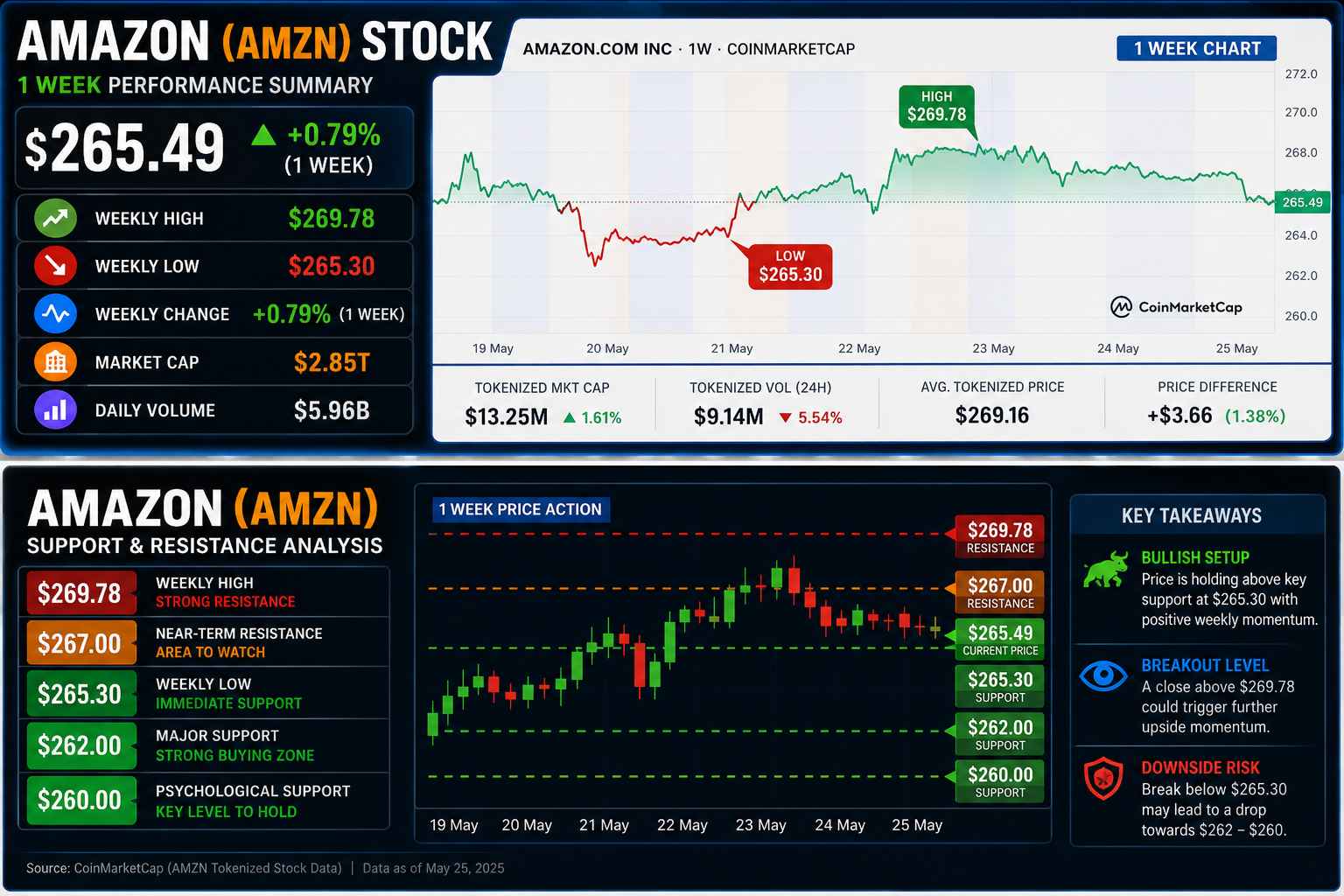
Tracking the current numbers gives investors a clear picture of the tight consolidation AMZN is currently experiencing.
| Metric | Value |
|---|---|
| Current Price | $265.49 |
| Weekly High | $269.78 |
| Weekly Low | $265.30 |
| Weekly Change | ~ +1.38% |
| Market Cap | ~$2.85 Trillion |
Technical Analysis: Support and Resistance
For swing traders and technical analysts, defining risk parameters is crucial for navigating the current Amazon stock price action.
Support Levels
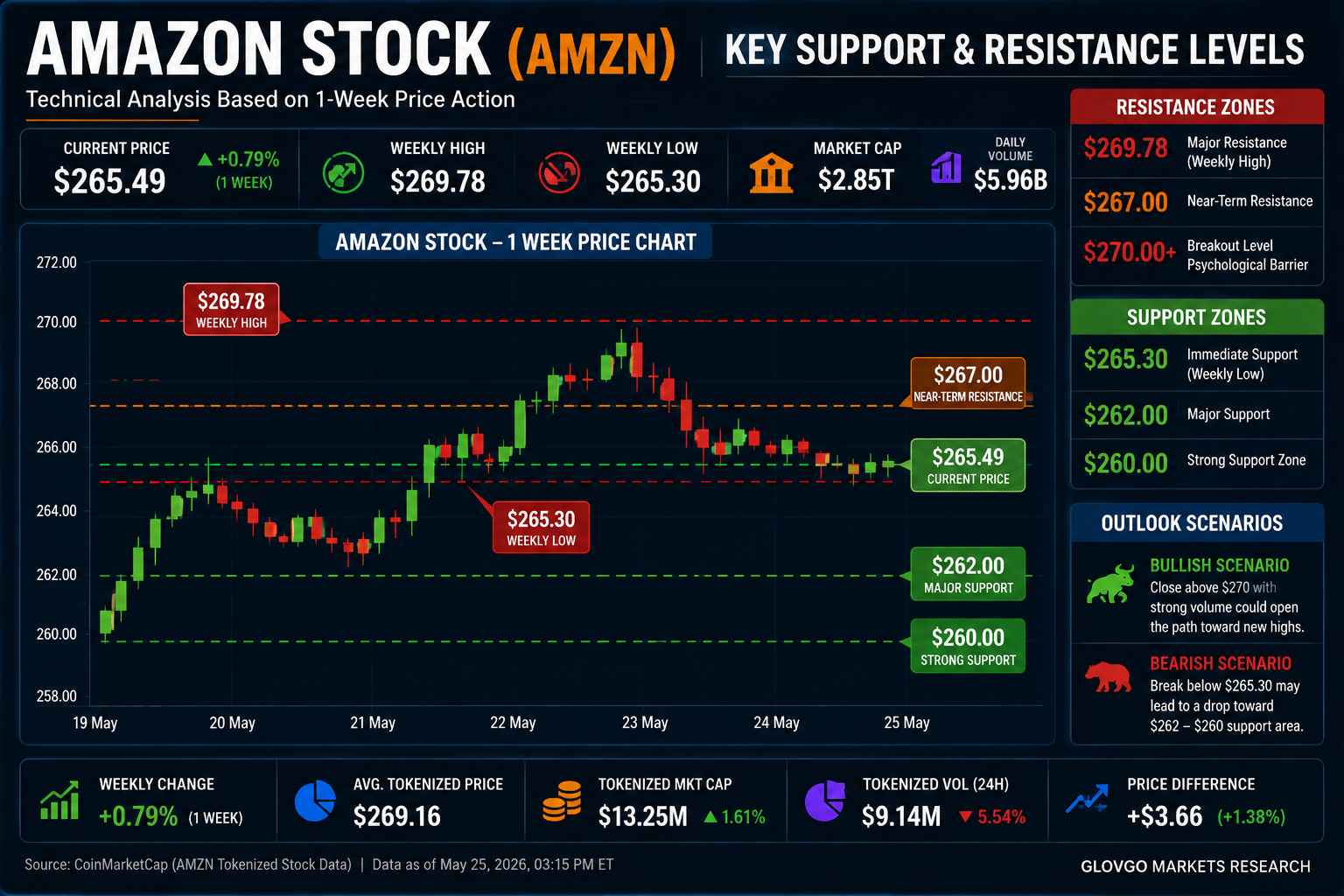
Immediate support is clearly defined at the recent weekly low of $265.30. If selling pressure increases, the $260 psychological level serves as the next major floor. The rising 50-day moving average is also trailing closely, offering dynamic support.
Resistance Levels
The immediate ceiling is the recent peak of $269.78. The $270 mark is a massive resistance level. If AMZN can secure a daily close above $270 on higher-than-average volume, technical traders will likely interpret it as a definitive breakout signal, paving the way for a test of all-time highs.
Amazon Stock: Bull vs Bear Factors
Evaluating the core arguments for and against the stock provides a balanced perspective for long-term investors.
| Bullish Factors | Bearish Factors |
|---|---|
| AWS growth recovery | Economic slowdown |
| AI infrastructure demand | Competition from Microsoft |
| Advertising revenue growth | Regulatory pressure |
| Margin expansion | Valuation concerns |
How Amazon Fits into the Broader Tech Landscape
While traditional tech stocks like Amazon offer foundational stability, investor capital is increasingly rotating across different asset classes looking for alpha. While AMZN provides a safe haven via steady cloud and retail revenue, high-risk capital often shifts toward digital assets. For instance, institutional interest remains high in crypto markets, as seen in comprehensive Bitcoin market strategies, or the aggressive momentum of niche sectors like the recent AI music crypto rally on the BNB chain. However, for core portfolio building, Amazon’s tangible cash flow makes it a standard anchor asset.
Should Investors Buy Amazon Stock Now?
The decision to initiate or add to an Amazon position depends largely on your time horizon. The stock is holding its ground exceptionally well above $265. If you are a short-term trader, keeping a close eye on the $270 breakout level is essential. For long-term investors, Amazon’s unmatched logistics network, sticky Prime ecosystem, and dominant AWS market share create a structural moat that is incredibly difficult for competitors to breach.
Frequently Asked Questions (FAQs)
1. Is Amazon stock a good investment?
Amazon remains a core holding for many institutional and retail portfolios due to its strong free cash flow and leadership in both e-commerce and cloud computing.
2. Why is Amazon stock rising?
The stock is maintaining upward momentum due to improving retail margins, stabilized AWS revenue, and heavy institutional investments in the company’s AI infrastructure.
3. What is Amazon’s market cap?
Currently, Amazon’s market capitalization stands at approximately $2.85 trillion.
4. Can Amazon reach new highs?
If the company breaks past the $270 resistance level and continues to show strong quarterly earnings, it is fundamentally positioned to test new highs.
5. What affects AMZN stock price?
The stock price is driven by AWS growth metrics, retail sales volume, digital advertising revenue, and broader macroeconomic factors like Federal Reserve interest rates.
6. Is Amazon still a growth stock?
Yes. Despite its massive size, high-margin segments like AWS and digital advertising keep Amazon firmly categorized as a growth stock by Wall Street.
7. What are analysts watching?
Analysts are laser-focused on operating margin expansion, the adoption rate of Amazon’s AI tools (like Bedrock), and the overall health of the US consumer.
8. Does AWS drive Amazon valuation?
Yes. While e-commerce brings in massive revenue, AWS generates the majority of Amazon’s operating profit, acting as the primary driver of its overall valuation.
9. What risks should investors consider?
Investors should watch for potential antitrust regulatory pressure from the FTC and intense cloud computing competition from Microsoft Azure and Google Cloud.
10. How can beginners evaluate Amazon stock?
Beginners should monitor the company’s quarterly earnings reports, pay attention to revenue growth in specific segments (like retail vs. cloud), and follow basic technical support and resistance levels.
Disclaimer: This article is for informational and educational purposes only and should not be considered financial or investment advice. The Amazon stock price and Amazon market cap figures fluctuate during trading hours. Investors should conduct their own research and consult a licensed financial advisor before making any investment decisions.
About the Author