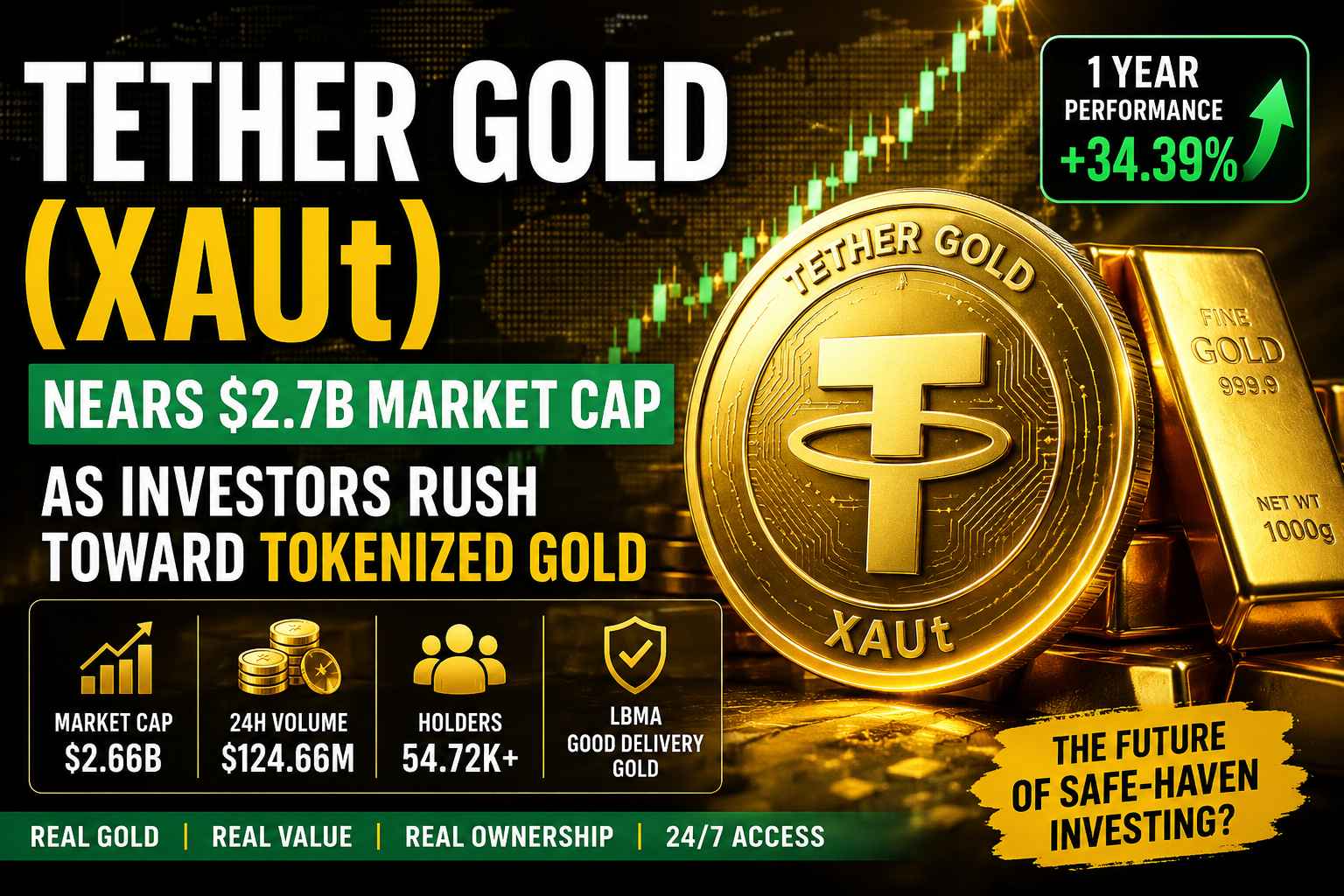
Tether Gold (XAUt) approaches a $2.7 billion market capitalization as growing demand for tokenized gold highlights the expansion of Real World Assets (RWA) in the cryptocurrency market.
Tether Gold (XAUt) Nears $2.7B Market Cap as Investors Rush Toward Tokenized Gold Amid Shifting Macroeconomic Policy
The global financial ecosystem is currently witnessing a historic migration of capital. As the boundaries between legacy commodity markets and decentralized blockchain networks continue to blur, Real-World Assets (RWAs) have emerged as a dominant narrative within the digital asset space. At the absolute center of this structural shift is Tether Gold (XAUt), a tokenized asset that has quietly expanded into a multi-billion dollar financial powerhouse.
For decades, physical gold has served as the ultimate safe-haven asset, historically utilized to protect generational wealth against fiat currency debasement and macroeconomic instability. However, in the modern, hyper-connected trading era, physical gold is increasingly viewed as cumbersome, expensive to store, and highly illiquid. Today’s investors are no longer content with relying solely on traditional brokers or paper-backed Exchange-Traded Funds (ETFs) that restrict trading to standard banking hours. Instead, a massive wave of capital is flowing directly into blockchain-based commodity alternatives.
Recent verified market data reveals that Tether Gold (XAUt) is rapidly approaching a $2.7 billion market capitalization, driven by a sharp influx of both institutional and retail adoption. Over the past year, Tether Gold (XAUt) has gained more than 34%, significantly outperforming traditional inflation metrics while reinforcing its appeal as a blockchain-based safe-haven asset. This sudden acceleration in network activity is not a random speculative event. It represents a calculated move by investors seeking the historical stability of precious metals combined with the 24/7 agility of cryptocurrency.
Why Investors Are Moving Toward Tokenized Gold in 2026
To understand the sudden surge in attention surrounding Tether Gold (XAUt), market participants must analyze the broader macroeconomic environment shaping investor psychology in 2026. Capital naturally flows to where it is treated best, and currently, investors are aggressively seeking shelter from a complex storm of global financial uncertainties and shifting monetary policies.
A primary catalyst driving capital into gold-backed tokens is the current news flow surrounding the United States Federal Reserve. According to verified news headlines visible across financial terminal dashboards, the market is actively digesting the swearing-in of Kevin Warsh as the new Federal Reserve Chairman. Warsh has publicly pledged to lead a “Reform Oriented Federal Reserve.” However, the political and economic commentary surrounding this transition highlights a deep structural tension.
Headlines note that President Trump, present at the swearing-in ceremony, stated that when the economy is booming, officials do not “have to go crazy with rate hikes,” actively highlighting that U.S. stocks are hitting record highs. Conversely, Federal Reserve Governor Waller, speaking in Frankfurt, delivered a strictly hawkish message. Waller stated that he does not “expect to support a change to the policy rate near term,” emphasizing that the jobs market has stabilized but “inflation [is] the driving force.” Waller explicitly noted a desire to remove any “easing bias” from the market.
For global investors, this tug-of-war between political desires for economic growth and central bank mandates to crush inflation creates massive fiat currency uncertainty. When central bank officials warn that markets are underpricing the risk of prolonged high energy prices—supported by data showing U.S. Baker Hughes oil and gas rigs increasing by 7 to a total of 558—investors historically rotate into commodities. Tokenized gold offers a direct, frictionless solution to this demand, allowing market participants to hold a hard asset on a decentralized ledger outside the traditional banking apparatus.
Current Market Performance and Liquidity
The transition from a compelling macroeconomic narrative to a mature financial asset is proven through verified on-chain and exchange data. Evaluating the current market snapshot provides critical insight into the liquidity profile and valuation of Tether Gold (XAUt).
The asset currently demonstrates a highly robust market presence, characterized by substantial market capitalization and active daily trading volume. This reflects consistent, heavy demand across global cryptocurrency exchanges.
| Market Metric | Current Verified Value |
|---|---|
| Current Price | $4,498.98 |
| Market Capitalization | $2.66 Billion |
| 24-Hour Trading Volume | $124.66 Million |
| Volume / Market Cap (24h) | 4.68% |
| 1-Year Price Performance | +34.39% |
| Total Value Locked (TVL) | $3.20 Billion |
Trading at $4,498.98 per token, the asset maintains a massive market capitalization of $2.66 billion. While short-term weekly metrics show a marginal consolidation of -0.53%, the long-term one-year performance indicates a robust appreciation of +34.39%. This clearly demonstrates that the asset is heavily utilized by long-term holders seeking capital appreciation tied directly to the underlying commodity.
Furthermore, the 24-hour trading volume of $124.66 million yields a Volume-to-Market-Cap ratio of 4.68%. In the context of stablecoins and commodity-pegged assets, a ratio near 5% indicates healthy, sustainable liquidity. It proves that there is consistent market turnover, allowing both retail traders and institutional desks to enter and exit large positions without causing significant price slippage.
What Is Tether Gold (XAUt) and How Does It Work?
To fully grasp why capital is flowing into this specific protocol, investors must understand the structural mechanics that govern the asset. Tether Gold (XAUt) is a digital token created by the same entity behind the world’s largest fiat-collateralized stablecoin, USDT. However, instead of being pegged to the U.S. Dollar, XAUt provides ownership on a 1:1 basis of one fine troy ounce of physical gold.
According to the official project documentation visible in the market data, the physical gold backing the token strictly meets the Good Delivery standard established by the London Bullion Market Association (LBMA). This is a critical distinction for institutional investors, as LBMA certification guarantees the highest global standards for purity, provenance, and physical security.
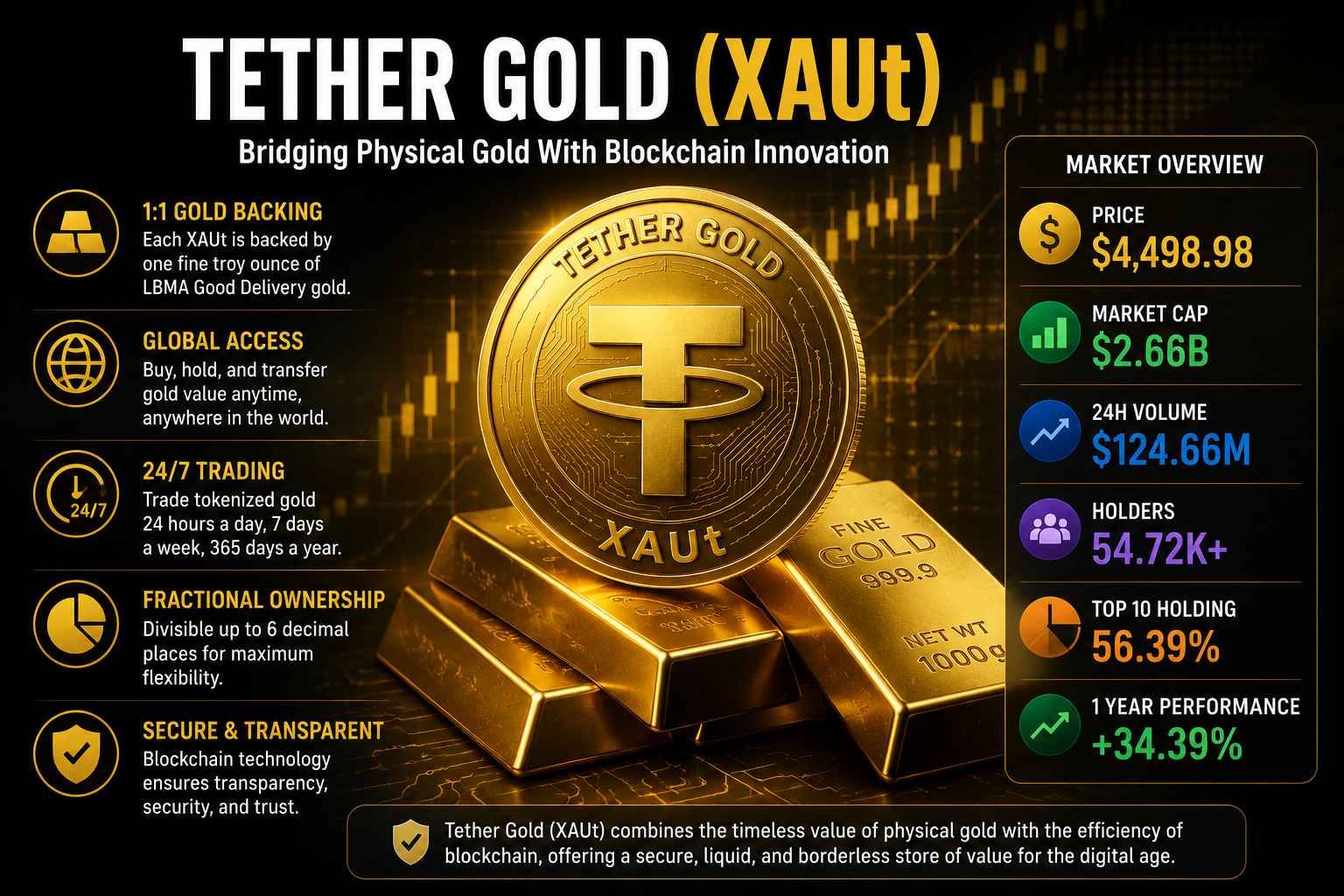
This technological framework completely abstracts the friction of physical custody. The blockchain architecture allows XAUt tokens to be fractionated up to six decimal places, meaning investors can purchase increments as small as 0.000001 of a troy fine ounce. This deep fractionalization radically democratizes access to gold investment. Historically, purchasing physical gold required significant capital outlays to acquire standard bars or coins. Today, a retail investor anywhere in the world can gain direct exposure to LBMA-certified gold with just a few dollars, utilizing nothing more than a smartphone and a decentralized wallet.
Analyzing Holder Data: Institutional Custody or Whale Dominance?
One of the most revealing metrics in decentralized finance is holder distribution. By analyzing who holds the supply, analysts can determine whether an asset is driven by widespread retail adoption or controlled by a small cohort of institutional players. The recent data for Tether Gold reveals a fascinating structural dynamic.
The verified data indicates a sharp, recent acceleration in network adoption, with the total number of unique wallet addresses climbing to 54.72K. This growing holder base confirms that retail awareness and adoption of tokenized gold are expanding rapidly. However, a deeper look at the supply distribution highlights a significant degree of concentration.
The top 10 wallet addresses currently control 56.39% of the total XAUt supply, while the remaining 43.61% is distributed among the broader base of over 54,000 holders. The single largest wallet commands 114.92K XAUt, representing over $517 million in value, which equates to 10.23% of the analyzed snapshot. The second-largest wallet holds 92.09K XAUt, valued at over $414 million.
While wallet ownership cannot be independently verified from public data alone, large balances of this size are often associated with exchange reserve hot wallets, institutional custodians, or treasury holdings rather than individual retail investors. This heavy concentration underscores the narrative that large-scale financial institutions, family offices, and crypto-native funds are utilizing XAUt for deep liquidity and capital preservation, relying on centralized infrastructure to secure their tokenized assets while offering fractional trading to their retail customer bases.
Fiat Market Pressures: EUR/USD Data Highlights the Macro Shift
The migration of capital into Real-World Assets like Tether Gold does not happen in a vacuum; it is a direct reaction to weakness and volatility in traditional fiat currency markets. While XAUt is seeing substantial growth, major fiat pairs are experiencing significant technical pressure.
Verified market data for the Euro to U.S. Dollar (EUR/USD) exchange rate provides a clear picture of this fiat volatility. The EUR/USD is currently trading lower at 1.16017, representing a daily decline of 0.13%. The technical indicators for the fiat pair contrast sharply with the bullish long-term trend of gold. The overall technical summary for EUR/USD displays a dominant 15 Sell signals against only 2 Buys. Furthermore, the moving averages gauge registers a “Strong Sell,” with the price residing below critical short- and long-term exponential moving averages.
Day traders monitoring the EUR/USD pair are closely watching the Classic Support 1 (S1) pivot level at 1.15414 as the price faces downward momentum. This technical weakness in fiat markets is exacerbated by resilient U.S. economic data, including a Q2 GDP Nowcast of 2.6%, which supports a “higher for longer” interest rate environment. As traders face technical breakdowns and liquidity disruptions in the forex markets—such as the upcoming May 25 Memorial Day and Pentecost Monday banking holidays—the 24/7 liquidity and hard-asset backing of Tether Gold become increasingly attractive alternatives for capital allocation.
Advantages Over Traditional Gold ETFs
While institutional capital allocators have historically relied on Exchange-Traded Funds (ETFs) to gain gold exposure, the emergence of RWA tokenization is rendering the traditional ETF model increasingly obsolete. Investors are rushing toward tokenized gold because it offers vast operational superiority.
Traditional gold markets and stock exchanges operate on archaic schedules, closing on weekends and public holidays. In contrast, Tether Gold (XAUt) trades 24 hours a day, 7 days a week, 365 days a year across global cryptocurrency exchanges. This uninterrupted liquidity is a massive competitive advantage. It allows institutional trading desks and retail investors to respond instantly to weekend geopolitical events or unexpected macroeconomic news, whereas ETF holders are forced to wait for the Monday morning opening bell, often suffering severe price gaps.
Furthermore, traditional ETFs carry management fees and administrative costs that slowly erode the investor’s principal over time. While Tether Gold does have inherent operational costs regarding the physical vaulting of the asset, the decentralized nature of the token allows it to be integrated directly into Decentralized Finance (DeFi) protocols. This programmability means investors can potentially use their tokenized gold holdings as collateral to take out loans or generate yield—a financial maneuver that is incredibly complex and legally burdensome to execute with shares of a traditional gold ETF.
Audiera (BEAT) Surges 113% as AI-Driven Web3 Music Network Captures Market Attention
Potential Risks and Considerations
Professional financial journalism demands an objective assessment of structural risks, ensuring that market participants understand the full scope of their exposure. While tokenized real-world assets offer profound innovations, allocating capital to Tether Gold (XAUt) involves assuming both traditional commodity risks and novel technological vulnerabilities.
The primary technological risk is smart contract dependence. Because XAUt operates on blockchain networks, the underlying cryptographic code managing the token could theoretically face exploits or network congestion. Although major stablecoin issuers invest heavily in institutional-grade security audits, the risk of technical failure is never absolute zero in decentralized systems.
Additionally, investors must acknowledge the inherent centralized custodial risk. Unlike purely decentralized cryptocurrencies like Bitcoin, which rely entirely on distributed mathematics, tokenized gold requires a centralized entity to physically store, secure, and audit the LBMA-standard gold bars in a real-world vault. Investors must trust the issuer’s corporate governance, auditing processes, and legal frameworks to ensure the 1:1 physical backing remains fully intact and legally redeemable during times of extreme market stress.
Frequently Asked Questions
What is Tether Gold (XAUt)?
Tether Gold (XAUt) is a digital token created by the issuers of USDT. It provides ownership on a 1:1 basis of one fine troy ounce of physical gold, combining the price stability of traditional precious metals with the transactional speed of blockchain technology.
Is Tether Gold (XAUt) backed by real physical gold?
Yes. The official documentation confirms that every XAUt token is backed by physical gold meeting the Good Delivery standard of the London Bullion Market Association (LBMA), stored securely in institutional vaults.
Can Tether Gold (XAUt) benefit from rising gold prices?
Yes. Because each XAUt token is backed by one troy ounce of physical gold, its value generally moves in line with global gold prices, allowing holders to gain exposure to commodity market performance through a blockchain-based asset.
Is Tether Gold safer than traditional gold ETFs?
While both carry risks, XAUt eliminates traditional brokerage counterparty risk and allows for direct self-custody on a hardware wallet. However, it introduces novel technological risks, such as smart contract vulnerabilities, which are not present in traditional ETFs.
Why are tokenized gold assets gaining popularity among crypto investors?
Crypto investors are adopting tokenized gold because it allows them to hedge against inflation and cryptocurrency market volatility without needing to convert their digital assets back into fiat currency or transfer funds to traditional bank accounts.
How many holders does XAUt currently have?
Verified on-chain market data indicates that there are currently 54.72K unique wallet addresses holding Tether Gold, showcasing a steady and recent increase in retail and institutional adoption.
How does XAUt track gold prices?
Because each XAUt token represents direct legal ownership of one troy ounce of physical gold, the market value of the token naturally and instantly tracks the global spot price of gold on commodity markets.
What is the current market capitalization of XAUt?
Based on the latest market snapshot, Tether Gold (XAUt) commands a massive market capitalization of $2.66 billion, making it one of the largest and most highly liquid tokenized real-world assets globally.
Can investors purchase fractional amounts of XAUt?
Yes. A primary advantage of blockchain tokenization is divisibility. XAUt tokens can be fractionated up to six decimal places, allowing investors to purchase micro-amounts of gold down to 0.000001 of a troy ounce.
What does the top holder distribution look like?
The top 10 wallet addresses currently control 56.39% of the total XAUt supply. In the crypto sector, this heavy concentration typically represents exchange hot wallets, institutional custodians, and smart contracts rather than individual retail holders.
How does the total supply of XAUt compare to its circulating supply?
Verified market data shows a Total Supply of 707.74K XAUt tokens, with a Circulating Supply of 592.82K XAUt. The circulating supply represents the tokens currently unlocked, available, and actively trading on the open market.
Conclusion
The dramatic rise of Tether Gold (XAUt) underscores a profound evolution in global capital markets. Investors are no longer willing to accept the friction, high fees, and restricted trading hours associated with legacy financial infrastructure. By successfully tokenizing LBMA-standard physical gold, the digital asset industry has bridged the gap between a 5,000-year-old store of value and the instantaneous, borderless efficiency of modern decentralized networks.
The verified market data paints a clear picture of an asset in high demand. With a market capitalization nearing $2.7 billion, a rapidly growing base of over 54,000 unique holders, and a robust one-year appreciation of 34.39%, XAUt has firmly established itself as a premier vehicle for inflation protection within the digital economy. The macroeconomic backdrop—highlighted by shifting Federal Reserve policies, robust U.S. GDP forecasts, and corresponding technical weakness in major fiat pairs like the EUR/USD—continues to push institutional and retail capital toward hard assets.
While investors must remain vigilant regarding centralized custodial risks and the technological dependencies inherent to blockchain networks, the fundamental value proposition of 24/7 liquidity and deep fractionalization is undeniably compelling. As interest in Real World Assets continues expanding across the cryptocurrency industry, Tether Gold (XAUt) remains one of the most closely watched examples of how traditional stores of value are being integrated into blockchain-based financial systems.
Financial Disclaimer:
This article is for informational and educational purposes only and should not be considered financial, investment, tax, or legal advice. Cryptocurrency, foreign exchange, and digital asset markets involve risk, and prices can change rapidly. Readers should conduct their own research and consult qualified financial professionals before making investment decisions. Data referenced in this article reflects publicly available information and verified market metrics available at the time of publication.
About the Author