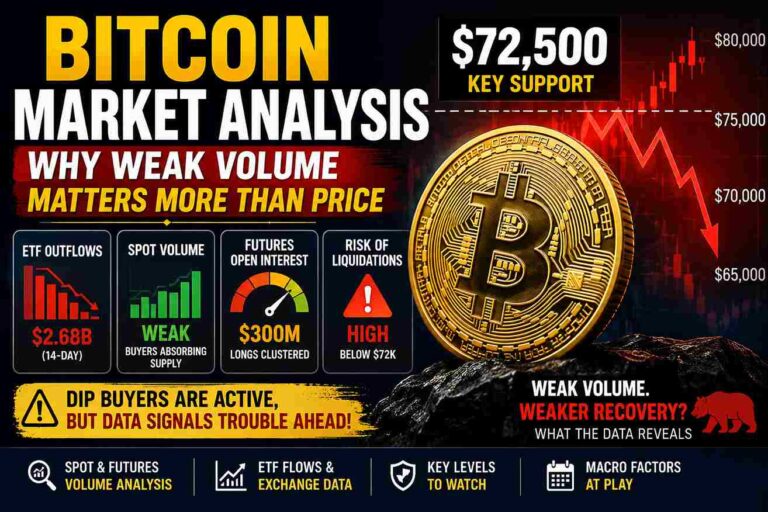
Institutional investors continue accumulating Bitcoin as ETF demand strengthens around the $60K support zone.
Bitcoin Institutional Inflows: How Smart Money is Buying the $60,000 Bottom
Bitcoin spot momentum is undeniably stalling right now. Retail traders are looking at fading technical indicators and preparing for further downside. But institutional desk data tells a completely different story.
Under the surface, the market architecture is shifting. We are tracking active, net directional volume across major Exchange-Traded Funds (ETFs). The numbers reveal steady accumulation by traditional finance conduits, even as daily price action remains flat.
February’s brutal selloff to the $60,000 level was a defining moment for this current cycle. On-chain metrics suggest this specific drawdown functioned as a massive structural flush. It wiped out the offshore leverage. It cleared out the over-extended momentum traders.
Now, the order books have reset. The market has transitioned from a speculative frenzy into a quiet, institutionally driven accumulation phase. Large capital allocators are stepping in, using these lower volatility windows to build out massive spot positions.
| Data Anchor | Real-Time Market Signal | Institutional Desk Consensus |
|---|---|---|
| BTC Spot Trend | Price momentum is fading. Traders are actively testing critical daily moving averages. | February’s $60,000 level is heavily viewed as the definitive macro bottom. |
| ETF Net Flows | Consistent net directional volume tracking across major US funds. | Bitcoin institutional inflows are quietly absorbing retail sell pressure. |
| Euro Stablecoins | Qivalis consortium officially expands its network to 37 backing banks. | European banks are aggressively accelerating on-chain settlement adoption. |
| Domestic Policy | South Carolina legally bans CBDCs and enacts Bitcoin mining protections. | State-level regulatory moats are providing safe harbors for CapEx deployment. |
The $60,000 Support and the ETF Accumulation Strategy
The stabilization above the February lows provides a rock-solid foundation for macro funds. When Bitcoin’s price velocity stalls, retail participants usually get bored or anxious. They view sideways consolidation as weakness.
Institutional order flow analytics show the exact opposite. This quiet environment is highly optimal for large-scale capital deployment.
Major asset managers hate high intraday volatility. When prices swing wildly, executing a billion-dollar buy order results in massive slippage. Sideways markets with predictable technical boundaries allow these funds to operate cleanly.
Instead of chasing green candles, fiduciary capital is placing limit orders at predetermined support thresholds. This is why we are seeing persistent Bitcoin institutional inflows despite the lack of headline-grabbing price rallies. Traditional finance is maintaining steady spot ETF demand.
This dynamic proves the asset class is maturing. Bitcoin pricing is increasingly dictated by fundamental portfolio rebalancing. Leveraged futures liquidations are slowly losing their grip on the steering wheel.
Why Wall Street is Watching the Rise of Programmable Bitcoin Privacy
Navigating the DXY Inverse Correlation
A major factor keeping spot prices muted right now is the U.S. Dollar Index (DXY). Traders on institutional desks are heavily focused on this metric.
Bitcoin historically trades with a strong inverse correlation to the DXY. When the dollar shows strength, dollar-denominated digital commodities face immediate head-winds. Central bank policy expectations and stubborn sovereign debt yields are keeping the dollar elevated.
However, smart money is looking past the immediate currency friction. They are treating current prices as a discount. Asset managers recognize that macroeconomic tightening cycles eventually pivot. By securing spot allocations now, they are positioning themselves for the inevitable shift in global monetary liquidity.
The Qivalis Expansion: Europe’s Banking Pivot
The most important long-term signal isn’t happening on the trading charts. It is happening in the back offices of European banks.
The Qivalis euro stablecoin consortium just executed a massive expansion. The network has scaled to include 37 major banking institutions. This is a tectonic shift for global financial plumbing.
European banking leaders are clearly exhausted by their reliance on fragmented legacy clearing systems. They are aligning behind a unified, euro-denominated digital asset. The goal is to route interbank settlements, cross-border payments, and collateral management directly through blockchain rails.
This is a direct operational challenge to the monopoly of dollar-pegged stablecoins. It shows that digital asset infrastructure is no longer a sandbox experiment. The sheer scale of the 37-bank Qivalis consortium proves that on-chain settlement is now a core strategic mandate for European monetary sovereignty.
South Carolina and the Domestic Regulatory Moat
While Europe builds payment rails, the United States is fortifying the physical network layer. State-level legislative action is providing the legal clarity that Wall Street demands.
The South Carolina governor recently signed a comprehensive digital asset bill. The legislation does two critical things. First, it completely bans the implementation of Central Bank Digital Currencies (CBDCs) within the state. Second, it legally protects the rights of Bitcoin miners to operate without discriminatory zoning or energy policies.
This creates a vital regulatory moat. Proof-of-work mining requires massive capital expenditure (CapEx). Facilities cost hundreds of millions of dollars to build. Institutional investors will not fund these projects if local governments can shut them down on a whim.
By codifying legal protections, South Carolina neutralizes a massive vector of political risk. It secures the physical hardware and energy contracts necessary to maintain the network’s global hash rate. For funds evaluating the long-term survival of the network, this type of legislative defense is a massive de-risking mechanism.
Retail Psychology: The Return to Baseline Normalcy
If you want to understand why the market feels so slow, look at the retail data. Intelligence metrics classify current retail activity as resting at a baseline normal.
The euphoria is gone. The panic is gone. Retail traders are sitting on their hands.
In previous cycles, retail mania drove prices to unsustainable heights before triggering violent crashes. Today, that speculative frenzy is absent. Retail participants are holding their existing spot positions, but they are abstaining from highly leveraged derivatives trading.
This psychological equilibrium is a dream scenario for ETF issuers and market makers. When retail goes quiet, erratic liquidity vacuums disappear from the order books. The market becomes stable.
The fading momentum noted by active day traders is simply a byproduct of this normalization. Without retail bidding up secondary tokens, price discovery remains anchored to actual macroeconomic inputs. It proves that the current price floor is being supported by sticky, long-term capital rather than hype.
The Stealth Accumulation Phase
We are squarely in a stealth accumulation phase. The headlines will continue to talk about technical resistance and fading momentum. That is noise.
The signal is found in the underlying infrastructure. Tier-one banks are deploying real capital into digital settlement rails. State governments are passing laws to protect decentralized computing. Exchange-Traded Funds are steadily sweeping up available spot supply.
Traders must navigate this sideways action carefully. The market will likely require more time to fully digest the recent influx of institutional capital. Downside risk models remain heavily anchored to that February $60,000 floor.
But the structural liquidity pathways are widening every single day. Tactical day trading is losing its edge. Strategic, long-term positioning is taking over. The permanent integration of digital assets into the legacy financial architecture is happening right now, and the institutional desks are pricing it in.
Frequently Asked Questions (FAQs)
What are Bitcoin institutional inflows?
Bitcoin institutional inflows refer to the large-scale movement of capital from traditional financial entities—like hedge funds, pension funds, and asset managers—into the Bitcoin market. This is primarily executed through regulated vehicles like Spot ETFs, rather than direct retail exchange purchases.
Why is the $60,000 level so important for Bitcoin?
Market data suggests the sharp selloff to $60,000 in February acted as a major reset. It flushed out highly leveraged traders and established a strong historical support zone. Institutional desks now heavily view this level as a baseline for risk management and a cyclical bottom.
How does the DXY affect digital asset prices?
The U.S. Dollar Index (DXY) measures the strength of the dollar against a basket of foreign currencies. Bitcoin typically shares an inverse correlation with the DXY. When the dollar is strong, dollar-denominated assets like Bitcoin usually face downward price pressure.
What is the Qivalis consortium and why does it matter?
Qivalis is a European stablecoin project that recently expanded to include 37 major banking institutions. It matters because it represents a massive institutional push to use blockchain technology for actual interbank settlements and cross-border payments, challenging traditional clearing systems.
Why are state laws like South Carolina’s mining protection significant?
Institutional investors require legal certainty before deploying capital. State laws that protect mining operations from discriminatory policies reduce political risk. This encourages large-scale funding for the physical infrastructure that secures the global decentralized network.
Are retail investors still driving the crypto market?
Currently, no. Intelligence metrics indicate retail engagement is at a baseline normal. The speculative mania of previous years has cooled off. This lack of retail volatility is exactly what allows Bitcoin institutional inflows to dominate long-term price discovery.
About the Author