Intel Stock Keeps Hitting Highs: Why Wall Street Analysts are Raising Their 2026 Targets
Intel Corporation is currently navigating what appears to be the most significant corporate transformation in the history of American silicon. After several years of trailing global competitors in advanced manufacturing nodes, the Santa Clara giant is dominating financial markets in May 2026. The primary driver of recent headlines is clear: Intel Stock Keeps Hitting Highs, fueled by strong institutional inflows and a series of foundational market catalysts.
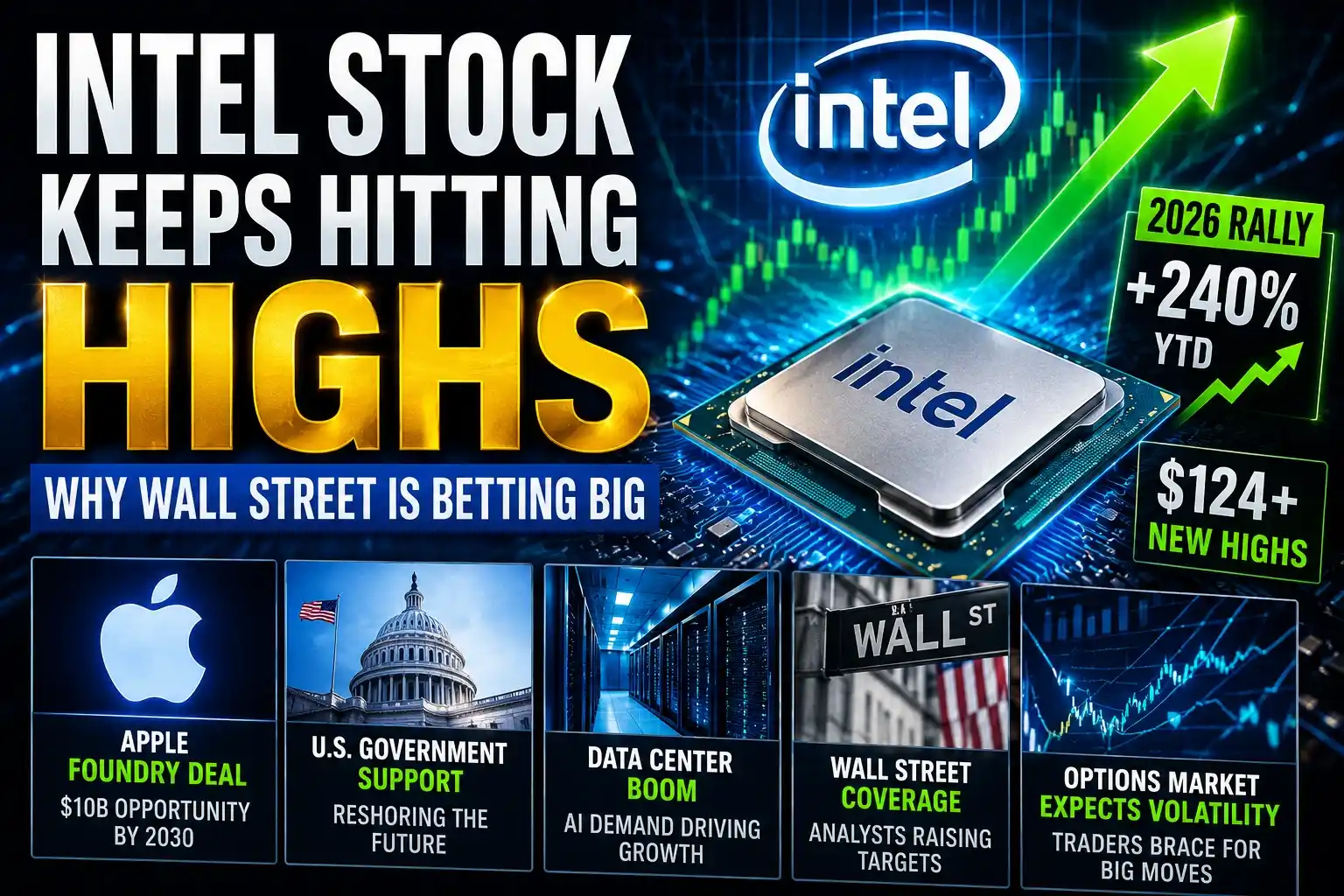
Shares of Intel surged nearly 14% on Friday, May 8, and maintained continued upside momentum through the morning of Monday, May 11. This price action pushed the stock toward the $124 level, marking one of the strongest rallies in the semiconductor sector this year. For an organization that faced intense skepticism just twenty-four months ago, this shift in the company’s long-term market positioning is a landmark event for the tech sector.
Institutional and retail traders are now deeply focused on options chains to measure the probability of the next major price swing. The velocity of this rally has forced many active managers to rapidly increase their portfolio weightings. Understanding the specific mechanics behind this move is essential for any investor managing technology exposure this week.
Intel Stock Performance Snapshot
| Metric | Current Trend (May 2026) |
|---|---|
| 2026 Year-to-Date Performance | Significant triple-digit rally |
| AI Data Center Revenue | Sustained double-digit growth |
| Foundry Expansion | Accelerating domestic capacity |
| Institutional Interest | Strong net inflows from major funds |
| Options Volatility | Elevated; pricing in large moves |
| Analyst Sentiment | Mixed but trending toward “Buy” upgrades |
Reporting on the Apple Foundry Narrative
The immediate spark for the May rally involves widely reported industry discussions regarding a preliminary manufacturing agreement with Apple Inc. According to various market reports and analyst discussions, the two tech leaders are in the early stages of a chip-making partnership. This would be a structural victory for Intel Foundry as it aims to capture market share from the current industry leader, TSMC.
Apple has historically utilized TSMC exclusively for the production of its advanced M-Series and A-Series processors. However, severe capacity limitations at TSMC—driven largely by the global artificial intelligence boom—have forced Apple to evaluate supply chain diversification. Industry discussions suggest that Intel’s advanced packaging and domestic capacity make it a logical alternative for high-volume production.
Bank of America analysts recently published a note analyzing the financial potential of such a partnership. Their internal models suggest that if Intel captures even a significant minority of Apple’s orders, the foundry revenue could reach approximately $10 billion annually by 2030. This revenue opportunity is exactly why professional capital is flowing into the stock at these levels.
The market is currently repricing Intel based on this shifting dynamic. It is no longer viewed strictly as a legacy CPU manufacturer facing competition from AMD. Instead, the current Wall Street consensus values Intel as a premier global foundry capable of servicing the world’s most demanding consumer electronics brands.
Strategic Federal Involvement and Reshoring
It is impossible to view the current Intel surge without considering the impact of federal policy. Securing domestic chip-making capacity is a primary focus for Washington, specifically regarding national security and supply chain resilience. The vulnerabilities associated with relying on centralized Asian manufacturing have forced a strategic pivot toward American soil.
Industry discussions around semiconductor reshoring have intensified significantly in Washington over the last year. Reports indicate that federal officials have engaged in high-level discussions with CEOs from Apple, SpaceX, and Nvidia. The goal is to encourage these large-scale buyers to utilize Intel’s domestic fabrication facilities for their future hardware needs.
This government-backed reshoring strategy is already showing tangible results. Market reports suggest Tesla has explored Intel’s 14A manufacturing roadmap for specialized components. These would be produced at Intel’s Terafab project in Austin, Texas. This federal support provides a unique layer of confidence for institutional investors who view Intel as a strategically important component of the US technology infrastructure.
Key Drivers for Institutional Conviction
- Industry-reported discussions regarding an Apple manufacturing partnership.
- Significant Q1 2026 earnings beat led by Data Center and AI demand.
- New commitments from major tech firms for the 14A manufacturing process.
- Sustained federal support for domestic semiconductor manufacturing.
Q1 2026 Earnings: Validation of the Turnaround
While reports of new partnerships provided the recent price spark, Intel’s underlying financial performance validated the bullish sentiment. The company reported its Q1 2026 earnings on April 23, clearing consensus Wall Street estimates by a wide margin. This confirmed that the turnaround is reflected in actual quarterly cash flows rather than just speculative narratives.
Total quarterly revenue reached $13.6 billion, surpassing the $12.36 billion consensus estimate. The company posted an adjusted earnings per share (EPS) of $0.29, compared to the meager $0.01 that analysts had projected. This marked the sixth consecutive quarter in which Intel’s revenue exceeded its own internal guidance, signaling a consistent trend of under-promising and over-performing.
The standout performer was the Data Center and AI segment, which generated $5.1 billion, representing a 22% year-over-year increase. Demand for AI infrastructure, cloud computing, and enterprise-level servers is currently pushing Intel’s manufacturing capacity to its limit. The market has responded by aggressively raising valuations for this segment.
Intel Q1 2026 Financial Results Summary
| Metric | Q1 2026 Actual | Wall Street Consensus | Performance Delta |
|---|---|---|---|
| Adjusted EPS | $0.29 | $0.01 | +$0.28 Beat |
| Total Revenue | $13.60 Billion | $12.36 Billion | +$1.24 Billion Beat |
| Data Center & AI Revenue | $5.10 Billion | $4.41 Billion | +$690 Million Beat |
| Intel Foundry Revenue | $5.40 Billion | N/A | 16% YoY Growth |
| Q2 Revenue Guidance | $13.8B – $14.8B | $13.03 Billion | Significant Raise |
Intel Foundry revenue also grew by 16% to $5.4 billion. For the second quarter of 2026, Intel projected total revenue of $13.8 billion to $14.8 billion. This forward-looking guidance was significantly higher than the $13.03 billion the market had modeled, prompting many analysts to rewrite their long-term growth forecasts.
AI Infrastructure and Enterprise Partnerships
The artificial intelligence narrative serves as the dominant macroeconomic tailwind for the entire semiconductor sector. However, the nature of this demand is evolving in 2026, and Intel is positioning itself to lead the next phase. The focus is shifting from training large language models to the large-scale deployment of AI inference and agentic systems.
Intel confirmed that its Xeon 6 processor has been selected as the host CPU for Nvidia’s DGX Rubin NVL8 systems. This partnership highlights the fact that even AI leaders like Nvidia rely on Intel’s silicon for high-level system coordination. This synergy ensures that Intel remains a core component of the broader AI hardware stack.
Intel also announced a multiyear collaboration with Google to deploy Xeon processors and co-develop custom AI infrastructure. These enterprise-level wins demonstrate that Intel’s products remain highly relevant for the world’s largest cloud service providers. As long as Intel Stock Keeps Hitting Highs, these partnerships will be cited as the primary fundamental pillars of the rally.
Analyzing Intel’s Position Against Industry Rivals
To understand why Intel Stock Keeps Hitting Highs, we must view the company through a comparative lens. The semiconductor landscape is more competitive than ever, yet Intel has carved out a unique identity as the only American company combining advanced design with world-class foundry capabilities.
| Company | AI Market Position | Manufacturing Capability | Core Market Narrative |
|---|---|---|---|
| Intel | Foundry + AI Inference | Expanding Global Foundries | High-growth recovery and reshoring. |
| Nvidia | Dominant AI Leader | Fabless (Reliant on TSMC) | Premium industry leader. |
| AMD | CPU/GPU Challenger | Fabless (Reliant on TSMC) | Efficient and fast-growing competitor. |
| TSMC | Manufacturing Leader | Global Market Dominance | Backbone of the global AI supply chain. |
Options Market Analysis: Measuring Volatility
With the stock experiencing significant gains this year, the derivatives market is seeing historic levels of activity. Options volatility remains significantly elevated compared to historical averages, suggesting that institutional players are bracing for continued price fluctuations. When Intel Stock Keeps Hitting Highs at this pace, premiums for both calls and puts tend to rise sharply.
Options volume has surged to 2.44 million contracts, representing 264% of the stock’s average daily volume. This high level of liquidity suggests that market makers expect significant directional moves in the coming sessions. Professional traders use these metrics to calculate the “expected move” for the week, which currently sits in the double-digit percentage range.
The volume put-call ratio is currently 0.84, indicating a neutral to slightly bullish sentiment. Speculators are buying out-of-the-money call options to participate in the upside, while hedge funds are purchasing put options as a strategy to protect their gains against a sudden correction. This balanced activity shows that while the trend is bullish, professional money is managing risk with a disciplined system.
Risks That Could Slow Intel’s Rally
While the current momentum is undeniably strong, disciplined investors must account for potential headwinds. No turnaround is without risk, and Intel still faces significant execution challenges over the next 18 to 24 months. Identifying these risks is a core component of professional risk management.
- Foundry Execution Risk: Transitioning to a foundry model requires a massive cultural and operational shift. Any delays in the 18A or 14A nodes could hurt client confidence.
- Margin Pressure: Building new fabrication facilities is incredibly capital-intensive. This could weigh on gross margins and free cash flow in the short term.
- TSMC’s Response: TSMC is not standing still. If the industry leader increases its capacity or lowers prices, Intel’s foundry growth could slow.
- AI Demand Cyclicality: If the enterprise spend on AI infrastructure cools down, the entire semiconductor sector would face a valuation reset.
Bank of America’s recent “Underperform” rating reflects these concerns. While they raised their price target to $96, they cautioned that the market may be overestimating the speed at which foundry revenue will hit the bottom line. This serves as a necessary reminder that the current rally is fueled by high expectations that must be met in future quarters.
What Wall Street Will Watch Next
Investors should look for specific catalysts over the next thirty days to determine if the rally has more room to run. The following events will dictate the short-term direction of the stock and determine if Intel Stock Keeps Hitting Highs through the summer months.
- Cisco Earnings (May 13): As a confirmed advanced packaging customer, Cisco’s commentary on Intel’s progress will be a major data point for the market.
- Official Foundry Client Confirmations: Any formal contract announcements from Apple, Tesla, or Nvidia would act as powerful bullish triggers.
- Monthly Inflation Data: Broad macroeconomic trends and Fed interest rate policy will continue to influence valuations for high-growth tech stocks.
- SOXX Index Momentum: Intel is a major component of the semiconductor index; broad sector health will directly impact Intel’s daily liquidity.
Path Toward $150?
Intel’s rapid rise from a legacy CPU provider to a foundational player in the AI foundry space is one of the defining financial stories of 2026. The combination of industry-leading earnings beats and strategic government support has fundamentally changed the stock’s trajectory. As long as the executive team continues to execute on the technical roadmap, the current valuation shift appears to be structurally supported.
Traders should expect continued volatility as the market digests these massive moves. The current $124 to $129 zone is a critical area of interest; a sustained break above this level could open the door for a move toward $150 by the end of the year. However, investors must maintain position sizing discipline to navigate the inevitable pullbacks that occur during parabolic rallies.
Whether Intel can fully justify this surge will depend on the Q2 financial results due in late July. Until then, the daily price action will be driven by institutional order flow, sector-wide AI sentiment, and the steady drumbeat of reshoring news. For now, the trend remains clear: Intel Stock Keeps Hitting Highs because the world is realizing the strategic value of American silicon manufacturing.
Disclaimer: This article is for informational and market analysis purposes only and should not be considered financial or investment advice. Always consult with a certified financial professional before making major investment decisions.
About the Author