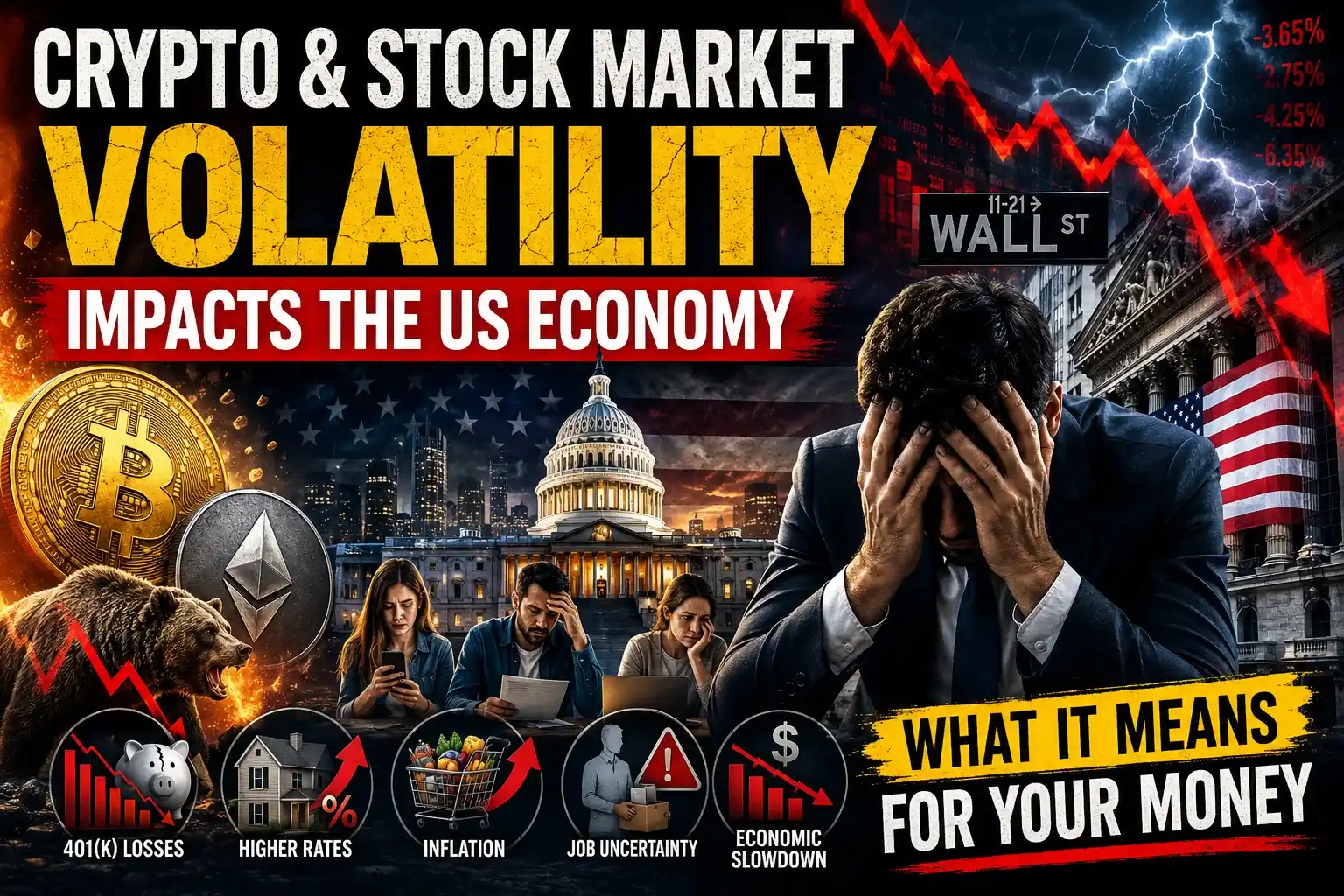
The Invisible Tax of Financial Volatility
Walk down any street in America today, and you can feel a subtle, lingering financial anxiety. The digital numbers flashing red and green on our smartphones are doing more than just tracking corporate valuations. They are dictating the future of the US economy.
For decades, Wall Street operated in a silo. Today, the lines between traditional equities, digital assets, and Main Street bank accounts have completely dissolved. When the markets violently swing, the shockwaves hit kitchen tables across the country within days.
Understanding how crypto and stock market volatility affects the broader economy is becoming increasingly important for American households. It is no longer just a topic for professional analysts; it is a fundamental part of navigating a highly uncertain global landscape.
Recent volatility across equities, Treasury yields, and digital assets suggests investors are entering one of the most fragile macroeconomic environments since the post-pandemic recovery period.
Why Crypto and Stock Market Volatility Matters in 2026
The financial landscape has reached a point of total integration. In 2026, the movement of digital assets and traditional stocks is more synchronized than ever before. This synchronization means that a localized panic in one sector can quickly evolve into a systemic event that touches every part of American life.
Market estimates indicate that approximately 50 million Americans now hold some form of digital asset. When you combine this with the millions of families relying on traditional stock portfolios for retirement, the scale of exposure is historic. Any sharp movement in these markets directly influences the psychological and financial health of the American middle class.
The Global Shadow Over the US Economy
To understand current market volatility, we must look at the geopolitical chessboard. International relations are experiencing historic friction, with supply chains being actively re-routed and defense spending accelerating globally. These external pressures are the primary drivers of the wild swings we see on our screens.
When global stability is threatened, massive pools of institutional capital react. Asset managers immediately rebalance their portfolios, pulling billions of dollars out of perceived risk assets. This sudden capital flight creates violent price swings in both the S&P 500 and the cryptocurrency sector.
This is not a theoretical exercise. When international trade routes face uncertainty, the cost of raw materials and energy often spikes. This forces the Federal Reserve to maintain higher interest rates, which directly suppresses stock valuations and tightens credit for everyday Americans.
The Wealth Effect: How Wall Street Dictates Main Street Spending
The primary transmission system between the financial markets and the real economy is known by economists as the “Wealth Effect.” The logic is simple but powerful. When investment portfolios hit record highs, Americans feel financially secure.
When people feel wealthy, they spend money. They buy new vehicles, renovate their homes, and book vacations. Consumer spending remains a massive driver of the US economy, typically accounting for roughly 70% of the Gross Domestic Product (GDP).
However, the Wealth Effect operates aggressively in reverse. When the S&P 500 drops significantly or Bitcoin sheds a third of its value in a month, that perceived wealth evaporates. Even if a worker has not lost their job, the psychological fear of a shrinking 401(k) can force them to immediately cut discretionary spending.
When millions of households freeze their spending simultaneously, corporate revenues can come under pressure. Companies may respond by pausing hiring, delaying expansion plans, or eventually evaluating staff levels. This is how a localized Wall Street panic can manufacture a Main Street slowdown.
How Market Volatility Impacts American Households
| Area of Impact | Economic Consequence |
|---|---|
| 401(k) & Retirement | Portfolio fluctuations lead to delayed retirement or reduced security. |
| Mortgage Rates | Volatility in bond markets leads to higher borrowing costs for homebuyers. |
| Consumer Spending | Reduced discretionary purchases as perceived wealth declines. |
| Small Businesses | Tightened lending conditions make it harder to meet payroll or expand. |
| Economic Planning | Increased uncertainty prevents long-term financial commitments. |
The Crypto Variable: A New Layer of Systemic Risk
Ten years ago, a collapse in digital assets would have been a localized event affecting a small group of tech enthusiasts. Today, the landscape is entirely different. Recent data confirms massive institutional participation, with hundreds of millions flowing into spot Bitcoin and Ethereum ETFs.
Cryptocurrency is now deeply integrated into the traditional financial plumbing. Major US banks, pension funds, and registered investment advisors hold digital asset exposure on behalf of their clients. The integration of these assets means crypto volatility now directly impacts institutional balance sheets.
For many young professionals, crypto represents a significant portion of their liquid net worth. A severe crypto drawdown can significantly reduce retail investor wealth during sharp downturns. This destruction of purchasing power impacts the broader retail economy exactly like a stock market correction.
Asset Class Behavior During Periods of Uncertainty
| Asset Class | Typical Reaction to Global Tension | Economic Impact on US Consumers |
|---|---|---|
| Large-Cap Tech Stocks | High Volatility; Subject to quick sell-offs to raise cash. | Reduces 401(k) balances; lowers consumer confidence. |
| Cryptocurrency (Bitcoin) | Extreme Volatility; Acts as a high-beta risk asset. | Can reduce retail wealth; suppresses spending among younger adults. |
| US Treasuries (Short-Term) | High Demand; Viewed as a primary safe haven. | Influences mortgage rates and auto loan costs for consumers. |
| Physical Gold / Commodities | Steady to Bullish; Functions as a hedge against inflation. | Increases the cost of everyday goods and raw materials. |
What This Means for Everyday Americans
The abstract movements of global capital eventually land on your monthly budget. The impact of crypto and stock market volatility is most visible in the cost of borrowing. When markets are highly volatile, lenders demand higher premiums to assume risk.
This translates directly into higher interest rates for credit cards, personal loans, and mortgages. A family attempting to buy a home today faces borrowing costs significantly higher than those available just a few years ago. This prices millions of Americans out of the housing market.
Additionally, small businesses rely on regional banks for credit lines to meet payroll and buy inventory. When volatility creates stress across portions of the regional banking sector, those banks tighten their lending standards. Local businesses are then forced to halt expansion to survive.
Risks Investors Must Watch
Navigating the current economic environment requires vigilance. Investors cannot afford to set their portfolios on autopilot. The primary risk factor remains sticky inflation driven by supply chain disruptions and geopolitical shifts.
If global tensions escalate, energy prices could rise. Higher energy costs feed directly into the price of food, transportation, and consumer goods. This scenario forces the Federal Reserve to keep interest rates elevated, essentially keeping the stock market in a high-pressure environment.
Another risk is the concentration of the stock market. A significant percentage of the S&P 500’s performance is driven by a handful of tech companies. If institutional sentiment shifts away from these sectors, the resulting market correction would likely be rapid and widespread.
The Federal Reserve’s Balancing Act
At the center of this financial storm sits the Federal Reserve. The central bank is attempting to execute one of the most difficult maneuvers in modern economic history. They must manage inflation without triggering a severe stock market downturn or a deep recession.
If the Fed cuts interest rates too quickly, inflation could resurface, eroding the purchasing power of the US dollar. If they keep rates too high for too long, they risk causing excessive stress across the banking system and corporate sector. This is a delicate process with very little room for error.
Recent volatility metrics across major US indices suggest investor uncertainty remains elevated compared to historical averages. Analysts continue monitoring inflation trends, Treasury yields, and institutional fund flows for signs of stabilization. Wall Street observers expect the Fed to remain highly data-dependent, meaning every monthly report will cause sharp market reactions.
Wall Street Strategy: Where Smart Money is Rotating
When the macro environment becomes volatile, institutional asset managers do not necessarily panic. They rotate. The smart money utilizes a specific strategy to preserve capital while waiting for the dust to settle.
Market analysts believe that defensive positioning is essential right now. This involves moving capital away from speculative growth stocks and highly leveraged companies. Instead, institutions are seeking safety in assets that generate reliable cash flow regardless of the economic climate.
Retail investors can learn from this institutional behavior. During periods of high global tension, preserving your principal investment becomes more important than chasing speculative gains. In the New York pits, the saying goes that you should sell what you can, not what you want, when liquidity dries up.
Defensive vs. Vulnerable Sectors
| Economic Sector | Institutional Sentiment | Reasoning for Capital Flow |
|---|---|---|
| Healthcare & Pharmaceuticals | Defensive (Inflow) | Demand remains constant regardless of economic conditions. |
| Consumer Staples (Food/Beverage) | Defensive (Inflow) | Consumers prioritize basic needs over luxury goods during a panic. |
| Aerospace & Defense | Strategic Growth (Inflow) | Benefits from increased global security spending. |
| Consumer Discretionary (Travel/Luxury) | Vulnerable (Outflow) | First area cut when household wealth feels threatened. |
| Unprofitable Tech / Speculative Crypto | High Risk (Outflow) | Highly sensitive to interest rates and institutional liquidity drains. |
Future Outlook: How to Protect Your Wealth
The current intersection of global tension, shifting central bank policies, and asset volatility is intimidating. However, market chaos also creates opportunities for disciplined investors. The goal is to survive the volatility so you can profit from the eventual recovery.
Financial planners consistently advise against panic selling. Liquidating retirement accounts during a sharp downturn often locks in losses and prevents you from participating in the rebound. Instead, this is the time to evaluate the quality of your holdings.
If you hold highly speculative crypto tokens or shares in companies with massive debt and no profits, you are carrying excess risk. Analysts suggest rotating into quality. This means focusing on established Bitcoin ETFs, large-cap companies with strong balance sheets, and short-term Treasury bills that offer attractive, stable yields.
Maintaining a strong cash reserve is also vital. In a volatile economy, cash is more than a safety net; it is a strategic tool. Having liquidity allows you to acquire high-quality assets at a discount when the broader market panics. At the end of the day, the numbers don’t lie, even if the intraday charts are messy.
The New Reality of American Finance
The traditional advice of simply buying an index fund and ignoring the news is becoming harder to justify. The impact of crypto and stock market volatility on the US economy is immediate and highly sensitive to global events.
We are living in an era where a geopolitical headline thousands of miles away can quickly influence American wealth, impacting your ability to secure a loan or keep a business open. The financial system is entirely interconnected, and what happens on a digital exchange in Asia can affect a mortgage application in Ohio.
Success in this environment requires education and emotional discipline. Do not let daily volatility dictate your long-term plan. Understand the macroeconomic forces at play, manage your risk ruthlessly, and position yourself alongside the institutional players who prioritize stability over speculation.
In 2026, understanding market volatility is no longer optional for American households. It is becoming part of everyday financial survival.
Disclaimer: This article is for informational and market analysis purposes only and should not be considered financial or investment advice. Always consult with a certified financial professional before making major investment decisions.
About the Author