Wall Street Pours $858 Million Into Crypto ETFs as Senate Preps Historic Vote
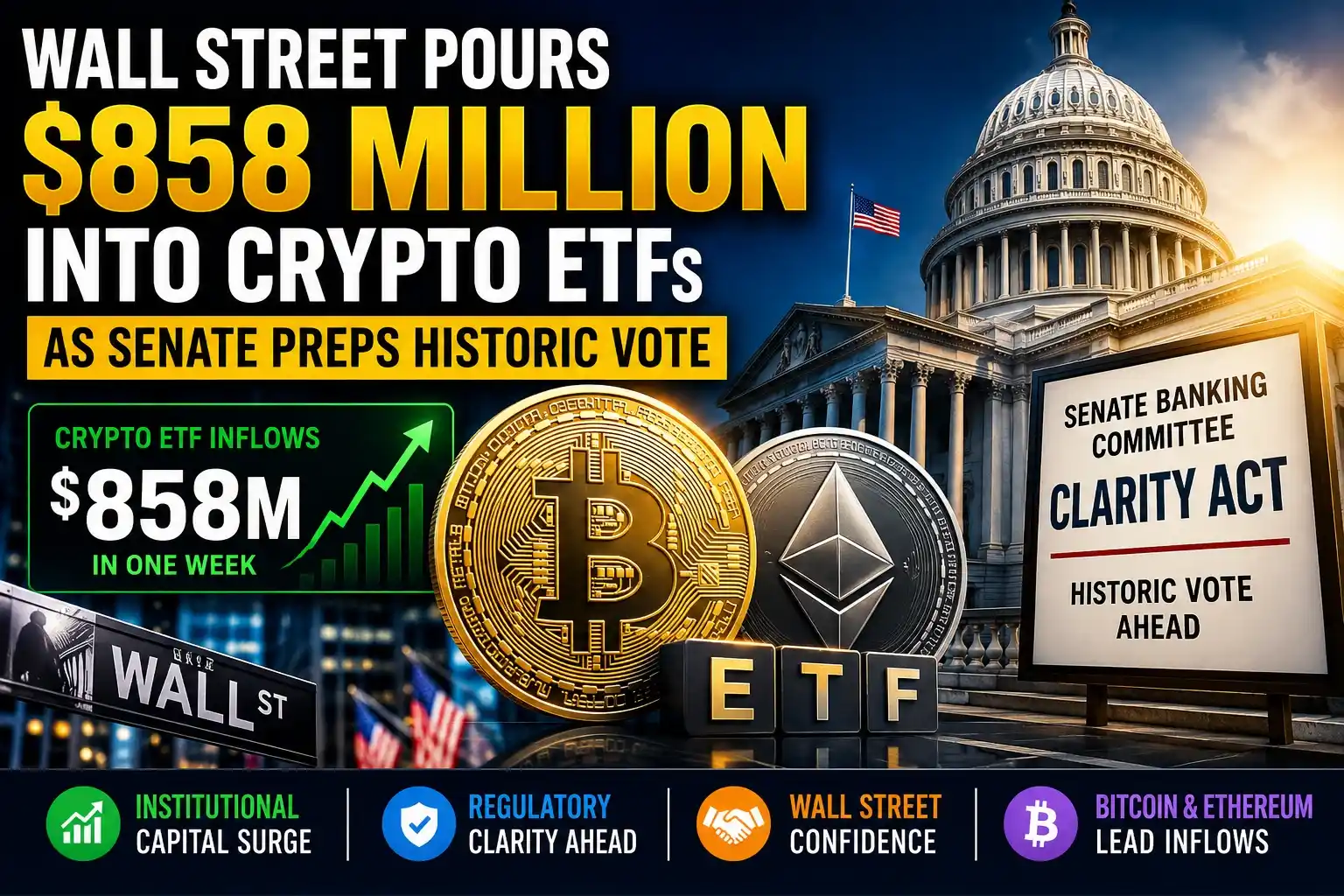
Global digital asset investment products just experienced a massive surge in institutional capital. Data confirmed on May 11, 2026, shows that crypto ETFs draw inflows 858M in a single week. This marks the sixth consecutive week of positive capital allocation into the sector.
Wall Street is not throwing money blindly at digital assets. This aggressive $858 million positioning is a direct response to impending legislative action in Washington, D.C. The Senate Banking Committee is preparing to review the highly anticipated CLARITY Act.
Institutional asset managers are acquiring heavy spot positions before the regulatory landscape shifts. The smart money is utilizing a proactive strategy to secure exposure ahead of potential price appreciation. This move suggests a high level of confidence in the upcoming legislative markup.
Breaking Down the $858 Million Capital Inflow
The recent influx of $858 million was largely absorbed by spot Bitcoin and Ethereum exchange-traded funds. BlackRock and Fidelity continue to dominate the institutional market share. Their respective ETF products have become the preferred system for traditional finance allocators to gain crypto exposure.
BlackRock’s iShares Bitcoin Trust (IBIT) absorbed a significant portion of the total capital in the days leading up to the report. Fidelity’s Wise Origin Bitcoin Fund (FBTC) also captured a substantial share of the net flows. This concentration indicates that institutions favor established brands with deep liquidity.
This capital rotation indicates that institutions view current market levels as an attractive entry point. The $858 million figure represents fresh capital entering the ecosystem. Analysts recognize this consistent buying pressure as a signal of long-term institutional conviction.
Institutional Capital Distribution
Understanding where the money is flowing provides insight into current risk appetite. Bitcoin remains the anchor asset for most traditional finance portfolios. However, Ethereum products are capturing an increasing percentage of total net flows as diversification becomes a priority.
| Asset Manager / Product | Asset Focus | Recent Inflow Trend (May 2026) |
|---|---|---|
| BlackRock (IBIT & ETHA) | Bitcoin & Ethereum | Aggressive Net Inflows |
| Fidelity (FBTC) | Bitcoin | Consistent Net Inflows |
| Grayscale (GBTC) | Bitcoin | Slowing Outflows |
| Other Global ETPs | Mixed Digital Assets | Moderate Net Inflows |
The table above illustrates the concentration of capital among top-tier financial institutions. Asset managers with established distribution networks are winning the race for assets under management. This concentration makes it easier for registered investment advisors to allocate client funds safely within a regulated framework.
The CLARITY Act: A Regulatory Turning Point
The urgency behind the recent surge in capital is directly tied to the CLARITY Act. This proposed federal law aims to settle the long-standing jurisdictional dispute between regulatory agencies. It specifically targets the friction between the SEC and the CFTC.
For years, the digital asset industry has operated under a cloud of uncertainty. The SEC has historically claimed that almost all digital tokens are unregistered securities. The CLARITY Act proposes a clear test to categorize specific digital assets as commodities instead.
If a blockchain network is deemed sufficiently decentralized, its native asset would fall under CFTC jurisdiction. This classification would significantly reduce compliance costs and legal risks for crypto companies. It would also validate the operational models of major US cryptocurrency exchanges.
Key Pillars of the Proposed Legislation
The legislation contains several structural changes designed to modernize US capital markets. These provisions aim to balance consumer protection with technological innovation. The core mechanics of the bill address the most pressing issues in the digital economy.
- Jurisdictional Boundaries: Clearly defines which assets are securities and which are commodities.
- Stablecoin Regulation: Establishes reserve requirements and operational guidelines for fiat-pegged tokens.
- Consumer Protection: Mandates specific disclosure requirements for token issuers and exchanges.
- Developer Safe Harbors: Protects software developers from being treated as financial institutions.
These structural guardrails are exactly what compliance departments at major banks have been waiting for. The passage of this act would allow massive waves of traditional financial capital to enter the sector. Wall Street is currently positioning itself for this exact scenario.
The Stablecoin Debate: Finding a Middle Ground
While the broader market components have bipartisan support, stablecoins remain a sensitive issue. The Senate Banking Committee has engaged in intense debate over the rules governing stablecoin rewards. This specific discussion is a major focal point for banking industry lobbyists.
Current proposals would limit companies from offering yield to users simply for holding a stablecoin. This rule is designed to prevent stablecoins from acting identically to interest-bearing bank accounts. Traditional banks want to prevent deposit flight from the legacy financial system into digital alternatives.
Stablecoins are the fundamental plumbing of the global cryptocurrency trading system. How the CLARITY Act regulates them will dictate the future structure of digital payments. A resolution to this standoff is expected during the mid-May markup sessions.
The Psychology of the Institutional Buyer
Retail investors often trade based on sentiment, momentum, and social media trends. Institutional allocators operate on a completely different framework. They rely on risk-adjusted models, legal clarity, and predictable regulatory environments.
The fact that crypto ETFs draw inflows 858M proves that institutions are anticipating a major de-risking event. They are not waiting for the bill to become law. They are positioning their portfolios based on the high probability of the bill passing the committee stage.
This accumulation strategy creates a strong pricing floor for top-tier digital assets. When billions of dollars are locked inside exchange-traded funds, the circulating supply on open exchanges decreases. This supply shock mechanic generally supports higher valuations over time.
The Role of Financial Advisors in ETF Adoption
A secondary catalyst for capital inflows is the gradual approval of spot crypto ETFs by major wirehouses. Independent broker-dealers and registered investment advisors manage trillions of dollars in American wealth. For decades, these professionals were limited by compliance restrictions regarding digital assets.
The launch of regulated spot ETFs completely changed this dynamic. Advisors can now purchase Bitcoin and Ethereum exposure for their clients using standard ticker symbols. This removes the technical complexities of managing private cryptographic keys or hardware wallets.
As more advisory platforms complete their internal due diligence, the potential total addressable market expands. The news that crypto ETFs draw inflows 858M is a reflection of this advisory adoption curve. We are still in the early stages of registered advisors offering digital assets to Main Street investors.
The Generational Wealth Transfer
Financial advisors are also keenly aware of shifting demographics among their client base. A historic transfer of wealth is currently underway as baby boomers pass assets to younger generations. Millennials and Gen Z have a statistically higher preference for holding digital assets.
To retain these inherited accounts, advisors must offer modern investment products. Incorporating regulated crypto ETFs into standard portfolio models is becoming a common industry practice. This generational shift provides a permanent structural bid for digital asset ETFs over the next decade.
Market Impact and Price Resilience
The correlation between legislative progress and market pricing remains strong. As news of the Senate Banking Committee markup spread, Bitcoin prices remained resilient. This price stability is heavily supported by the sustained inflow of institutional ETF capital.
Spot crypto ETFs have continued attracting significant institutional participation since their launch. This represents one of the most successful product rollouts in the history of financial markets. The $858 million added this week reinforces a deeply entrenched macroeconomic trend.
Ethereum is also experiencing a related tailwind as institutional buyers seek diversified exposure. With ETH trading with renewed strength, allocators are utilizing spot Ethereum ETFs to capture network growth. The entire digital asset class is effectively trading as a proxy for regulatory optimization.
Navigating Potential Legislative Risks
It is vital to assess the downside risks associated with this legislative push. The Senate calendar is crowded with competing national priorities. If the markup slips past May, the probability of the bill passing this year may decrease.
A delay would leave the digital asset industry in regulatory limbo for several more months. This would likely result in continued enforcement actions by various agencies. Innovation and capital might continue to flow toward more favorable jurisdictions in Europe and Asia during such a delay.
However, the immediate impact on existing spot ETFs would likely be limited. Products like BlackRock’s IBIT are already operational under current securities laws. The underlying assets would simply experience typical market volatility as the timeline for mass adoption is recalculated.
Expected Legislative Timeline
The legislative process requires multiple victories before a bill becomes law. Investors must monitor specific procedural checkpoints. The following table outlines the expected path for the CLARITY Act.
| Legislative Milestone | Expected Timeframe (2026) | Market Implication |
|---|---|---|
| Senate Banking Committee Markup | Mid-May | High volatility; early indicator of final bill text. |
| Full Senate Floor Vote | Summer | Major market catalyst; requires 60 votes. |
| House Reconciliation | Late Summer / Fall | Finalizing text differences between chambers. |
| Presidential Signature | Late 2026 | Absolute regulatory certainty achieved. |
Every successful step in this timeline will likely act as a bullish catalyst for the broader market. Conversely, any procedural delays will test the patience of short-term speculators. Long-term institutional investors will likely view any dips caused by delays as secondary accumulation opportunities.
The Global Perspective on US Regulation
The outcome of the CLARITY Act will resonate far beyond the borders of the United States. Global financial hubs in London, Dubai, and Hong Kong are closely watching Washington’s moves. The United States remains the deepest and most liquid capital market on the planet.
If the US establishes a clear, innovation-friendly framework, it could become a global center for digital asset development. Foreign capital would likely increase its flow into American crypto companies and related securities. This is another reason why crypto ETFs draw inflows 858M from global funds.
Conversely, if the US fumbles this opportunity, other nations may absorb the intellectual and financial capital. The European Union has already implemented its MiCA framework, providing a strong alternative. The stakes for American financial leadership in the digital age are incredibly high.
Actionable Insights for Portfolio Optimization
Understanding macroeconomic trends is only half the battle. The other half involves executing a rational strategy without succumbing to emotional trading. The data clearly shows that institutional players are actively accumulating.
Retail investors should avoid trying to time the exact second the Senate votes. Instead, a consistent allocation strategy into regulated ETF products offers a more balanced approach. This method allows investors to build a position while mitigating the risk of short-term price swings.
It is also advisable to focus on blue-chip digital assets during periods of regulatory change. Bitcoin and Ethereum have the clearest paths to compliance under the proposed framework. Smaller, speculative tokens carry significantly more legal risk until the jurisdictional boundaries are firmly established.
Three Strategies to Consider
- Evaluate ETF Fees: Compare the annual expense ratios of different products before allocating capital. Lower fees compound significantly over a multi-year period.
- Monitor the Markup: Follow updates from the Senate Banking Committee regarding the stablecoin compromise. This will be the first major signal of the bill’s success.
- Diversify Crypto Exposure: Do not rely solely on one asset. Consider adding Ethereum ETFs to capture the growth of decentralized infrastructure and smart contracts.
The financial ecosystem is undergoing a historic transition. The integration of blockchain technology into traditional markets is a mathematical reality. Investors who pay attention to the regulatory mechanics now will be best positioned for the future of finance.
Looking Ahead: The Next Phase of Institutionalization
The convergence of massive institutional capital flows and landmark legislation creates a unique historical point. We are witnessing the final stages of the institutionalization of digital assets. The days of cryptocurrency operating strictly on the fringes of the financial system are over.
As the year progresses, the data will show if the current $858 million inflow was an anomaly or the new baseline. If the CLARITY Act clears the Senate Banking Committee, expect these weekly inflow numbers to accelerate. Wealth managers across the country are simply waiting for that official green light.
The narrative has shifted from whether digital assets will survive to how they will be integrated into the global economy. The fact that crypto ETFs draw inflows 858M in just a few days is proof of this paradigm shift. Staying informed and sticking to a disciplined strategy remains the best path forward for all investors.
Disclaimer: This article is for informational and market analysis purposes only and should not be considered financial or investment advice.
About the Author