How the broader economy directly impacts your everyday wallet and grocery bills.
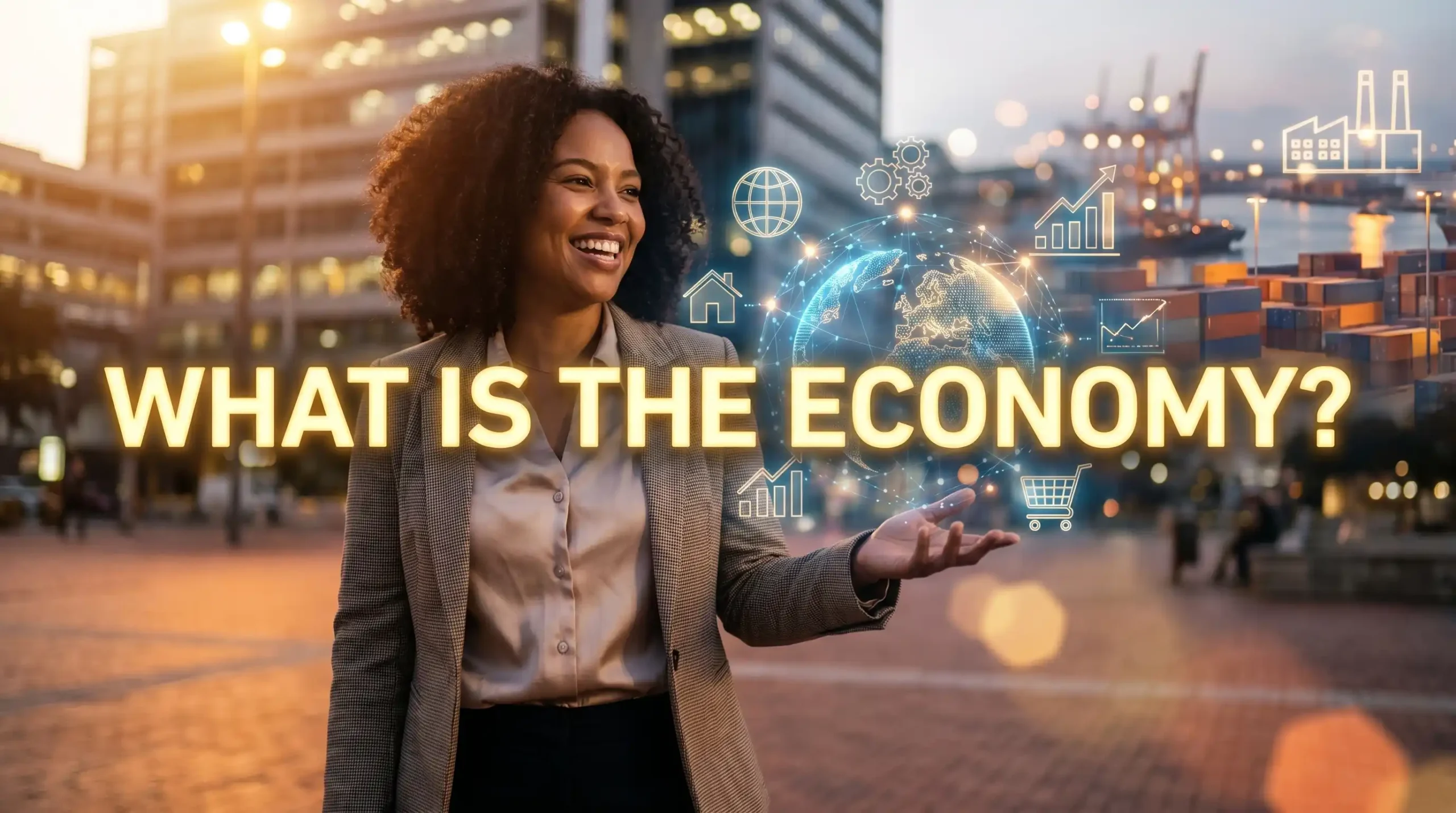
What is the Economy?
Definition: The economy is the structure through which goods and services are produced, distributed, and consumed within a society.
Quick Summary:
The Core Mechanism: The economy is not an abstract concept; it is a continuously moving mechanism of buyers, sellers, and government entities driven by daily transactions across various sectors.
The 2026 Reality: Persistent inflation (hovering near 4%) and interest rates remaining at multi-year highs are actively reshaping the housing market and corporate tech investments.
Your Strategy: Surviving the current economic environment requires auditing expenses, adapting to AI-driven workflows, and building resilient, diversified income structures. You turn on the financial news. Analysts debate complex metrics. Numbers flash across the screen. It often feels overwhelming. You need clarity. You are asking: what is the economy? What is the economy in simple terms, and how does it actually work in 2026? It is not a magical entity. It is a massive, ongoing mechanism. It is simply the sum of every transaction happening around you. Every dollar spent. Every hour worked. Every product shipped. Right now, your wallet is feeling the pressure of 2026. Prices remain elevated. Market dynamics are rapidly evolving. Lack of financial awareness leads to poor economic decisions. Understanding this economic environment is highly practical. You must know how the pieces fit together. Let us break down the noise analytically.
So, Exactly What is the Economy? The US Economy Explained Simply
Market data and capital flow across borders reveal a remarkably straightforward reality. The US economy explained simply is a giant structure of buyers and sellers. You are a buyer. You buy groceries. You pay rent. You purchase software subscriptions. Companies are buyers, too. They buy server space. They buy raw materials. They buy labor. When you go to work, you are the seller. You sell your time. You sell your specialized skills.
The Three Sectors of the Mechanism
To truly understand where these transactions happen, you must look at the three primary sectors that make up the economic structure:
The Primary Sector (Extraction): This involves harvesting raw materials. Agriculture, mining, and oil extraction live here.
The Secondary Sector (Manufacturing): This takes those raw materials and builds products. Construction, automobile manufacturing, and food processing fit into this category.
The Tertiary Sector (Services): This provides services rather than physical goods. Retail, healthcare, finance, and technology software exist here. The United States operates primarily as a tertiary, service-based economy. Most modern American wealth is generated through specialized services and technology, rather than heavy manufacturing.
The Transaction Engine
Every transaction across these sectors has two sides. Your spending is someone else’s income. Think about a standard purchase. You buy a premium noise-canceling headset. That money pays the retail worker (Tertiary). It pays the global shipping company (Tertiary). It pays the overseas manufacturer (Secondary). It pays the company extracting the metals used in the wiring (Primary). If consumer confidence drops, people stop buying premium goods. All those connected individuals and companies lose a fraction of their income. This interconnected structure is deeply sensitive. A disruption in one sector sends measurable shockwaves everywhere else.
The Role of Government: Fiscal Policy and Taxes
You cannot discuss the economy without addressing the government. The federal government is the largest single buyer in the United States. The government extracts money from the transaction engine through taxes. It then injects that money back into the mechanism through spending—funding infrastructure, defense, healthcare, and public services. This is known as fiscal policy. When the economy slows down, the government might reduce taxes to leave consumers with more spending money, or increase its own spending to create jobs. When the economy runs too hot, they might raise taxes or cut spending to cool things down. The balance between what the government collects and what it spends directly impacts the national deficit and the broader economic climate.
The Scoreboard: GDP Meaning for Beginners
You hear this acronym constantly in financial media. GDP. Gross Domestic Product. You need the GDP meaning for beginners. GDP is the total monetary value of everything produced in a country over a specific time period. It acts as the primary macroeconomic scoreboard. If the United States produces roughly $28 trillion worth of goods and services this year, that is the national GDP.
Why GDP Matters, and Where It Fails
Why do analysts care? Because it measures overall growth. If GDP rises, companies are producing more output. They generally need more workers to achieve this. Opportunities multiply across sectors. However, GDP has distinct limitations. It measures total output, not overall human wellbeing. It does not reflect income inequality. A rising GDP does not automatically mean the average worker feels wealthier or more secure. It is a macro indicator. It is not your personal financial statement.
The Invisible Drain: How Inflation Affects Everyday Life
Inflation acts as financial gravity. When people ask about the impact of inflation on daily life, the core answer is purchasing power. A hundred dollars today buys less than it did five years ago. The number on the bill stays the exact same. The value of the currency dilutes. This generally happens in two distinct ways. First is demand-pull inflation. Consumers have excess cash. They want to buy more goods than the market can supply. Prices naturally rise to balance the equation. Second is cost-push inflation. Supply chains fracture. Raw material costs spike. If global conflicts cause jet fuel prices to surge, transportation costs escalate rapidly. Companies do not simply absorb these increased costs. They pass them down to the consumer.
The stark difference between stock market gains (Wall Street) and the rising cost of living for average citizens.
The Reality of Purchasing Power
Look at your standard grocery bill. As of mid-2026, core inflation still hovers stubbornly around the 3.8% to 4.2% range. The cost of basic staples remains elevated. Consider the mathematics. If inflation sits at 4%, and your annual wage increase is only 2%, your real income has effectively dropped. You are working the same hours, but your compensation buys less. This forces households to make strategic choices. People downgrade their lifestyles. They cancel secondary subscriptions. They delay major purchases. This reduction in spending slows down the overall transaction engine.
Red Flags: Signs of a Recession 2026
We are navigating a transitional year. You must watch the macroeconomic horizon carefully. What are the actual signs of a recession 2026? You evaluate corporate behavior and established data points. The traditional media definition is two consecutive quarters of negative GDP growth. Officially, however, the National Bureau of Economic Research (NBER) defines a US recession by looking at a broader, deeper decline in economic activity across the market, lasting more than a few months. Here are the specific metrics to monitor closely.
Corporate Liquidations and Margin Compression
Watch the highly vulnerable sectors. When margins compress, over-leveraged companies struggle to survive. For example, consider recent stress in the ultra-low-cost airline sector. When debt loads become unsustainable against rapidly rising operational costs and volatile fuel prices, operations face abrupt restructuring or liquidation. The macroeconomic environment offers very little mercy to a business model with zero margin for error. When massive entities face liquidation, it creates a ripple effect. Mid-tier vendors lose revenue. Service providers lose vital corporate contracts. Rising corporate defaults are a clear indicator of structural economic stress.
The Technological Shift and Employment
Look closely at the technology sector. Companies are actively pivoting their business models. As a tech entrepreneur developing automated platforms, I see this shift daily. The focus is moving heavily toward AI-driven workflows and modular SaaS architectures—essentially software built in interchangeable blocks to automate specific business tasks. Why? Because businesses seek ultimate efficiency. Automation is expected to significantly reduce demand for certain routine digital roles. We are seeing continued quiet layoffs in the tech sector as companies optimize their workforce, investing capital into automated systems rather than expanding large human teams. Rising unemployment in specific, previously stable sectors is a classic warning sign.
The Yield Curve Inversion
This sounds highly technical. It is actually quite logical. Usually, lending money for ten years pays more interest than a two-year loan. You are taking on more long-term risk. An inversion happens when short-term yields pay more than long-term yields. This indicates that bond investors expect central banks to cut rates soon due to underlying economic weakness. Historically, an inverted yield curve is one of the most reliable predictors of an impending economic slowdown.
The Interest Rate Cycle and Monetary Policy
Interest rates represent the fundamental cost of money. The Federal Reserve sets the baseline rate. When the economy runs too hot and inflation spikes, they raise rates. In recent years, we have seen interest rates hit multi-year highs. Borrowing becomes expensive. This intentionally cools consumer and corporate demand. When the economy slows down significantly, they lower rates. Borrowing becomes much cheaper. This stimulates new growth.
Borrowing Costs Impact Everything
Right now, elevated borrowing costs are heavily impacting markets. Look at the US housing market in 2026. The mortgage rate dictates your monthly payment. A 7% rate makes a property vastly more expensive over thirty years compared to a 3% rate. Consequently, the housing market remains sluggish. Inventory sits. Volume drops. The same applies to corporate expansion. High rates force startups to rethink capital-intensive projects. If the cost to borrow capital exceeds the projected return on investment, they cancel the project.
Now, Your Personal Finance Strategy
Now that we understand the macroeconomic structure, let us translate these insights into actionable personal strategies. You cannot control the Federal Reserve. You cannot dictate global supply chains. You can only control your personal strategic response. Here is a practical framework.
Build Resilient Income Systems
Your income should ideally be a diversified structure. Relying solely on a single income stream carries inherent risk in a volatile market. Build digital assets. Launch optimized affiliate hubs targeting professional audiences. The method is simple. Decouple your overall financial stability from a single corporate employer. If one stream faces macroeconomic pressure, the system as a whole survives.
Adapt to the New Tools
Do not avoid the ongoing technological shift. Embrace it fully. If sectors are moving toward AI-driven workflows, learn to manage those specific tools. Understand how to humanize machine-generated content and integrate automation into your daily operations. Workers who adapt quickly remain highly valuable. You want to be the architect directing the tools, not the asset being replaced by them.
Optimize Your Cash Flow
Liquidity provides strategic options. When the economic environment tightens, cash reserves are crucial. Focus your energy on reducing high-interest variable debt. Credit card debt should be treated as an immediate financial priority. Simultaneously, maintain liquid capital in high-yield savings accounts. Cash is oxygen. When asset prices drop during a market correction, available cash allows you to acquire premium assets at a steep discount.
Strategic Expense Auditing
Review your monthly outflows analytically. Audit your personal finances like a business. Cancel redundant SaaS subscriptions. Optimize your fixed costs. Redirect those recovered funds directly into your investments or emergency savings. Financial defense is equally important as financial offense.
Key Takeaways
The Economy is a Networked Structure: It constantly expands and contracts based on collective spending, government policy, and corporate behavior across multiple sectors.
Inflation Erodes Wealth: Your purchasing power is the true metric of your financial health, not just your base salary.
Interest Rates Control Growth: High borrowing costs slow down everything from the local housing market to global corporate hiring.
Adaptability is Mandatory: Embracing automated tools and building multiple income streams is your best defense against macroeconomic volatility.
The Final Reality Check
The economy is simply a reflection of human behavior operating at scale. In 2026, the landscape is actively shifting. Old operational models are evolving. You cannot afford to be a passive observer. You must actively manage your financial position. Understand the core metrics. Respect the impact of inflation. Build a resilient personal system that withstands external pressure. In an uncertain economic cycle, clarity and adaptability become your strongest financial advantages. You may consider subscribing to our daily financial newsletter today to receive data-driven market analysis directly to your inbox and build your ultimate survival strategy.