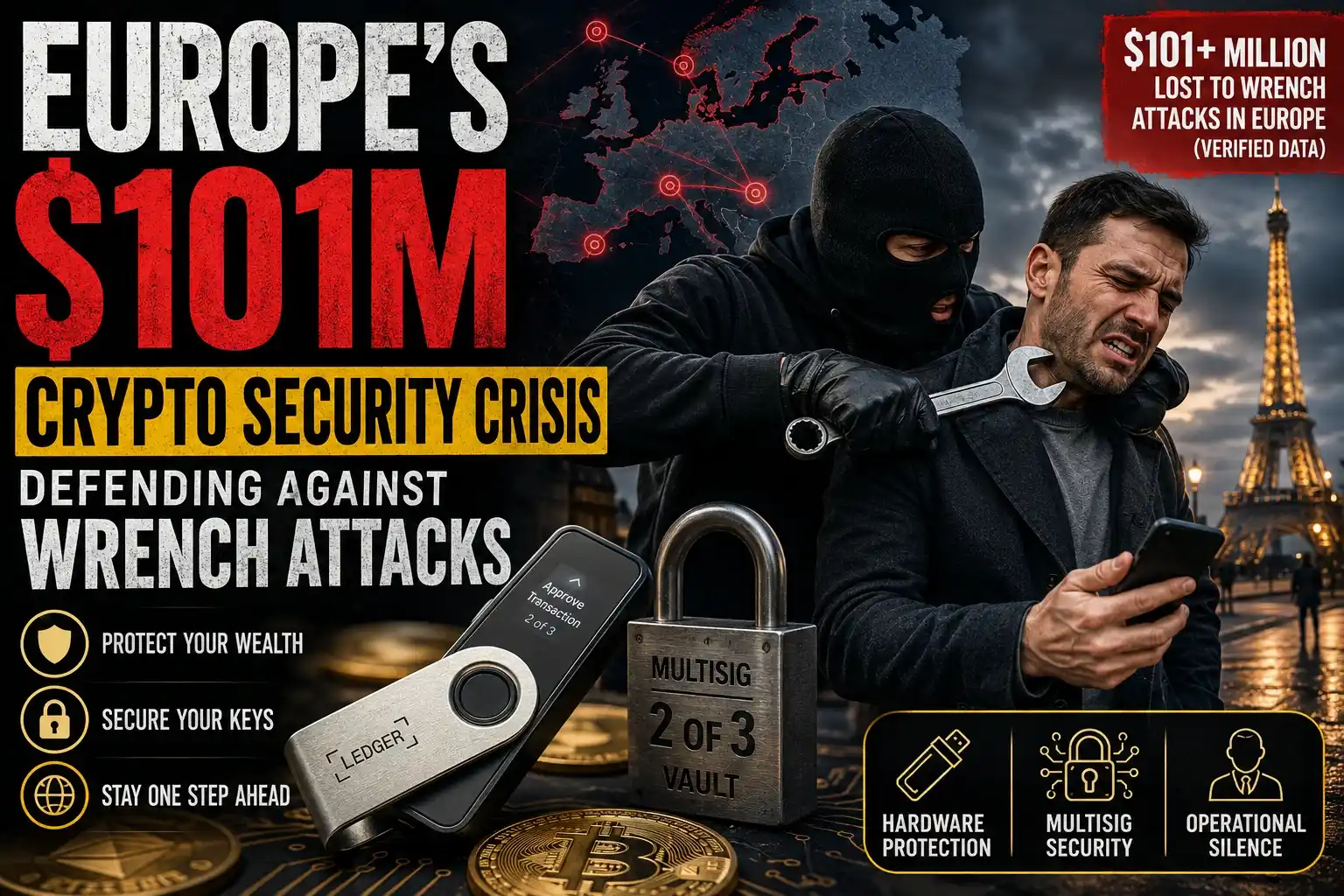
How Investors Are Protecting Their Crypto From Europe’s Rising Wrench Attack Threat
By: Institutional Digital Asset Research Desk | Updated: May 2026 | Category: Cryptocurrency & Web3 Security
Europe has quietly become the global hotspot for physical crypto extortion, with total losses now exceeding $101 million according to verified security data. In the digital asset industry, capital allocators spend countless hours optimizing cryptographic protocols, auditing smart contracts, and securing private keys behind complex layers of encryption. This institutional shift occurs amidst broader market volatility, such as the recent Bitcoin liquidation event that saw prices drop below $80,000.
Yet, recent data indicates a glaring vulnerability in the ecosystem that no amount of software code can fix: the physical security of the asset holder.
The threat landscape is increasingly extending beyond digital systems into real-world operational security risks. The concept of the “crypto wrench attack” is simple but brutally effective. Criminal operators bypass military-grade encryption by directly coercing the individual holding the keys, often through physical intimidation.
With millions already extracted from investors across European cities, this theoretical threat has transitioned into a statistical reality. In my analysis, securing your portfolio in 2026 requires an immediate pivot from purely digital defenses to a comprehensive hybrid security framework.
This strategic guide is designed for high-net-worth investors, active traders, and long-term holders operating within the European theater and global markets. Below, we outline an institutional-grade security architecture engineered to protect both your capital and your personal safety.
The Anatomy of a Coercion-Driven Crypto Assault
To defend against a threat, you must first understand its mechanics. A physical crypto wrench attack is rarely a random crime of opportunity. Data indicates that these events are highly targeted, meticulously planned operations executed by organized syndicates.
Reconnaissance and Targeting
The process almost always begins online. Threat actors profile potential targets by monitoring social media activity, forum participation, and public blockchain ledgers. If an individual publicly discusses their portfolio size, posts images of luxury purchases, or checks into high-end locations while attending Web3 conferences, they inadvertently place themselves on a target list.
Organized groups use data brokers and public corporate records to trace a digital footprint back to a physical residence or routine travel route.
The Extortion Phase
Once a target is isolated, the physical confrontation occurs. The perpetrators understand that digital asset transactions are irreversible and censorship-resistant. Their primary objective is to force the victim to unlock their mobile devices, access their exchange accounts, or input their hardware wallet PIN.
Under extreme physical duress, the average investor will comply immediately. The operation is typically executed within minutes, moving funds to privacy-focused transaction channels before local law enforcement can intervene.
Why Crypto Wrench Attacks Are Increasing in Europe
The recent data highlighting $101 million in losses raises a critical question for market participants: why is Europe the current epicenter of this specific crime?
First, Europe boasts a high density of early crypto adopters and blockchain entrepreneurs. Cities like London, Lisbon, Berlin, and Zug have established themselves as major tech hubs for the industry. This creates a geographic clustering of high-net-worth digital asset holders.
Second, the regulatory landscape in Europe, particularly the implementation of frameworks like MiCA (Markets in Crypto-Assets), has forced greater corporate transparency. While this is excellent for market legitimacy and institutional adoption, the resulting corporate registries often make it easier for malicious actors to identify company founders, board members, and large stakeholders through public documentation.
Finally, cross-border mobility within the Schengen Area allows organized criminal groups to execute an operation in one jurisdiction and swiftly relocate to another. This mobility complicates multi-jurisdictional law enforcement efforts and asset recovery procedures. This risk environment is compounded by macro-economic warnings, including recent alerts that a US stock market crash could hit within two years, pushing investors toward harder assets while increasing their visibility.
The Institutional Security Framework: A Strategic Guide
Mitigating the risk of targeted physical extortion requires a proactive capital allocation strategy. You must invest in the right hardware and establish protocols that remove single points of failure. Investors should independently evaluate wallet providers, custody services, and regional regulatory requirements before selecting a security framework. Below is the elite blueprint for securing your digital wealth.
Tier 1: Hardware Wallets and Plausible Deniability
Relying solely on a mobile phone wallet or a single exchange application is a severe security liability. Your foundational layer must involve a cold storage hardware device. However, simply owning a device is insufficient; you must utilize its advanced risk-mitigation features.
- Passphrase Protection (The 25th Word): Industry-standard devices offer passphrase functionality, which creates a completely hidden wallet. If coerced during a wrench attack, you can provide the PIN to your main device, which holds a decoy balance (e.g., $1,000). Your primary wealth remains securely hidden behind the passphrase, invisible to the attacker.
- Duress PINs: Certain hardware models allow you to program a specific “duress PIN.” If you enter this PIN under threat, the device is programmed to either wipe its own memory or open a dummy wallet. This satisfies the attacker’s immediate demands while structurally protecting your core holdings.
- Air-Gapped Systems: For maximum digital isolation, consider air-gapped devices that never connect to a computer via USB. These utilize QR codes or MicroSD cards to sign transactions, creating a physical barrier between your keys and the internet.
Tier 2: Multisignature (Multisig) Vault Architecture
For portfolios exceeding significant valuation thresholds, relying on a single hardware wallet becomes an unacceptable risk. In my analysis, Multisignature (Multisig) architecture is widely considered one of the strongest defenses against physical asset targeting.
A multisig setup requires multiple unique keys to authorize a transaction. The most common institutional standard is a 2-of-3 quorum. This means you generate three keys in total, but you need at least two to authorize the movement of funds.
| Key Location | Strategic Purpose | Security Benefit |
|---|---|---|
| Key 1: Primary Residence | Immediate access for routine portfolio management and transaction initiation. | Offers convenience, but remains vulnerable if the residence is physically breached. |
| Key 2: Bank Safety Deposit Box | Secure, geographically separated off-site backup. | Requires a physical trip during banking hours, making immediate forced transfers impossible. |
| Key 3: Third-Party Custody Partner | Emergency backup key held by a collaborative security firm. | The partner acts as a security check. They will not sign a transaction without video verification and rigorous identity checks. |
This structural friction significantly reduces immediate coercion risk. If an assailant breaches your home and demands your funds, you physically cannot comply. You only possess one key (Key 1). Even under extreme duress, you cannot authorize the transfer without traveling to a bank vault or passing an identity verification process with your custody partner. This architectural roadblock is a massive deterrent for criminals seeking a quick exit.
Operational Security (OpSec) Best Practices
Hardware solutions are only effective if combined with strict operational discipline. Your daily habits and public footprint serve as your first line of defense. Establishing a solid method for digital identity protection and hardware wallet security is essential in today’s hyper-connected world.
Information Diet and Social Media Silence
The most effective strategy to prevent physical asset targeting is to ensure threat actors do not know you hold digital assets in the first place. Adopt an absolute zero-tolerance policy for discussing your portfolio size, trading victories, or specific holdings on public platforms.
Avoid wearing branded merchandise from crypto exchanges or protocol teams in public settings. For high-net-worth individuals, wealth should remain completely invisible.
Physical Location Obfuscation
Never register your primary residential address on public corporate documents or domain registrations. Utilize professional registered agent services and mail forwarding facilities to create a permanent buffer between your public business identity and your physical home.
When attending industry events in Europe, be highly mindful of your transportation. Avoid discussing crypto markets in rideshares, hotel lobbies, or bars where conversations can be easily monitored by opportunistic actors.
Peer-to-Peer (P2P) Transaction Protocols
A measurable percentage of physical assaults occur during arranged P2P trades. If you must execute an over-the-counter (OTC) transaction locally, never meet in a private residence, a hotel room, or a secluded area.
Utilize well-lit, highly monitored public spaces, preferably near law enforcement facilities or bank lobbies. Always insist on using trusted escrow services rather than direct, in-person peer-to-peer transfers.
Structuring Your Capital: A Tiered Security Model
Security is not a one-size-fits-all metric. It must scale proportionally with the overall size and risk profile of your portfolio. Based on industry data and institutional risk models, we recommend deploying a tiered capital strategy.
The Operating Account (Low Balance)
This is your mobile wallet or exchange account used for daily activities, small purchases, or testing new Web3 protocols. It should never contain more than a nominal amount of capital. If your phone is physically taken or you are forced to empty this wallet, the financial loss is entirely negligible.
The Trading Account (Medium Balance)
This capital sits on regulated, high-tier exchanges equipped with mandatory two-factor authentication (utilizing hardware security keys, rather than SMS text verification) and IP whitelisting. This setup allows for market agility and trading execution while maintaining a strong digital barrier against unauthorized withdrawals.
The Cold Storage Vault (Primary Wealth)
This tier represents the vast majority of your net worth. It must be locked in a geographically distributed 2-of-3 or 3-of-5 multisignature setup. This capital is entirely inaccessible on short notice, effectively neutralizing the threat of an immediate physical extortion attempt.
Valuation Perspective: Evaluating Custody Risk
In the modern financial landscape, investors must weigh the cost of premium custody solutions against the statistical risk of catastrophic loss. Setting up a multi-signature vault or partnering with a collaborative custody firm involves setup fees and annual maintenance costs.
However, when evaluating a multi-million dollar portfolio, the cost of institutional-grade security is mathematically negligible compared to the $101 million already lost to coercion-driven incidents in Europe. Market participants must view physical and digital security not as an operational expense, but as a mandatory insurance premium on their digital wealth.
Frequently Asked Questions (FAQs)
1. What exactly is a crypto wrench attack?
A crypto wrench attack is a form of physical extortion where criminal operators bypass digital security measures by physically threatening the asset holder, forcing them to hand over their passwords, hardware devices, or private keys.
2. Why are wrench attacks increasing specifically in Europe?
Europe features a high concentration of crypto wealth clustered in major tech hubs. Additionally, the regulatory push for corporate transparency makes it easier for threat actors to identify wealthy founders and investors through public business registries, while borderless travel aids quick escapes.
3. Are hardware wallets enough to protect my portfolio?
While hardware wallets protect against remote digital breaches, they do not inherently protect against physical coercion. To defend against real-world extortion, investors must utilize advanced features like passphrases, decoy wallets, and multisignature setups.
4. What is multisig custody and how does it stop physical extortion?
Multisignature (multisig) custody requires multiple keys to approve a transaction (e.g., 2 out of 3 keys). By storing these keys in different geographic locations, an investor makes it physically impossible to hand over their entire portfolio during a sudden, localized extortion attempt.
5. Should investors avoid public exposure in the crypto industry?
Security experts widely recommend “operational silence.” Avoiding public discussions about portfolio size, limiting flashy displays of wealth, and keeping your residential address off public databases significantly reduces your chances of being targeted by organized groups.
Final Executive Analysis
The stark reality that $101 million has been lost to physical coercion in Europe is a wake-up call for the entire global crypto ecosystem. As the market capitalization of digital assets continues to rise, the financial incentive for threat actors to bypass digital networks and target the human element will inevitably increase. Mathematical encryption is flawless, but human beings remain vulnerable targets.
By implementing a robust, institutional-grade framework—utilizing decoy wallets, establishing a multisig quorum with collaborative custody partners, and practicing aggressive operational silence—you effectively remove yourself from the target list. You transform your wealth from an easily accessible liability into a structurally fortified asset.
Your security infrastructure requires active management, continuous auditing, and strict discipline. Do not wait for a physical breach in your geographic area to test your operational protocols.
Join 25,000+ digital asset investors receiving weekly institutional-grade crypto security intelligence, custody strategies, and threat analysis directly to their inbox. Register for our elite macro newsletter today.
Disclaimer: This analysis is provided for informational and educational purposes only and does not constitute personalized financial, investment, or security advice. The digital asset landscape involves significant risks. Always conduct your own rigorous due diligence or consult with a certified security professional before executing any capital allocation or custody strategy.
About the Author